




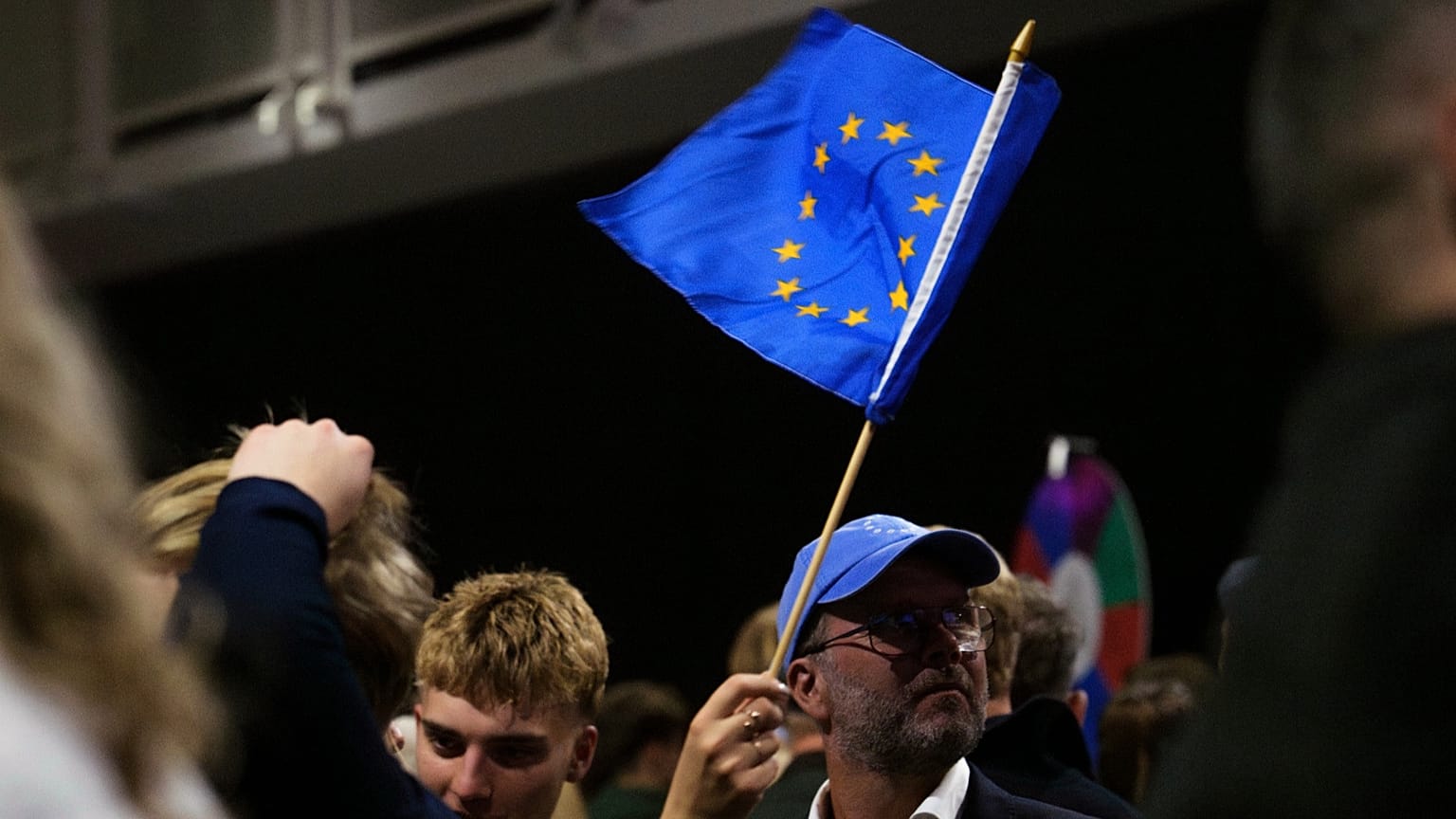













Good morning. My name is Angela Skujins and welcome to your Tuesday newsletter. On today’s menu: The who’s who of those wanting to join the 27 member club gather for an exclusive EU Enlargement Summit hosted by Euronews. Here’s what you need to know today.
Wednesday is a big day for enlargement news, with the Commission expected to hand out report cards for those wanting to join the bloc. More on that below. But to give you a taste of what’s to come, the must-attend Euronews enlargement fiesta, the Euronews Enlargement Summit 2026, kicks off at 10:30 am CET from Autoworld at Schuman.
 ADVERTISEMENT
The A-list: Leaders of Ukraine, Albania, Moldova, Georgia, North Macedonia, Armenia, Montenegro, Croatia and the European Council will convene at the heart and home of EU lawmaking — Brussels — for a significant moment regarding how to grow the EU, something that is tied to its existential future.
According to Euronews’ resident enlargement guru, Luca Bertuzzi, officials within the Berlaymont have made enlargement a key plank of the EU’s external relations, offering its neighbours a membership prospect to draw them into its orbit (and out of Russia’s influence). Now, Brussels must show that its enlargement ambitions can deliver results.
A decade after the Brexit referendum, the EU is trying to turn enlargement momentum into concrete results by spelling out the steps the most advanced candidates must still take to finalise their accession.
But the European Commission’s upcoming roadmaps for the so-called frontrunners — Montenegro, Albania, Moldova and Ukraine — risk widening the gap with hopefuls whose bids have lagged for years, such as North Macedonia and Georgia.
Arguably the most closely watched negotiations belong to those in Ukraine due to Russia’s escalating aggression, with its bid launched following the 2022 full-scale invasion. The stakes arguably could not be higher.
On Ukraine: Taras Kachka, Ukraine's Representative to the EU, just told Europe Today that Kyiv is delivering on reforms necessary to join the bloc “faster and better” than ever before, even with an invasion nipping at its heels.
“We might see challenges that are stemming from the security situation, Russian aggression, and the fact that Ukraine is really one of the biggest candidates among frontrunners,” he said in an interview with Sasha Vakulina.
Ukraine has finally begun to make formal progress thanks to the change of government in Hungary, with former prime minister Viktor Orbán previously derailing progress, and is still expected to open all negotiating clusters before the end of the year.
However, there are some major hurdles posed by EU member states regarding how Ukraine should integrate itself — and its agricultural heft — to the bloc. How does this chime with anti-corruption probes, also? Taras admitted there might be “complex negotiations” in the future but there should not be a “problem” for Kyiv’s overall EU accession path. Watch.
At the front: Montenegro is closest to the finish line, but its progress is getting bogged down in bilateral issues with Croatia, rooted in the troubled legacy of the Yugoslav Wars of the 1990s.
Petar Marković, Head of the Mission of Montenegro to the EU, just told Europe Today that Podgorica officials did not have a summer break to continue reforms as part of the accession process and be on-track to be the EU's 28th member by 2028.
"We are also facing intensified talks with our closest EU member state and neighbour, Croatia, to resolve some open questions of mutual interest, which we are confident will be done satisfactorily for both sides," he said. Watch.
In second place: Albania, generally considered the nation clinching silver, has been shaken by major protests over preparatory work for a luxury resort in a protected area, planned by US President Donald Trump’s son-in-law Jared Kushner.
Other important mentions: Moldova, meanwhile, has been catching up so fast that the Commission has had to reallocate internal resources to keep pace with Chișinău, which is close to closing a chapter it has only just opened.
And of course, there is Ukraine, which we previously mentioned.
What’s new: The EU executive has recently proposed institutional safeguards for new member states, which are currently being discussed in the context of Montenegro’s accession treaty. That treaty is due to serve as the blueprint for how Brussels deals with newcomers.
Other enlargement news: As I mentioned earlier, on Wednesday the European Commission is due to present its annual “package” with progress reports for the candidate countries, together with roadmaps for the four “frontrunners”: Montenegro, Albania, Moldova and Ukraine.
The roadmaps will be a living document that will be annually updated and will include the milestones the candidate countries will have to reach for the following year to continue progressing in their accession process.
The Commission is due to reference the growing gap between the frontrunners and the other candidate countries, and to provide a more detailed approach on gradual integration, including with the launch of dedicated dialogues with the frontrunners.
Polish PM Donald Tusk urges president to confirm judges amid constitutional crisis.
Polish Prime Minister Donald Tusk has called on President Karol Nawrocki to confirm judges elected by parliament to Poland's Constitutional Tribunal.
The move comes after protesters and riot police faced off outside the court last week following the suspension of its president, in the latest incident in an intensifying stand-off over judicial appointments and control of the Tribunal.
"Resolving the conflict is simple and can be achieved without amending the constitution," Tusk wrote in a post on social media on Monday. "The President recognises the judges lawfully elected by the Sejm, as stipulated by the constitution, and they take up their duties at the Tribunal."
He also accused Nawrocki of "opting for a forceful confrontation, which could cost Poland dearly."
Glogowski Pawel has the full story on the constitutional crisis wobbling Warsaw.
More from our newsrooms
Canadian minister stops short of endorsing EU carbon tax as energy alliance deepens. Canadian Climate and Environment Minister Julia Dabrusin has defended industrial carbon pricing as a tool to cut CO2 emissions and protect businesses from unfair competition, but stopped short of explicitly endorsing the European Union's carbon border tax. Marta Pacheco has the interview and the story.
Wizz Air flight from London to Sofia diverts after 'bomb threat'. The aircraft diverted and landed safely at Budapest Liszt Ferenc International Airport in accordance with the relevant security protocols and procedures, the airline said in a statement shared with Euronews. Nathan Rennolds has the story.
Ukraine to channel up to €1bn in EU loans into joint defence projects. Ukraine is set to channel up to €1 billion from its EU loan into a programme designed to bring its defence industry closer to its European partners, with a focus on air and missile defence, drones, counter-drone systems and ammunition. Luca has the details.
We’re also keeping an eye on
- European Commission President Ursula von der Leyen delivers a speech at the European StartUp event in Brussels.
- European Parliament President Roberta Metsola meets with Armenian Prime Minister Nikol Pashinyan.
That’s it for today. Luca Bertuzzi contributed to this newsletter.