




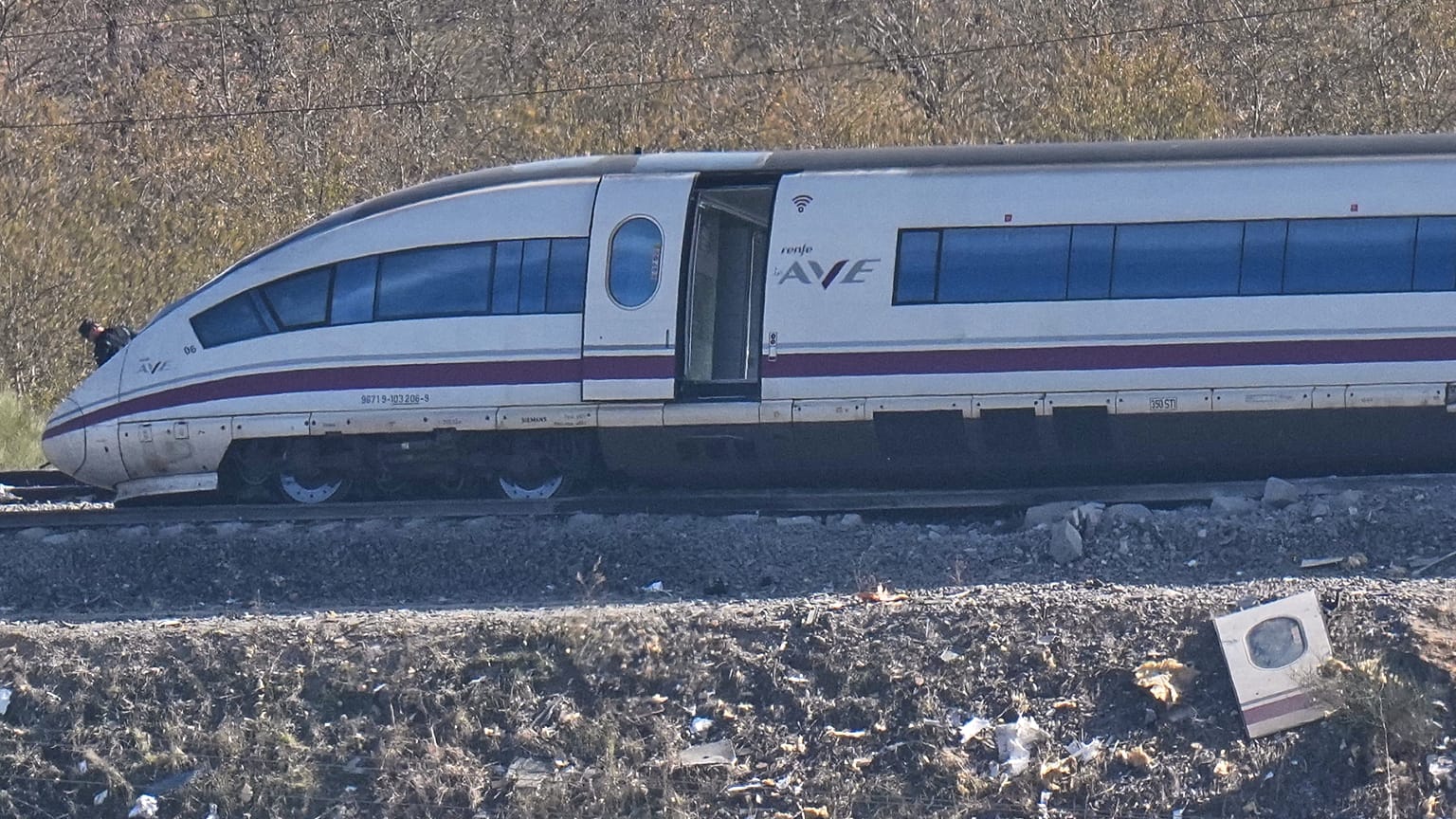













Spanish PM Pedro Sánchez is facing mounting pressure following the incident, which has further knocked confidence in Spain’s rail infrastructure.
Spain is observing a third day of national mourning on Saturday following a deadly train collision in Urda, Toledo, that claimed the lives of at least 69 people earlier this week.
 ADVERTISEMENT
Residents and local officials gathered on Saturday in a Spanish village near the site of the collision for a memorial Mass honouring the victims.
The pews inside the San Juan Bautista church were packed, while dozens more people gathered outside to listen to the service, some wiping away tears.
Meanwhile, distraught relatives of the victims endured growing anguish on Friday as authorities worked to identify bodies. Prime Minister Pedro Sánchez said Spain was working "tirelessly" to complete the identification process.
Castilla-La Mancha's leader Emiliano Garcia-Page warned they "do not rule out more dead," saying the emergency services had collected "31 bags of partial remains" that complicated the identification work.
The legal authorities in charge of the process have said 67 reports for missing people remain active, including 14 for foreign nationals.
They concern citizens from the United States, Canada, Australia, France, Japan, Mexico, Argentina, Venezuela, Tunisia and the Czech Republic.
A Portuguese citizen who worked on one of the trains is among the dead, Portugal's government said on Friday. Another 39 injured people remained in hospital in Castilla-La Mancha, per authorities.
Wednesday's crash was the country's second such disaster this year and one of Europe's deadliest rail accidents this century.
LZB system failure under investigation
Train drivers are demanding urgent measures to strengthen rail safety in Spain.
The Spanish Union of Train Drivers and Railway Assistants (Semaf) has requested a review of regulations governing how trains should operate when their automatic protection systems fail.
In a statement, Semaf has urged the State Railway Safety Agency (AESF) to act "urgently" to "clarify and amend the regulations governing the rail protection system, LZB," as well as the procedures related to the European Rail Traffic Management System (ERTMS).
According to preliminary information from the Independent Authority for the Technical Investigation of Accidents and Incidents (AITAT), the LZB system stopped functioning at 8:31 am on Wednesday, prior to the collision. However, it has not yet been determined whether the LZB failure was the direct cause of the accident.
Semaf aims to prevent trains from resuming normal operations if there is a risk that two trains could end up on the same section of track.
The Minister of Transport Óscar Puente, who ruled out resigning on Friday, announced new measures aimed at reducing technical risks and "restoring public confidence" in the railway system, though he has not yet specified what those measures will be.
The concerns raised by the train drivers are not new. In January 2026, Semaf reported that hundreds of train drivers had long been reporting incidents on the railway network, without receiving any response or seeing any corrective measures taken.
Following an accident in Adamuz (Córdoba), Semaf reached an agreement with the government to strengthen railway safety; however, the union has since reported further delays in implementing the agreed-upon measures.
Sánchez acknowledges 'shattered confidence'
The Urda train accident has put further pressure on Sánchez ahead of elections in November.
Sánchez said on Friday that trust in the high-speed network was "shattered" but pledged "solutions" to prevent further accidents.
The incident happened on a key line linking Madrid to the southern city of Seville, which was also the scene of a collision in January that killed 46 people in the region of Andalusia.
Train driver union Semaf has called two fresh strikes at state operator Renfe for November 10 and 12, demanding "structural measures" for rail safety, after maintaining a stoppage on Thursday that had been organised before the accident.
The head of the main conservative opposition Popular Party, which leads most polls, Alberto Núñez Feijóo, accused the government of "not replacing an obsolete security system when it should have done so".
"Who's going to get on a train now? Now you're scared when you do," Cecilio, a relative of a victim, told the AFP news agency.
"Lots of lives have been lost in nine months. I think this should make everyone reflect - the whole of society, the politicians - about why this is happening in the 21st century," he added.
"I am not blaming one side or the other, but something is going wrong here."