


















The first humanitarian operation in years in Russian-occupied Ukrainian town of Oleshky offers a fragile glimmer of hope for civilians trapped by war, but raises grave concerns over Moscow's true intentions and the fate of those seeking evacuation to Ukrainian-controlled territory.
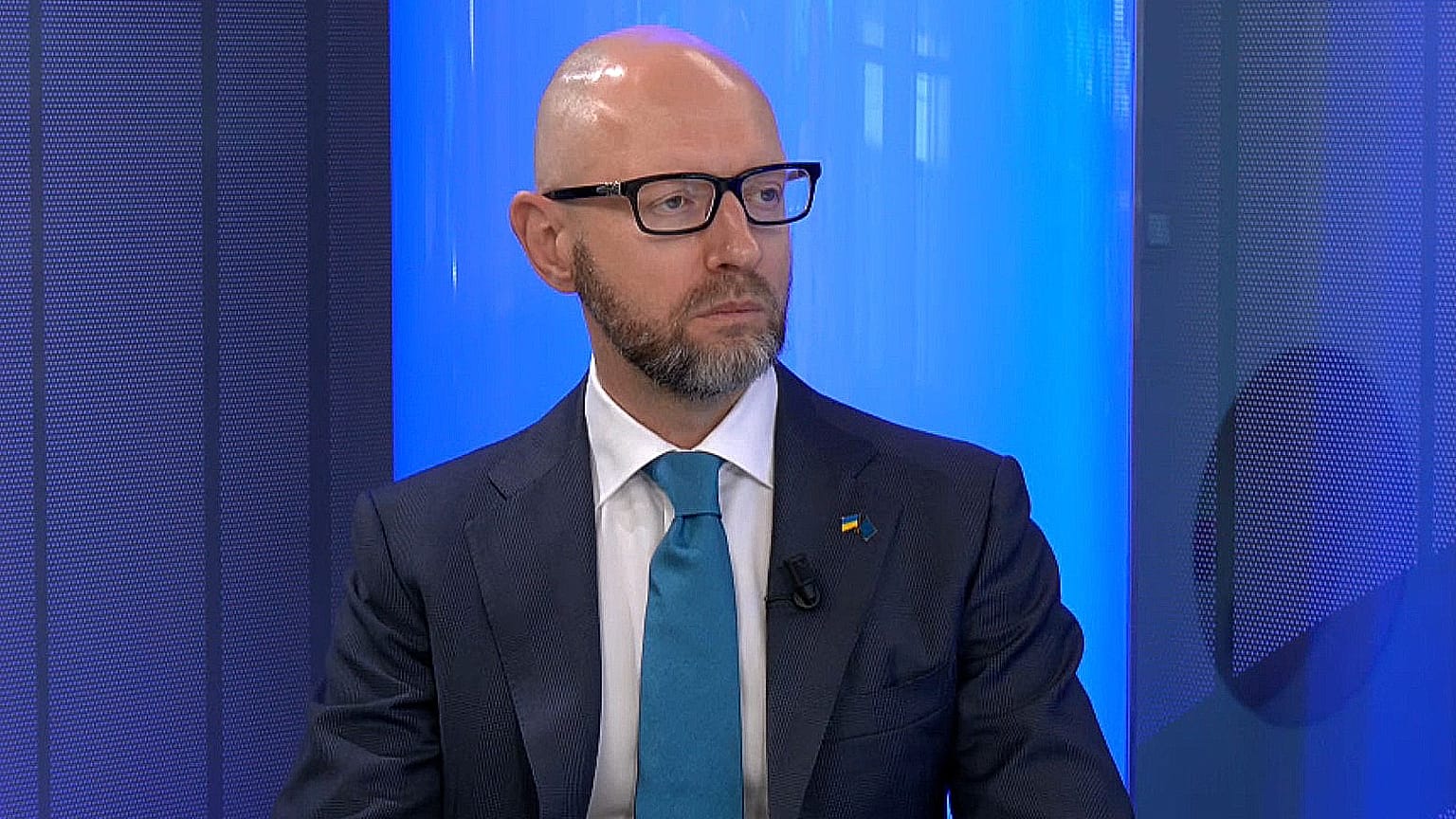
Former Ukrainian Prime Minister Arseniy Yatsenyuk has ruled out the prospect of a rare humanitarian ceasefire in Russian-occupied Oleshky paving the way for a broader truce, accusing Moscow of exploiting the operation to gain favour with the White House.
 ADVERTISEMENT
Asked by Euronews whether the localised ceasefire could become a first step towards a wider agreement, Yatsenyuk gave an unequivocal response.
"My answer would be very short. No."
Pressed on whether Russia would agree to a ceasefire, he added: "No way."
His remarks come as Ukraine and Russia prepare to deliver humanitarian assistance and evacuate civilians from Oleshky, a town in southern Ukraine's Kherson region that has been under Russian occupation since the early days of the full-scale invasion.
The operation follows a six-day localised ceasefire brokered with the involvement of US First Lady Melania Trump. Ukrainian and Russian officials confirmed on Thursday that demining of evacuation routes had been completed and a humanitarian convoy was ready to depart.
Evacuations were scheduled to take place until 2 pm local time (1 pm CEST) on Friday, with aid distribution planned afterwards.
But serious questions remain over the fate of civilians wishing to leave, particularly those seeking to return to Ukrainian-controlled territory through a route involving occupied Crimea, Russia and Belarus.
Yatsenyuk accused Moscow of treating the remaining residents as hostages and using their plight to stage a propaganda operation portraying Russian forces as rescuers.
"And in this way, they try actually to buy some kind of positive attitude from the White House. That's my take," he said.
"There is no way to trust Russians, period," Yatsenyuk added, warning that the humanitarian mission could be exploited for propaganda purposes.
He argued that Washington had a particular responsibility to ensure civilians received humanitarian assistance and were free to decide whether to return to Ukrainian-controlled territory.
The former prime minister also addressed the presence of American journalists covering the operation, urging them to report independently rather than amplify Moscow's narrative.
"We kindly ask you folks to be journalists and to tell the truth, but not to parrot Russian propaganda," he said.
'Putin is ready to end the war on his terms'
Yatsenyuk's scepticism extends to the latest US-led diplomatic efforts to bring Kyiv and Moscow back to the negotiating table, with further technical-level talks being discussed for November, potentially in Abu Dhabi.
He dismissed Russia's willingness to resume negotiations as an attempt to create the appearance of progress without making meaningful concessions.
"Putin is ready to end the war on his terms," he said, arguing that the Russian president would accept only an agreement amounting to Ukraine's capitulation.
Yatsenyuk accused Moscow of using negotiations to buy time, circumvent sanctions and deepen divisions between Washington and its European allies.
He argued that Putin's ultimate objective remained unchanged: bringing the whole of Ukraine under Russian control.
Despite his pessimism about the prospects for a breakthrough, Yatsenyuk insisted that Washington and Kyiv should continue pressing Moscow to accept an unconditional ceasefire.
Europe must be 'at the table', not 'on the menu'
The former prime minister also warned against excluding European countries from negotiations over Ukraine's future, accusing Moscow of deliberately seeking to marginalise the European Union.
Yatsenyuk invoked the distinction between Europe having a seat at the negotiating table and finding itself on the menu, arguing that Washington should insist on including its closest European allies.
He said the EU's financial support for Ukraine had made it an indispensable participant in any negotiations, while Moscow's opposition to European involvement reflected its efforts to weaken Western unity.
Asked who should represent the EU, Yatsenyuk said the decision belonged to European governments, suggesting Finnish President Alexander Stubb or European Commission President Ursula von der Leyen as potential candidates.
He dismissed the suggestion that Russian objections should determine Europe's choice.
"Who cares?", he said, admitting Moscow objects anyone.
Yatsenyuk was also sceptical about recent diplomatic outreach to Vladimir Putin by Finnish President Alexander Stubb and Norwegian Prime Minister Jonas Gahr Støre, arguing that Moscow could interpret such initiatives as a sign of European weakness and division.
"Putin was really happy in getting this kind of telephone call because it is a sign of ruptures and fissures within the European Union," Yatsenyuk said.
He also recalled earlier diplomatic efforts by European leaders, including French President Emmanuel Macron, to engage directly with Putin, warning that repeating such initiatives risked emboldening Moscow.
"Europeans have to act in concert. We need to speak in one voice," he said.