




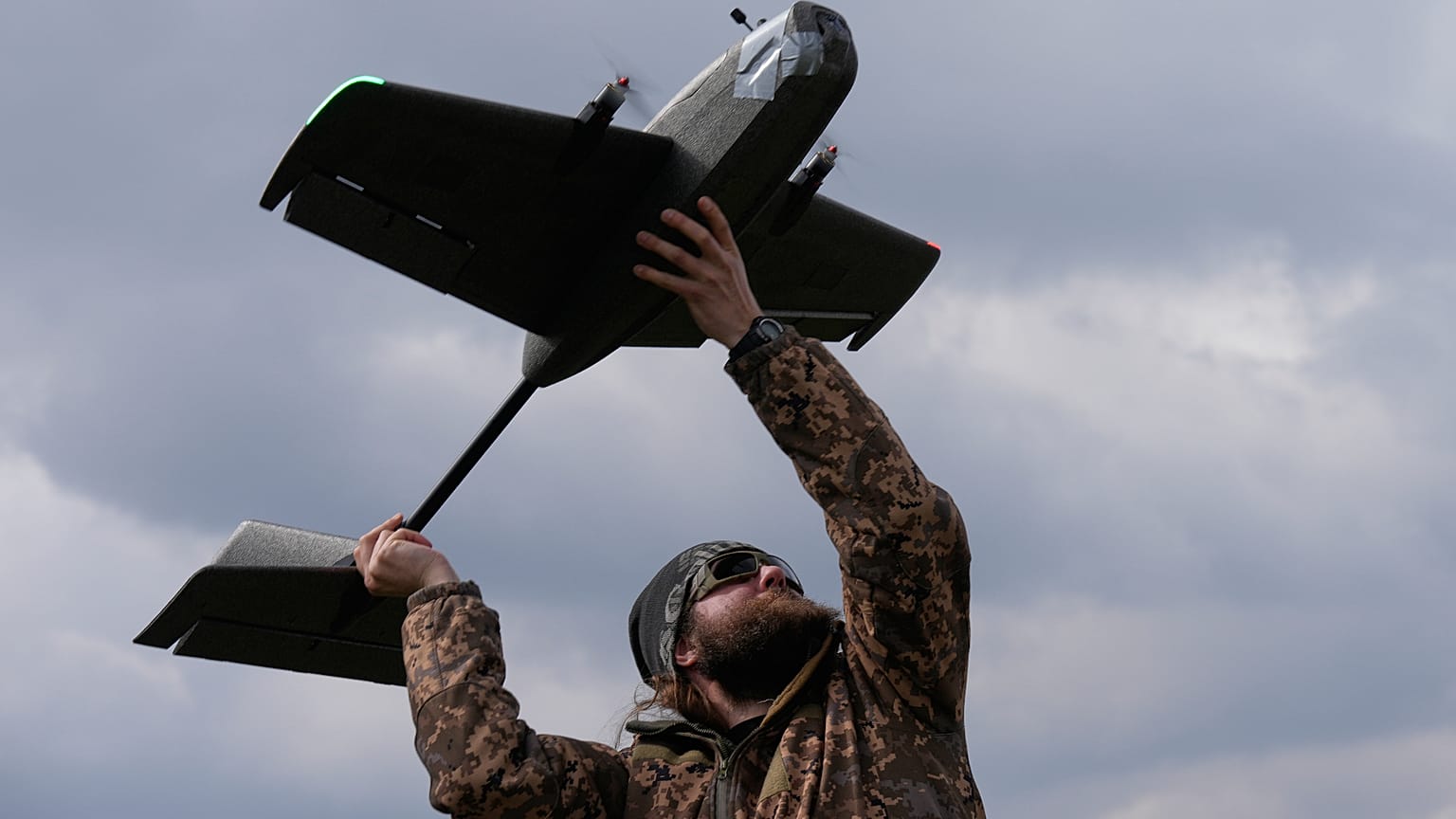













Ukraine made significant progress in countering Russia's jet-powered drones, with some air defence units reporting interception rates around 80%. But recent restrictions on US satellite services exposed Kyiv's reliance on US technology as it races to develop cheaper, more effective interceptors.
Ukraine's improved interceptor drone technology has helped it counter Russia's jet-powered drones, but disruptions to US Starshield satellite services threaten those gains.
 ADVERTISEMENT
According to the Institute for the Study of War (ISW), Ukraine's interception rate fell slightly from 77% to around 74% during disruptions to the military-grade satellite service between 14 and 24 October.
The figures nevertheless represent a marked improvement on early September, when Ukrainian officials reported intercepting around 60% of Russia's jet-powered drones.
Some Ukrainian air defence units have reported interception rates exceeding 80%, although these figures reflect individual units' performance rather than nationwide results.
The Starshield restrictions, which affected high-speed drone operations, were lifted on 24 October, according to Ukrainian officials. However, the disruption highlighted the country's dependence on US satellite communications to sustain its air defences.
ISW warned that maintaining and improving interception rates would require Ukraine to develop and deploy affordable, high-speed interceptor drones on a much larger scale.
Russia has increasingly turned to jet-powered versions of its Shahed-type attack drones, which travel considerably faster than conventional propeller-driven models, leaving Ukrainian air defence crews with significantly less time to detect and intercept them.
Ukraine relies on a combination of interceptor drones, fighter aircraft and ground-based systems to counter the threat.
Interceptor drones have proved particularly effective, according to ISW, but many depend on Starshield connectivity to operate at the speeds required to engage faster Russian targets.
Ukrainian forces also use F-16 fighter jets, either firing air-to-air missiles or engaging targets with onboard guns. Both approaches have drawbacks: missiles are expensive and scarce, while gun engagements demand considerable pilot skill and expose aircraft and crews to additional risks.
Using fighter jets against drones also increases maintenance requirements and diverts aircraft from other missions.
Ukraine has installed ground-based gun turrets in Kyiv and the surrounding region, although expanding these systems nationwide would require considerable time and resources.
The race for cheaper interceptors
The growing threat has accelerated efforts by Ukrainian manufacturers to develop faster, more affordable interception systems.
One such project is the F-Jet 80, a jet-powered interceptor being developed by Ukrainian company F-Drones, which plans to incorporate artificial intelligence into its guidance system.
The company aims to keep the unit cost at approximately $7,000, compared with an estimated $20,000 to $70,000 for other high-speed interceptor drones and around $1 million for an air-to-air missile launched from an F-16.
Although the F-Jet 80 remains under development, its manufacturer says it has already successfully intercepted several Russian drones.
For Ukraine, the challenge extends beyond developing effective technology to producing it in sufficient numbers to counter Russia's expanding use of jet-powered drones.
ISW argues that integrating affordable interceptor drones into Ukraine's existing air defence network offers the strongest prospect of sustaining high interception rates as the country approaches another winter of Russian aerial attacks.