


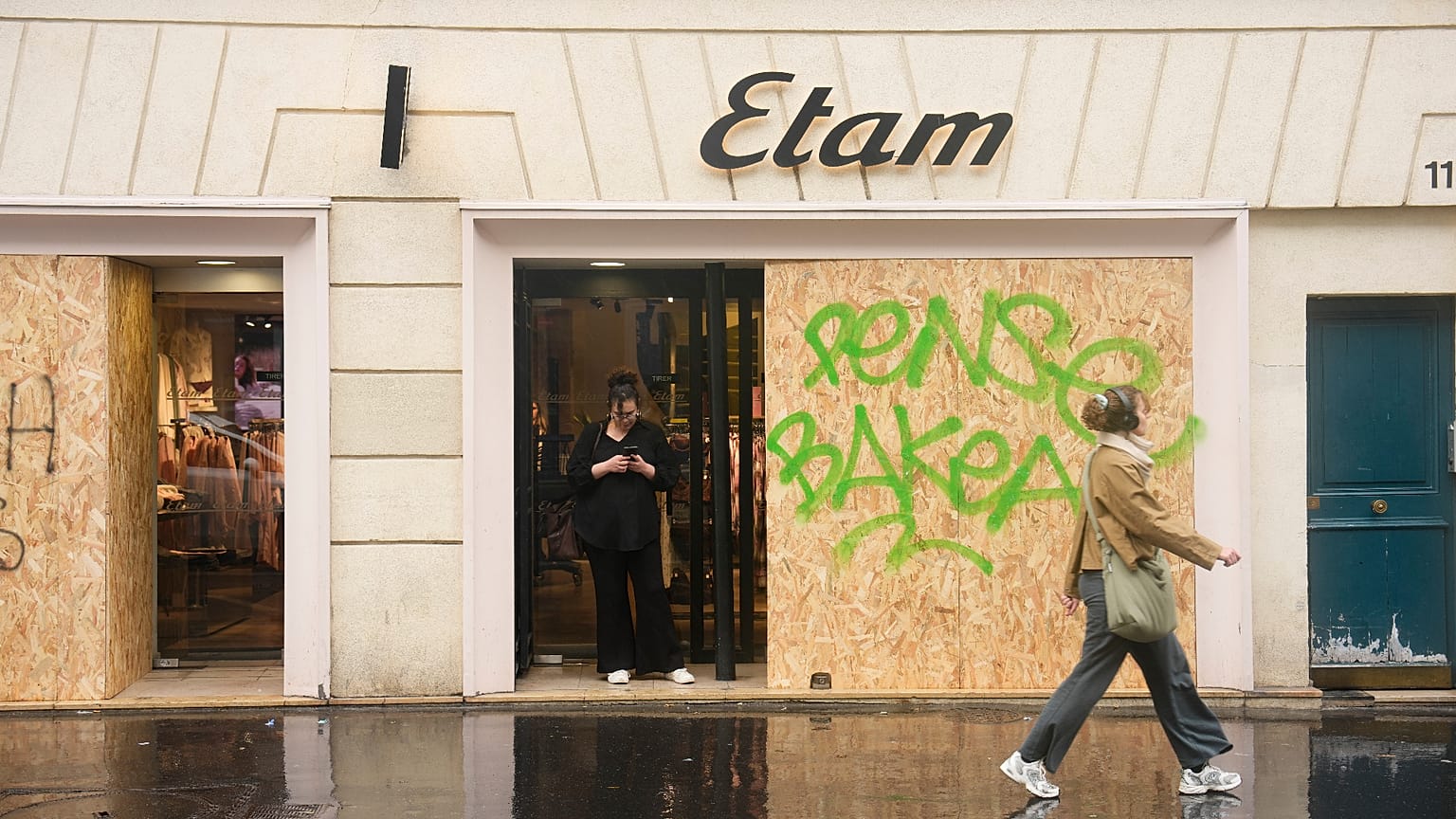


As France readies itself for another day of nationwide protests, the government's efforts to prevent renewed violence have prompted criticism from some.
France is bracing for another day of nationwide protests on Saturday, with tensions mounting after authorities in Paris reversed their approval of a major demonstration route, prompting a legal challenge from trade unions.
 ADVERTISEMENT
The march was due to follow an agreed path between the symbolic place de la Bastille and Nation. But on Friday evening, the police prefecture imposed an alternative route along the outer boulevards of southeastern Paris, citing the risk of renewed violence.
Warning that the new route would be more difficult to secure and could create disorder, organisers said they intended to continue with their original plans.
The dispute comes a week after widespread violence and looting overwhelmed police in several French cities.
According to authorities, more than 3,000 shops were damaged or looted across the country on 17 October, when 60,000 police officers and gendarmes were deployed.
Interior Minister Laurent Nuñez has announced that 70,000 officers would be mobilised this Saturday, supported by specialist intervention units, armoured vehicles and water cannons.
Despite its scale, the deployment is not unprecedented.
It is comparable to a security operation mounted on 14 July this year, when France's national celebrations coincided with a World Cup semi-final against Spain.
During the largest mobilisation of the Bloquons tout movement in September 2025, some 80,000 officers were deployed, while at the height of the Yellow Vest protests, on 8 December 2018, the government mobilised 89,000 police officers and gendarmes across the country.
In Paris, a police intelligence assessment obtained by Le Monde estimates that between 60,000 and 120,000 people could take to the streets on Saturday.
According to Le Monde, police have also identified between 300 and 600 potentially violent activists.
The Interior Ministry has instructed prefects to reinforce checks at railway stations and major transport routes to detect equipment that could be used in violence and to consider restricting movement of individuals deemed a serious threat to public order, potentially including the suspension of some public transport services.
Warnings from the government
Alongside the strengthened security response, the government has also made a series of promises to engage in dialogue over demands.
On a visit to Limoges following the destruction of its historic town hall during last weekend's unrest, French Prime Minister Sébastien Lecornu promised government proposals on education, as well as state support for reconstruction efforts.
President Emmanuel Macron also met secondary-school representatives on Friday, promising a major overhaul of the Parcoursup university admissions system, according to participants.
But student organisations, demanding a €10-billion plan to revamp the education system, said they would continue demonstrations until concrete reforms were announced.
Lyon
In Lyon, France’s third largest city, authorities are also preparing for further unrest after seeing some of last weekend's most serious destruction.
Around 150 to 200 businesses were targeted by looters, according to authorities, most of them in the Presqu’île, the city’s main shopping district.
The metropolitan authority and the local chamber of commerce and industry have arranged for 40 private security guards, divided into two teams of 20, to patrol vulnerable shopping areas on Saturday.
The prefecture has also prohibited demonstrations across large areas of central Lyon amid concerns of renewed attacks on businesses and public buildings, as well as confrontations between rival political groups.
Despite the ban, student organisations in Lyon have said they intend to demonstrate on Saturday as calls for gatherings continue to circulate on social media.
The Solidaires trade union and the Human Rights League had legally challenged the restrictions, but their appeals were rejected by Lyon's administrative court on Friday evening.
Restrictions across France
Restrictions were also imposed in other cities across France.
In Bordeaux, trade unions are challenging a ban on their planned city-centre demonstration.
In Marseille, a trade union march is scheduled to take place along a modified route avoiding major shopping streets.
Curfews and restrictions on gatherings have also been introduced in Toulouse, Limoges and Saint-Étienne.
In Orléans, between 20,000 and 30,000 opponents of the far-right National Rally are also expected to demonstrate as the party holds its congress.
Around 3,000 police officers and gendarmes are being mobilised in the area, with the authorised counter-demonstration route to be diverted away from the historic centre.