

















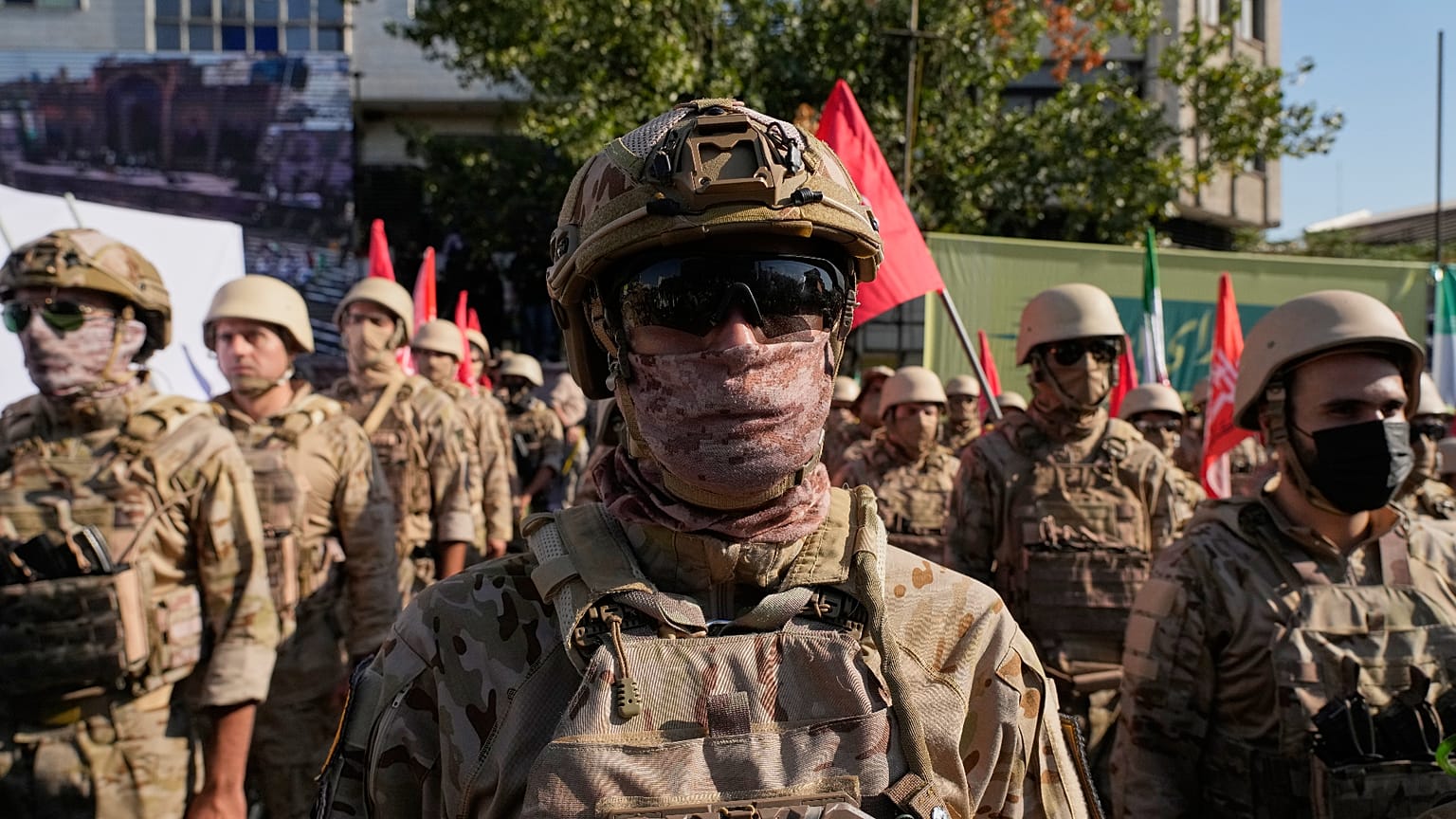













Iran's army spokesman said Tehran's forces were prepared to strike first "should circumstances require it," while IRGC officials claimed tighter control of Hormuz, and Washington publicly pondered how much authority Pezeshkian and Araghchi actually wielded.
Iran's army spokesman said on Wednesday that the armed forces were prepared to carry out pre-emptive strikes in the war against the US, as senior IRGC figures claimed tighter control over the Strait of Hormuz and Washington questioned how much authority Iran's civilian leadership actually holds.
 ADVERTISEMENT
ADVERTISEMENT
ADVERTISEMENT
"Should circumstances require it, we will conduct pre-emptive operations down the line in order to prevent the enemy from committing any act of aggression or intrusion," spokesman for Iran's regular army Brigadier General Mohammad Akrami-Nia told the state-run IRNA news agency.
IRGC officials separately said Hormuz was firmly in Tehran's hands, despite a parallel US naval blockade of the vital waterway.
"The Strait of Hormuz is closed and the armed forces have full control over it, and this situation will continue until Iran's legitimate demands are met," Brigadier General Mohammad Reza Naqdi, a senior IRGC adviser, said in a media interview.
He claimed that some vessels were using small boats to smuggle oil through the strait to larger tankers.
"Soon, a small number of the routes that violators have created by blasting and destroying some of the existing rocky passages in the Strait of Hormuz will be blocked," Naqdi said.
A second IRGC adviser, Brigadier General Amirahmadi, said international bodies had recorded an average of around 10 ships per day transiting the strait, against nearly 125 before the war that began with US-Israeli strikes on Iran on 28 February.
"These ships are mainly those that pass through the waterway and designated route with the permission of the Islamic Republic of Iran," he said.
Washington questions Iranian authorities
Iran's President Masoud Pezeshkian said in a speech on Wednesday that the government was engaged in negotiations while simultaneously facing what he called "an all-out war on every front."
"We speak from a position of dignity and power, and at the same time we are vigorously pursuing a programme of resistance and resilience," Pezeshkian said.
On the country's severe electricity shortages, he said the government would close sports and cultural centres if necessary to reduce consumption.
Vance, confirming that Washington had held talks with Pezeshkian and Foreign Minister Abbas Araghchi, said it was unclear how much authority the two men wielded within Iran's power structure.
"One of the things we picked up on is it's not totally clear how their country makes decisions," Vance told Reuters after a campaign event in Alaska.
He said the main US objective was to prevent Iran from acquiring nuclear arms and suggested Tehran should take a concrete step on enrichment to demonstrate it was not seeking one.
"I think if they want to show a commitment to not building a nuclear weapon, they would do something meaningful on their enrichment capacity," Vance said.
Speaking in Maryland on Tuesday, US President Donald Trump said Iran was "no longer such a bully" and claimed full US control over the strait.
"They were the bully of the Middle East. They're not so much the bully anymore, but we have to finish up. And it's only a question of which way do we want to do it, the nice way or the not-so-nice way. And pretty soon you'll find out," he said.
Trump has repeatedly questioned its decision-makers, calling for "new leadership in Iran," and said the new Ayatollah Mojtaba Khamenei — who still has not made a single public appearance since he was appointed supreme leader in March — was "a sick man".
However, in a June podcast, Trump suggested the younger Khamenei is in charge. "They say he is giving approval, because that's the way it has been for a long, long time," the US president said.