




























IMF chief Kristalina Georgieva has urged heavily indebted governments to tighten their belts and central banks to take a hawkish stance, signalling a return to austerity as the energy shock from the Iran war, record public debt and a credit-fuelled AI investment boom weigh on the global economy.
The days when governments could lean on cheap money and fast growth to keep their debts in check are over, according to the head of the International Monetary Fund (IMF), who called for spending discipline and tighter monetary policy around the world.
 ADVERTISEMENT
ADVERTISEMENT
ADVERTISEMENT
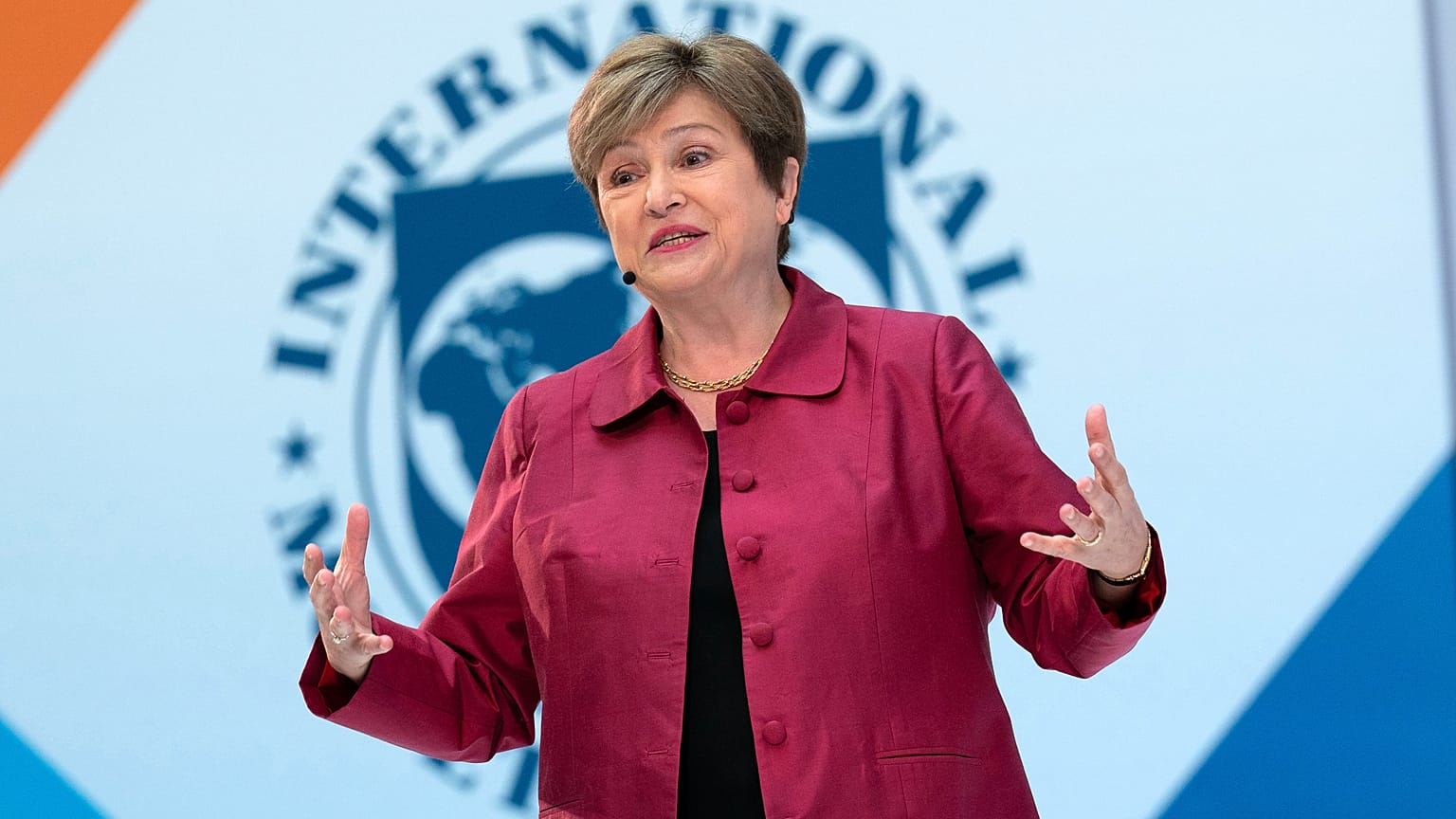
Speaking in Singapore on Wednesday, ahead of the IMF and World Bank annual meetings in Bangkok next week, Kristalina Georgieva said policymakers "can no longer rely on higher growth rates alone to solve fiscal problems".
Worldwide public debt is close to levels last seen after World War II and could top 100% of GDP before 2030, the IMF chief warned, singling out developed economies as the "worst offenders".
"Yet, we don't see decisive action in the high-debt advanced economies where the need of the hour is for credible medium-term fiscal consolidation plans," Georgieva said, adding that "fiscal space is crying out for replenishment".
Borrowing costs are already climbing, she noted, with 10-year government bond yields in the US, Germany and Japan at their highest levels since 2007, 2009 and 1996 respectively.
On monetary policy, Georgieva described recent rate hikes by the US Federal Reserve, the European Central Bank and the Bank of Japan as "highly appropriate".
"Now may be a good time for a prudently hawkish bias in many countries' monetary policy," she said.
The IMF chief also warned that the global economy is being pulled in opposite directions by a negative energy supply shock from the Iran war and a positive demand shock from artificial intelligence, adding that "the combined impact of these two forces is highly uneven across the world".
Oil prices remain at about $100 a barrel, she said, well above the $89 the IMF assumed for this year in its July forecasts, which put global growth at 3% in 2026 and 3.4% in 2027.
"Even if the war in the Gulf were to end soon, the problem of high energy prices will likely persist for some time," Georgieva said.
An AI boom with risks attached
"Love it, hate it, or fear it, AI is here," the IMF chief said, describing the technology as "rapidly becoming a key driver of countries' relative fortunes in the world economy".
If done right, AI could lift global growth by as much as half a percentage point a year, according to IMF estimates.
Over a decade, that would be like adding "an economy the size of ASEAN to the world economy", Georgieva said, referring to the Southeast Asian bloc.
But she cautioned that "the AI building boom is inflationary", with spending on the technology, relative to the size of the economy, likely to outstrip past investment waves in railways, power grids and telecoms.
A letdown for investors could become "a far-reaching shock," she warned.
Georgieva also flagged dangers ranging from job losses and cyberattacks to cutting-edge models that could "escape human control and run amok".
The IMF is due to publish updated global growth forecasts during next week's meetings in Bangkok.