

















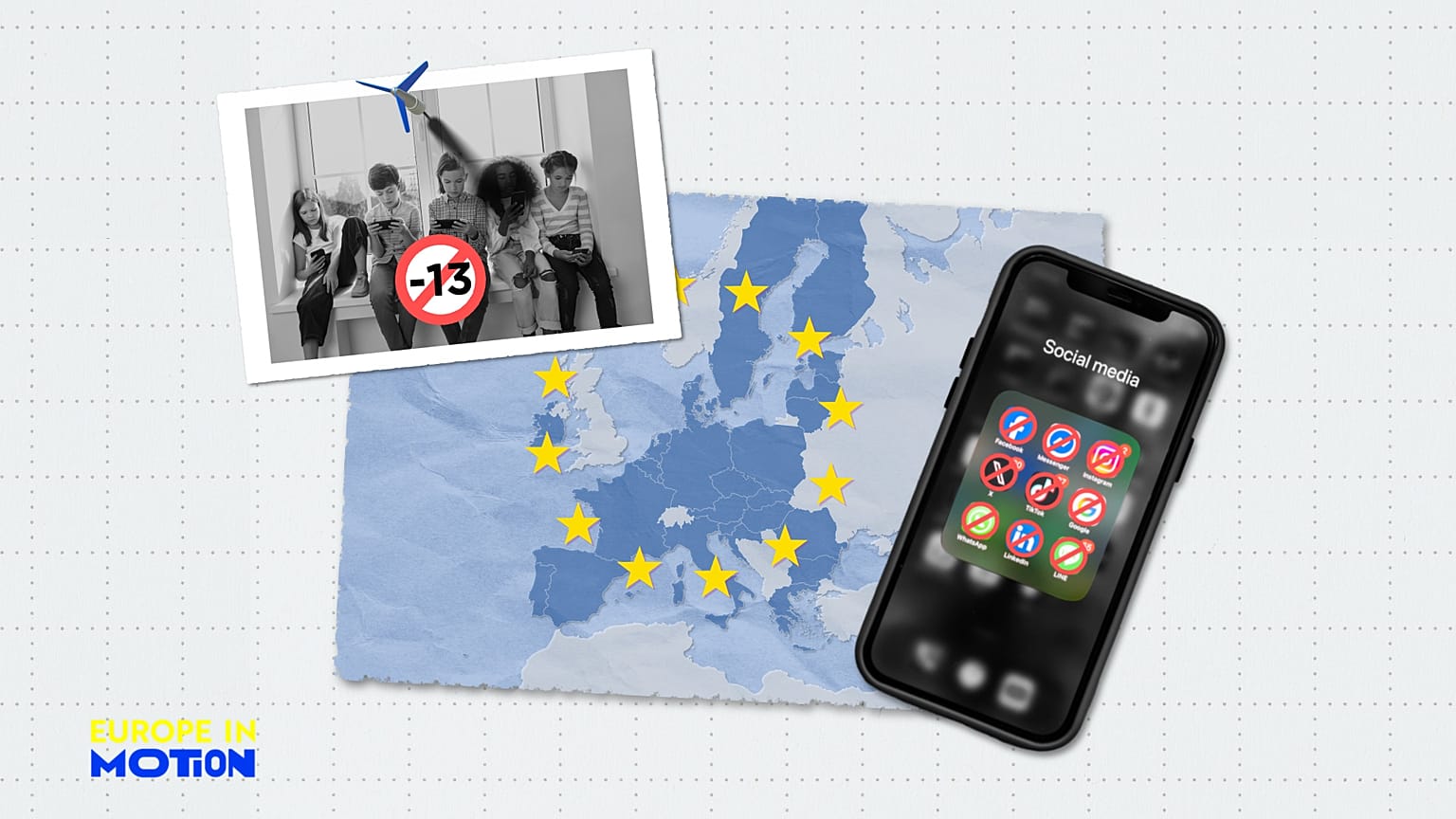














Some 91% of Europeans agree on tightening social media regulation for children, with a blanket ban emerging as the most widely backed measure.
A new EU proposal, the KIDS Act, could ban children under 13 from using social media and limit features for those aged 13 to 15.
 ADVERTISEMENT
ADVERTISEMENT
ADVERTISEMENT
The goal is to crack down on phone addiction and doomscrolling, but also to protect children from harmful content — or contacts — as well as mental and physical risks.
Child rights organisations have welcomed the move, though some are warning that restricting social media access to teenagers might push them towards even more dangerous online communities.
The vast majority of EU citizens (91%) agree that more measures are needed to regulate child social media use, according to Eurobarometer's poll EU Challenges and Priorities.
The action that received the largest support (36%) was a social media ban for children under a certain age.
Greece shows the strongest backing for this measure with 49%, followed by Bulgaria, Romania, Portugal, Ireland and Slovakia, all at 44%. The lowest support emerged in a cluster of central European countries: Austria (27%), Germany (28%), and the Czech Republic (29%).
'Shifting the burden from platforms to parents'
However, some child rights organisations are not too impressed with the EU's plan.
"We back 13 as the minimum age, but we don't see it as a new ban," Jeanne-Marie Quashie, EU advocacy officer at Terre des Hommes Netherlands, told Europe in Motion. "Currently, social media platforms have set 13 as the age to access their platforms."
She said that the act's age limit aligns with standards already set out in Article 8 of the General Data Protection Regulation (GDPR), and that the new legislation needs improvement in how it intends to regulate access for 13- and 14-year-olds.
Under the current framework, teenagers won't be able to independently create a social media account, but their parents will have to initiate and confirm the account for them.
The account will then be managed through a linked parent profile or an admin dashboard, which will, for example, set the screen time limit, with a maximum of one hour per day.
In which case, a considerable part of responsibility will fall on parents.
"The EU KIDS Act is moving in the right direction by targeting platform design over blanket bans", Quashie said. "But making access depend on a parent's sign-up shifts the burden from tech companies onto families."
"For 13- to 15-year-olds, safety must be built in, not switched on," she added. "Children's access to online spaces must be conditional on safety, not parental authorisation."
Child social safety: What are Europeans most concerned about?
Concern about child social media use runs high across the EU, with around 70% of respondents saying they are very or somewhat worried about cyberbullying (71%), online grooming (70%), and exposure to harmful content (69%).
At the same time, concern about addictive design, one of the main targets of the KIDS Act, polled lower, at just 60%, with only 28% very concerned.
Yet there are some exceptions: in Cyprus, the rate of respondents worried about addictive design jumps to 89%, while it reaches 87% in Luxembourg.