
















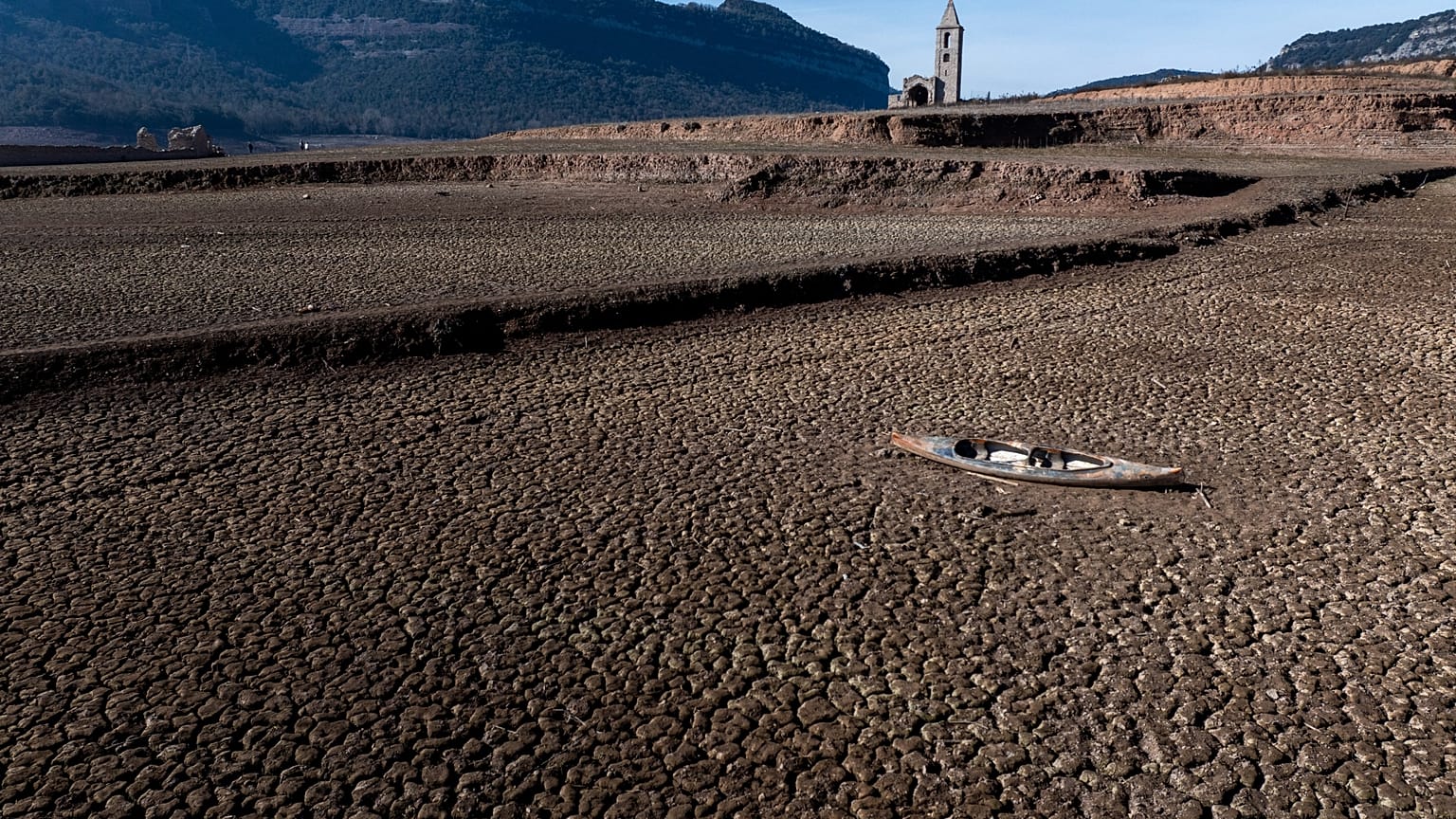













With three weeks left in August, Europe still struggles with water restrictions as intense heat strains its fragile water reserves. Beyond dried-up water reservoirs and drought alerts, decades of leaks, overuse and pollution have left the bloc short on water.
Summer is halfway through, but water restrictions are still in place across the bloc. This summer's record-breaking temperatures are speeding up water evaporation from rivers and lakes, worsening drought conditions. But heat only accelerates a shortage that the EU has built up for decades.
 ADVERTISEMENT
ADVERTISEMENT
ADVERTISEMENT
Europe relies heavily on water. Electricity cooling uses 33 percent of Europe's water, agriculture 31 percent, public supply 21 percent, and industry 14 percent, the European Environment Agency (EEA) reports. To meet these needs, the EU extracts about 200,000 billion cubic metres of water annually, exceeding natural replenishment and depleting groundwater and river flows.
Low water levels increase the risk of pollution, reducing the availability of clean, resilient water. Today, only 37 percent of Europe's surface water has a good or high ecological status, while 29 percent have a good chemical status, according to the EEA's latest data. Water losses compound the problem as Europe wastes 23 percent of its treated water through leaky pipes before it reaches households.
The 2025 Water Resilience Strategy is Europe's answer to its growing water scarcity. It aims to make Europe’s water supply climate-resilient by boosting water efficiency by at least 10 percent by 2030. It restores and protects water quality and quantity by reducing pollution and over-extraction; reduces waste and leaks through a water-smart economy; and uses digital solutions to improve water management.
Can this be enough to secure Europe’s water future? Which sector should cut its water use the most? Our poll is anonymous and takes only a few seconds to complete. The results will be featured across EU-wide XL coverage - in videos, articles and newsletters - and will help shape our reporting as we examine how Europe can secure its position in the age of artificial intelligence.