














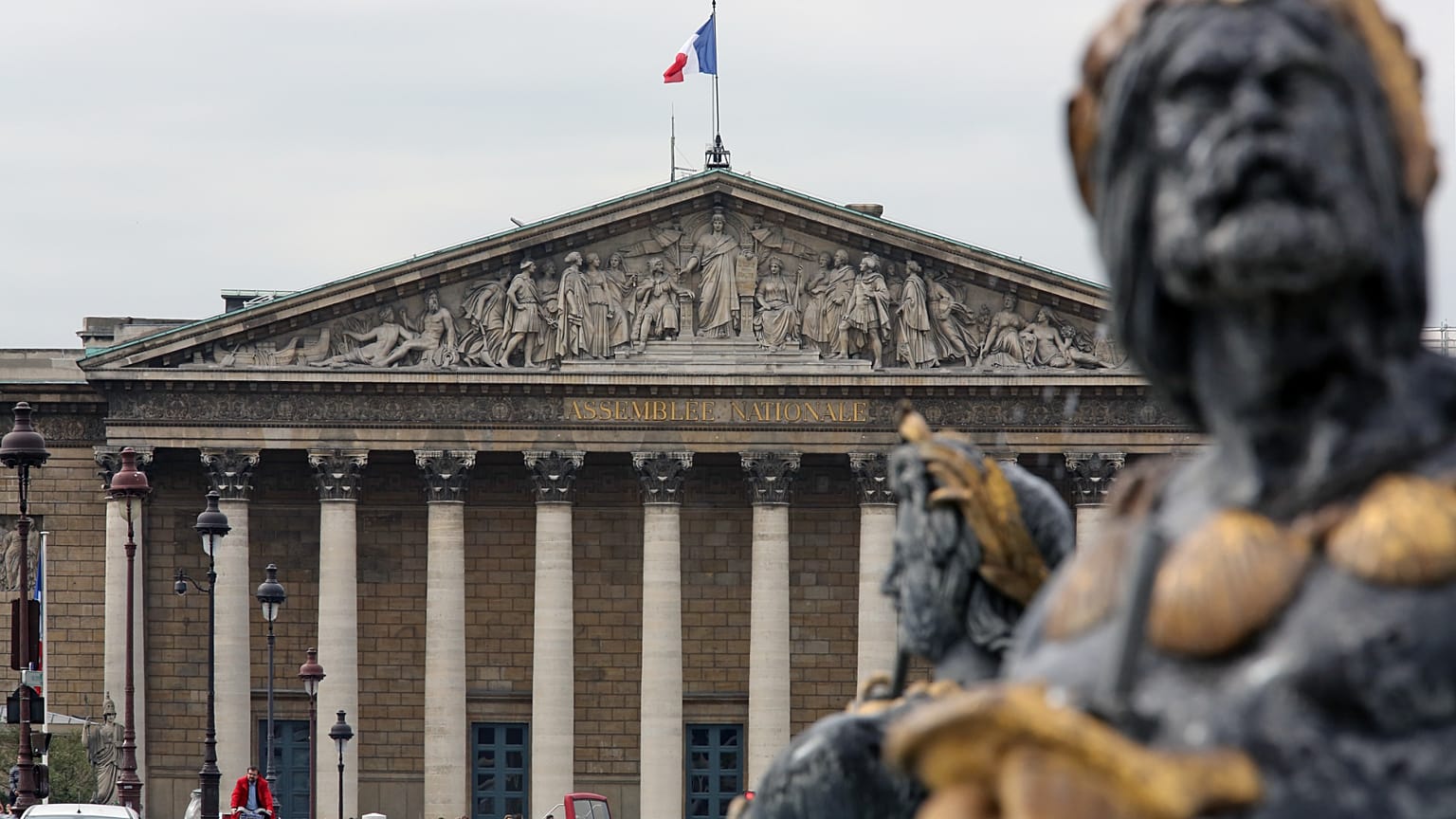













Plans for a new reception pavilion at the National Assembly face strong opposition, with a petition nearing 100,000 signatures after Paris Council backed relaxed planning rules around the Palais-Bourbon.
For almost two years this saga, full of twists and turns, has pitted and involved several players: the National Assembly and its president Yaël Braun-Pivet, Paris City Hall and the association Sites & Monuments.
 ADVERTISEMENT
ADVERTISEMENT
ADVERTISEMENT
The project to build a new reception pavilion for the National Assembly has proved highly divisive. Championed by the president of the institution, Yaël Braun-Pivet, it involves replacing the historic stone pavilion, dating from 1888, with a contemporary glass structure. The future building is to house a shop, a cafeteria and educational spaces, functions which the Sites & Monuments association considers secondary for a parliament.
"The problem is that this building would break that symmetry and introduce a large quantity of new material, namely glass", explains to Euronews Julien Lacaze, president of Sites & Monuments. He recalls that the project is to be built within a Remarkable Heritage Site (SPR) in the 7th arrondissement, in an area listed as a UNESCO World Heritage site.
In his view, the architectural project disrupts the historic harmony of the Seine embankments on several levels: it breaks the symmetry between La Madeleine and the colonnade of the Palais-Bourbon, introduces glass on a massive scale into an ensemble dominated by stone, and undermines both the horizontality and the architectural unity of the site.
"What is most serious is destroying a historic building. Once you have demolished something and put up something that is not in harmony with its surroundings, it is final. It cannot be reversed", laments the president of this association, founded in 1901, recognised as being in the public interest since 1936 and accredited for environmental protection. Sites & Monuments specialises in the defence of heritage.
In the association president's view, other solutions exist, more respectful of the building's original architecture, and deserve to be examined.
He cites in particular the proposal by the Japanese firm SANAA, a Pritzker Prize laureate, which suggested keeping the existing 1888 pavilion while adding a contemporary stone extension, rather than glass as in the approved project. In his view, this proposal would have met the Assembly's functional needs without fundamentally transforming the architectural landscape.
A construction cost deemed excessive
Beyond the aesthetic and historical issues which Julien Lacaze believes are under threat, the project has also drawn criticism over its cost. The announced budget of 52.8 million euros strikes him as too high in a context of budgetary constraints, all the more so as the final bill could rise during the works. Although the project will be self-financed by the National Assembly, he argues that: "It is the French people's money. At a time when people are being asked to tighten their belts, spending 53 million euros on a building with a shop and a cafeteria is questionable."
Since the project was announced, the association's president says he has identified several elements in the way the case has been handled which he considers problematic. According to him, no information on the progress of the project was released for almost a year after the competition. A first planning application is said to have been submitted in contradiction with the Preservation and Enhancement Plan (PSMV) for the 7th arrondissement, notably because of the excessive height of the building, its footprint on protected areas and the impact on heritage gardens and courtyards.
Faced with the risk of legal challenges, the permit is said to have been withdrawn. He says the authorities then initiated a targeted amendment of the PSMV in order to make the project compatible with planning rules.
"It is a question of ego"
This architectural project has been driven by the president of the National Assembly, Yaël Braun-Pivet, since 2025.
Julien Lacaze accuses her of wanting to leave her mark on her term of office through an architectural statement intended to symbolise the institution's transparency.
"What you can criticise [Yaël Braun-Pivet] for is not a lack of architectural culture. It is not listening."
Asked by Franceinfo, the president of the National Assembly said she was "overwhelmed by criticism of a project people do not know".
In its campaign, the Sites & Monuments association enjoys the support of several political figures, notably from Les Républicains (LR) and La France insoumise (LFI), as well as former presidential candidate Ségolène Royal.
Launched just over a year ago on the Change.org online platform, the petition has seen renewed interest in recent weeks. It is approaching 100,000 signatures at the time of publication of this article.
Contacted by Euronews, the National Assembly did not respond to our requests for comment.
For its part, Paris City Hall told us by email that "this project, which aims to modernise and strengthen conditions for receiving the public at the Palais-Bourbon by increasing the areas dedicated to them" must now be "the subject of a planning application, which will be examined by the state, during which the City will be consulted in an advisory capacity".
"False", retorts the president of the association, who claims, with evidence to support him, that the City has already taken a position in favour of the project, since the Council of Paris approved the amendment to the Preservation and Enhancement Plan (PSMV), needed to bring the project into line with planning rules.
"There was a decision by the City of Paris approving the draft amendment (...) on 16 July," he says. In his view, the municipal majority has therefore indeed thrown its weight behind the project.
"Emmanuel Grégoire is taking up the cause for the project. Despite strong opposition, the City of Paris has given its approval."
According to Julien Lacaze, the project is also backed by part of the government, as he notes that the request to amend the PSMV originates from the regional prefect and the Paris police prefect, which in his view means that the Ministry of Culture also supports the project.
"We will do everything that is legal. We have the right to launch petitions and we will challenge the permit in court," he says.
"If this building is constructed, it will be a sign of the lack of sensitivity, the obstinacy and the outsized egos of some of our leaders in Paris."
The association plans to continue collecting signatures for the petition, to take part in the public inquiry into the PSMV amendment and, finally, to file a legal challenge against the future planning permission.