















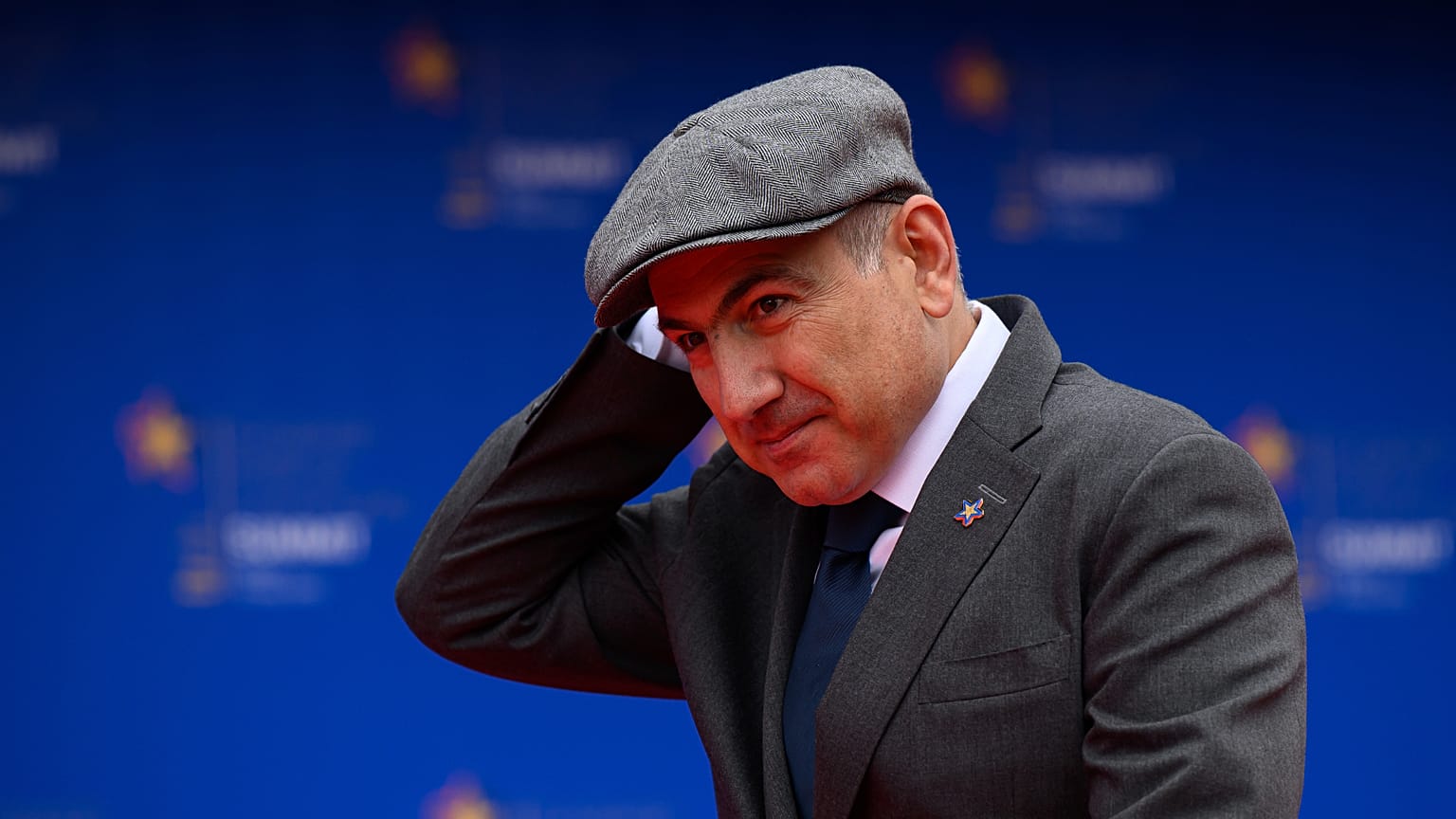














With the latest polls showing him on course for a landslide victory on Sunday, PM Nikol Pashinyan told Armenians – and Russia – that he is seeking a balanced yet sovereign approach to his foreign policy, as Russia continued to exert pressure by imposing more sanctions ahead of the crucial vote.
With just days left before historic elections on Sunday, Armenian Prime Minister Nikol Pashinyan is walking a tightrope, balancing his pro-West push with efforts to avoid an escalating clash with Russia amid Moscow’s increasing pressure on Armenians ahead of the decisive vote.
 ADVERTISEMENT
ADVERTISEMENT
ADVERTISEMENT
As the latest polls showed Pashinyan on course for victory on Sunday, he responded to the Russian-led Eurasian Economic Union (EAEU) 's call for an Armenian referendum on the country's pro-Western, EU-aligned path, saying on Monday that the moment for such a choice has not yet arrived.
The Armenian prime minister moved to de-escalate tensions with Russia and the EAEU by saying that Yerevan “will continue working in the Eurasian Economic Union until the moment when a choice between the EU and the EAEU becomes unavoidable."
However, he added that Armenia’s future is a sovereign matter and that the “decision must naturally be made by the people of Armenia in a referendum.”
Armenia’s EU membership bid is at the moment “theoretical," Pashinyan pointed out.
“Until the point when Armenia has either officially applied for EU membership or is very close to obtaining candidate status, holding any referendum would be unreasonable,” Pashinyan said.
“Putting a theoretical choice to a referendum is of course neither very sensible nor justified," he added.
“Therefore, we will continue to work calmly and steadily, without disputes, within the Eurasian Economic Union, and I am convinced that we still have potential in this direction, which we will use in the near future."
The Armenian premier further said that “relations with Russia are in a transformational phase,” but that he considered this process “positive” and that Armenia’s relations with Russia remained "open and sincere, and we have kept no dark corners in that relationship.”
However, Pashinyan continued, Armenia is “working seriously to normalise relations with Turkey and Azerbaijan,” which, to him “is not a matter of whim but a necessity,” in a continuation of his counter to the pro-Russian opposition which has been pushing to keep the former Soviet state in Moscow’s traditional orbit.
“If we have no relations with Turkey, that scale is empty — and an empty scale creates serious risks and instability,” the Armenian prime minister explained.
In another twist in the already tenuous Armenia-Russia relations, Russian President Vladimir Putin sent Pashinyan a letter on Sunday to congratulate him on his birthday, saying that “relations between our countries and peoples have traditionally been friendly, and we are interested in their further progressive development.”
In parallel, Moscow continued its growing economic onslaught of measures and threats by banning imports of almost all fish products from Armenia on Monday, after restricting imports of various Armenian fruits and vegetables as well as wine, brandy and Jermuk mineral water.
The Kremlin has also threatened to cut critical Russian oil and gas supplies to Armenia.
Pashinyan responded to these measures by pledging state compensation to Armenian farmers affected by Russian embargoes.