













The figures reveal a worrying trend: the share of wages spent on rent has risen from 38% in 2019 to 50% in 2025, the highest level in the entire data series.
The housing affordability crisis continues to worsen in Spain. In 2025, the financial effort Spaniards had to make to rent a home reached a new record: 50% of the average gross salary went on rent, compared with 47% in 2024.
 ADVERTISEMENT
ADVERTISEMENT
ADVERTISEMENT
According to a study based on data from InfoJobs and Fotocasa, the increase in rental prices once again far outpaced wage growth. While advertised salaries increased by barely 1% over the past year, the cost of rental housing went up by 6.9%, reaching 14.21 euros per square metre per month.
Taking an 80-square-metre home as a reference, the average annual rent rose to 13,642 euros, a figure that means half of the national average gross salary, set at 27,336 euros a year, has to be spent on rent.
Madrid and Catalonia, the regions under greatest pressure
By autonomous community, Madrid tops the ranking for the share of wages going on rent, at 71% of gross pay, followed very closely by Catalonia, where the proportion reaches 70%. The Balearic Islands (64%), the Basque Country (58%) and the Canary Islands (56%) complete the group of territories where renting a home places an especially heavy burden on workers.
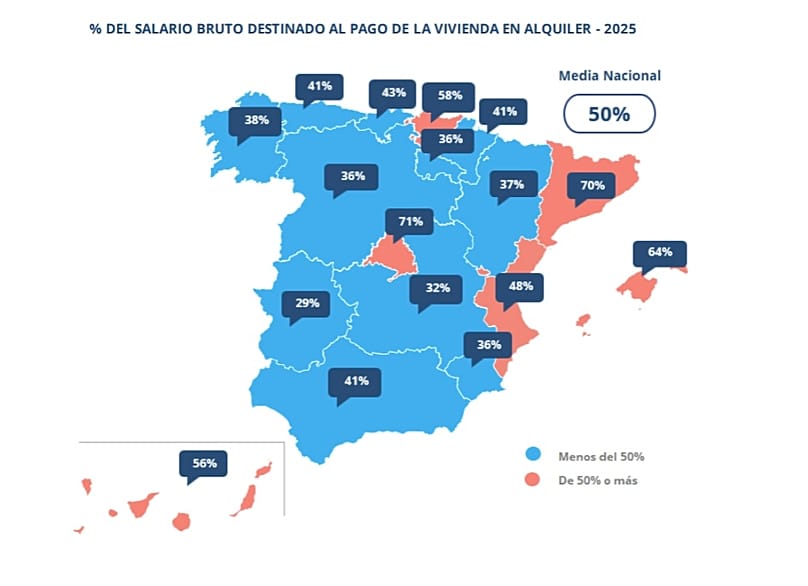
At the other end of the scale are Extremadura (29%) and Castilla-La Mancha (32%), the only regions where the effort remains relatively more contained, although still above the levels recommended by international bodies.
Barcelona, the least accessible province
The analysis by province reveals even starker differences. Barcelona confirms its position as the province where renting requires the greatest financial effort, swallowing up 76% of the average gross salary. It is followed by Madrid (72%), the Balearic Islands (64%), Vizcaya (61%) and Las Palmas and Guipúzcoa, both on 57%.
By contrast, the provinces under the least pressure are Jaén (23%), Teruel (25%), Cáceres (27%) and Ciudad Real (28%). In fact, only seven provinces and the autonomous community of Extremadura record levels at or below 30% of salary going on rent.
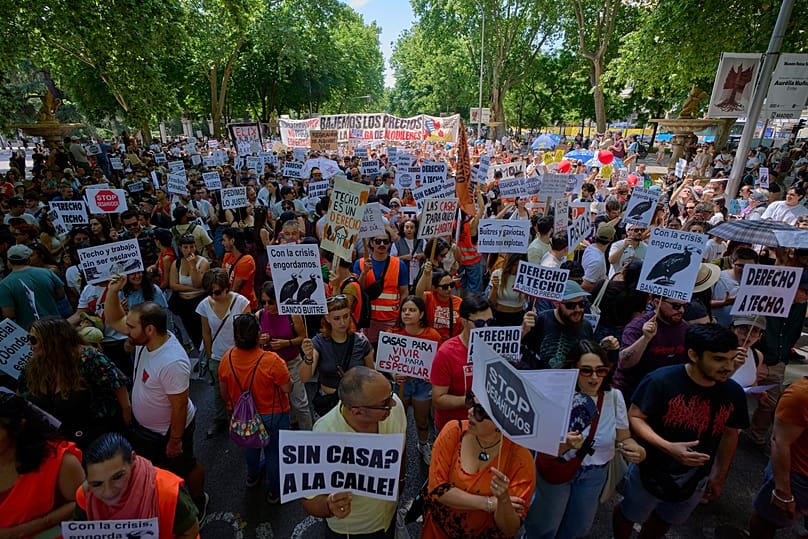
A 'housing emergency' situation
Fotocasa warns that this figure marks a turning point in the housing access crisis. The company's Head of Research and spokesperson, María Matos, stresses that having to devote 50% of wages to rent amounts to a situation of 'genuine housing emergency', as it is 20 points above recommended levels.
For its part, InfoJobs highlights the growing disconnect between wage trends and housing costs. Although the advertised annual gross salary rose by 276 euros compared with the previous year, this increase is not enough to offset the sharp rise in rental prices, a situation that limits the ability to save, constrains labour mobility and delays key life decisions such as leaving the parental home or starting a family.