












The US Department of Justice has released an additional filing linked to the Trump-IRS settlement, preventing the federal agency from pursuing existing tax audits involving the US president, his family and affiliated businesses.
On Tuesday, the US Department of Justice quietly published an additional filing related to the settlement between US President Donald Trump and the IRS.
 ADVERTISEMENT
ADVERTISEMENT
ADVERTISEMENT
The one-page document appeared a day after officials disclosed a separate nine-page agreement tied to Trump’s $10 billion (€8.6bn) lawsuit, filed against the federal agency in January over the leaking of his tax returns.
According to the filing, the IRS is "forever barred and precluded" from "prosecuting or pursuing any and all claims [...] appeals [...] examinations [...]" of the US president, "related or affiliated individuals," and associated trusts and businesses.
The waiver applies to all tax returns submitted before the settlement officially took effect on Monday.
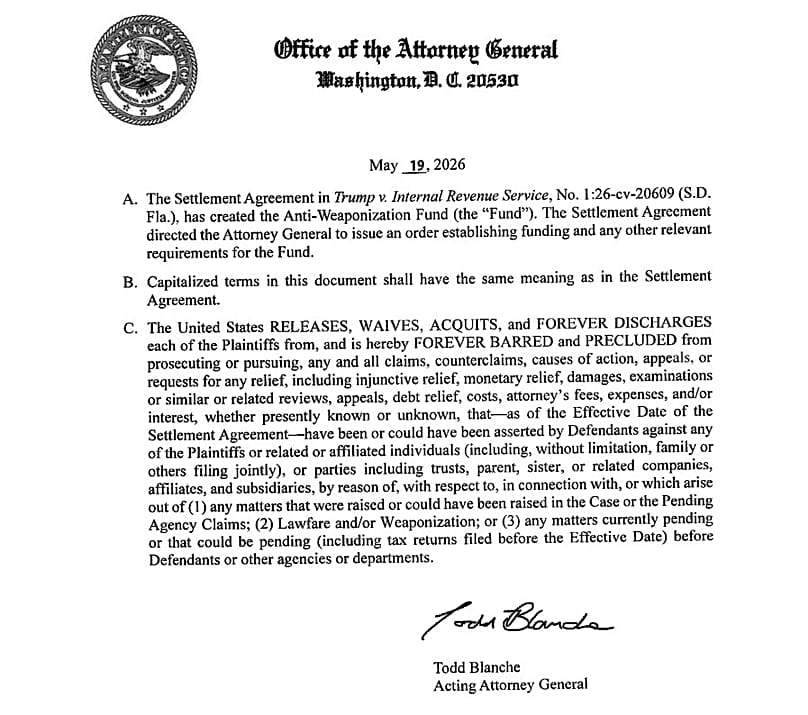
The addendum, dated Tuesday, was signed by Acting US Attorney General Todd Blanche. The document does not include signatures from IRS officials or lawyers currently representing Trump.
Blanche was not among the signatories on the original settlement agreement released a day earlier. That document was signed by Associate US Attorney General Stanley Woodward, IRS Commissioner Frank Bisignano and Trump's lawyer Daniel Epstein.
The US Justice Department did not explain why the waiver was not included in the agreement released Monday and why it isn’t signed by the same people, simply stating that "as is customary in settlements, both sides have executed waivers of a variety of claims that were or could have been brought [...]".
"There would be little point in settling several significant claims if either party could simply turn around and seek to initiate more adverse claims that could have been pursued previously," the statement also read.
"This is only with respect to existing audits, not future," it concluded.
The newly disclosed filing significantly broadens the scope of the original agreement and has prompted renewed debate over the independence of the IRS and the extent of executive authority.
'Anti-Weaponization Fund' fuels political backlash
Before this contentious addendum, the lawsuit itself had already generated significant controversy because Trump was effectively suing a federal agency that ultimately falls under the executive branch he controls as president.
Although the IRS operates with a degree of institutional independence under the US Treasury Department, critics argued the case created an unprecedented dynamic in which a sitting president was engaged in litigation against an agency overseen by his own administration.
The concerns intensified further after the administration negotiated a settlement that not only resolved the lawsuit, and now imposes sweeping restrictions on future IRS action connected to Trump and his family, but that also created a $1.776 billion (€1.52bn) "Anti-Weaponization Fund" financed with taxpayer money.
According to the US Department of Justice, the fund is designed to provide compensation to individuals who believe they were subjected to politically motivated investigations or prosecutions.
Democrats and government ethics groups have criticised the structure and oversight of the fund, arguing that its governance provisions remain unclear, while Blanche defended the legality of the agreement during congressional questioning on Tuesday.
The settlement has intensified scrutiny of how the Trump administration is handling legal disputes involving federal agencies, particularly those connected to the president’s finances and tax affairs, at a time when allegations of insider trading have also increased.