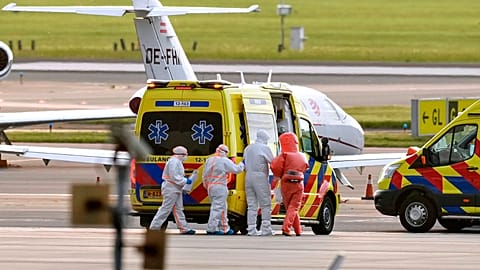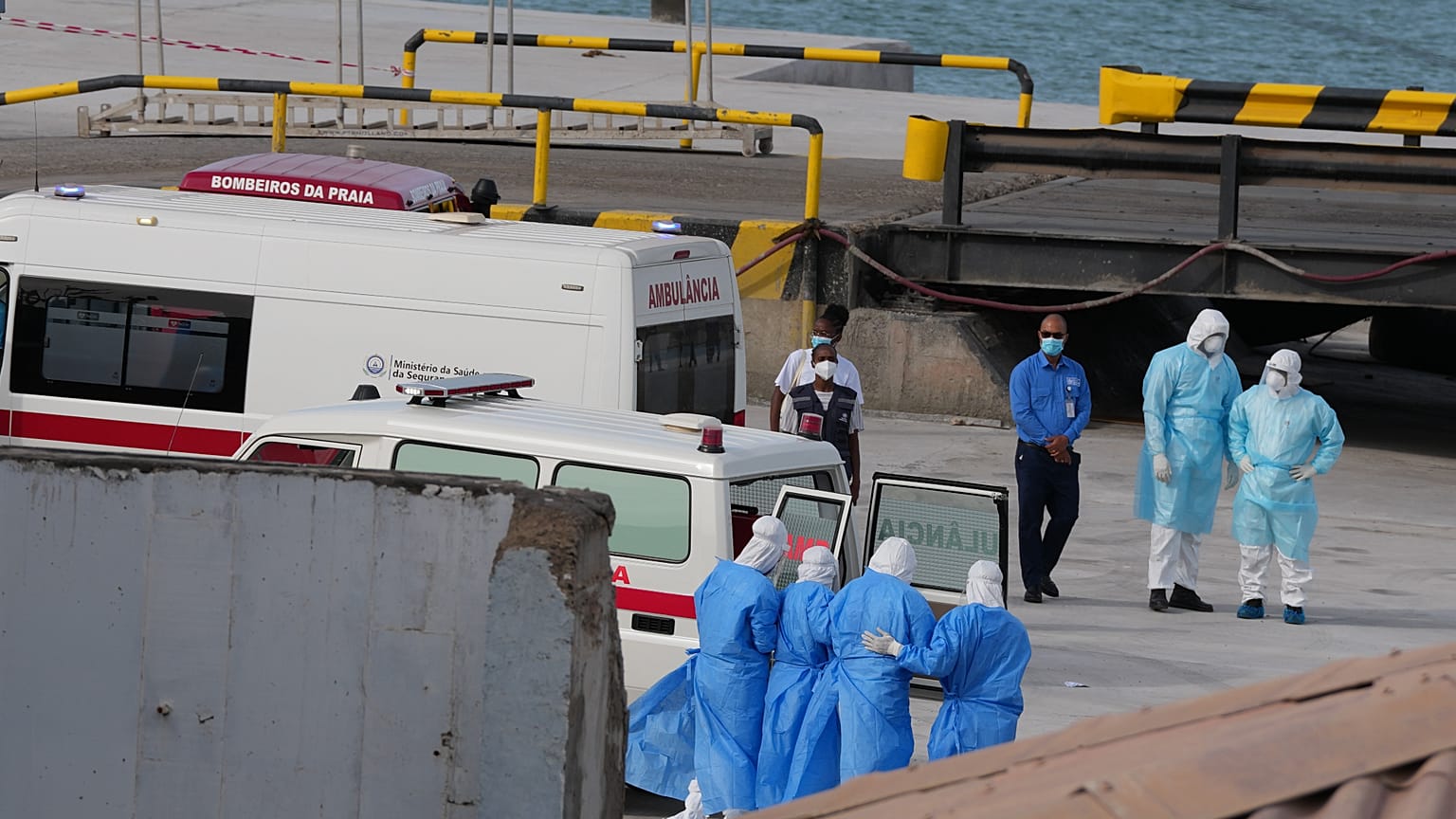














All the passengers have been evacuated to their home countries, where they will undergo quarantine.
Spanish health authorities are investigating whether a woman in Alicante has contracted hantavirus as the country prepares for the cruise ship to dock this weekend.
 ADVERTISEMENT
ADVERTISEMENT
ADVERTISEMENT
The woman is believed to have travelled on the same flight as a Dutch passenger who subsequently died in Johannesburg, Secretary of State for Health Javier Padilla told reporters on Friday, adding that the woman is in isolation and her symptoms included coughing and "general malaise".
Spanish authorities have begun preparing to receive more than 140 passengers and crew members on board a hantavirus-stricken cruise ship headed for the Canary Islands, where health officials have said they will perform careful evacuations.
The vessel is expected to reach the Spanish island of Tenerife, off the coast of West Africa, on Saturday or Sunday.
Five cases of hantavirus linked to an outbreak on a cruise ship have now been confirmed, the World Health Organization (WHO) said on Thursday, warning that more infections could still emerge because the virus can have an incubation period of up to six weeks.
During a press conference WHO infectious disease epidemiologist Maria Van Kerkhove sought to distinguish the outbreak from the early days of the COVID-19 pandemic.
"I want to be unequivocal here. This is not SARS-CoV-2. This is not the start of a COVID pandemic. This is an outbreak that we see on a ship," she said. Van Kerkhove explained that hantavirus does not spread in the same way as coronaviruses, but rather through "close, intimate contact".
Countries scramble to track passengers who disembarked
Health authorities across four continents were continuing to track down and monitor passengers who disembarked the ship before the deadly outbreak was detected, and are trying to trace others who may have come into contact with them since then.
On April 24, nearly two weeks after the first passenger had died on board, more than two dozen people from at least 12 different countries left the ship without contact tracing, the ship’s operator and Dutch officials said Thursday.
The World Health Organization confirmed on Friday that a flight attendant on a plane briefly boarded by an infected cruise passenger in South Africa had tested negative for hantavirus.
The KLM flight attendant was working on a Johannesburg to Amsterdam flight on April 25 and had later fallen ill. She was taken to an isolation ward at an Amsterdam hospital on Thursday.
The cruise passenger, a Dutch woman whose husband died on the ship, was too ill to take the international flight to Europe and was taken off the plane in Johannesburg, where she died.
The Dutch public health service is currently undertaking contract tracing on passengers from the flight who had contact with the ill woman before she left the plane.
On Friday, UK health authorities said a third British national is suspected to have the hantavirus.
The UK Health Security Agency said the suspected case is on Tristan da Cunha, a remote British overseas territory in the south Atlantic where the ship stopped in April.
There was no word on their condition.
Two other Britons who were on the ship have been confirmed to have the virus. One is hospitalized in the Netherlands and the other in South Africa
What happened on the MV Hondius?
Three passengers have died and eight others have been sickened by hantavirus on board the Dutch-flagged MV Hondius cruise ship, which remains marooned off the coast of Cape Verde with nearly 150 people onboard.
Dutch officials said on Friday they were also in close contact with the ship's owner and the authorities of countries whose citizens are on board.
The United States has agreed to send a plane to the Canary Islands to repatriate its 17 citizens from the cruise ship, she said. The British government also said it will charter a plane to evacuate the nearly two dozen British citizens on board.
The ship left Argentina on 1 April on an Atlantic cruise and was scheduled to include stops in Antarctica, the Falkland Islands and other locations, though its itinerary has since changed due to the outbreak.
The head of the World Health Organization (WHO), Tedros Adhanom Ghebreyesus, said three patients with suspected hantavirus cases have been evacuated and are on their way to the Netherlands.
“At this stage, the overall public health risk remains low,” he wrote on his X account.
Meanwhile, Maria Van Kerkhove of the WHO said officials are investigating possible human-to-human transmission - something considered extremely rare - and believe the first infected person likely contracted the virus before boarding. Authorities have also said there are no rats on board.
A case linked to the ship has also been confirmed in Switzerland, while health authorities in South Africa and Switzerland have identified a strain capable of spreading between humans in rare cases.
Passengers disembarked after first onboard death
Around 40 passengers disembarked from the cruise ship after the first passenger died on board, Dutch officials say. The passengers left the MV Hondius during a stop at the remote South Atlantic island of St. Helena, according to the Dutch foreign ministry.
Among them was the wife of a 70-year-old Dutch passenger who died onboard after falling ill during the voyage. She later flew on a commercial flight to South Africa, where she collapsed and died in the hospital.
The cruise operator, Oceanwide Expeditions, had previously only confirmed that the Dutch woman left the ship with her husband’s body and had not publicly acknowledged that dozens of other passengers also disembarked.
Dutch authorities did not say where the passengers who left the ship are now.
45 days of quarantine for Spanish passengers
The 14 Spaniards aboard the cruise ship MV Hondius will be taken to Tenerife before being transferred to Madrid, Spanish health authorities said.
They will undergo up to 45 days of quarantine in Spain’s most advanced isolation facility, at the Hospital Central de la Defensa Gómez Ulla in Madrid.
The High-Level Isolation Unit (UAAN) is a specialised facility created after the 2014 Ebola outbreak and previously used during COVID-19 evacuations from Wuhan.
What is hantavirus?
Hantavirus refers to a group of viruses carried by rodents, primarily transmitted to humans through inhalation of airborne particles from dried rodent droppings.
According to the US Centers for Disease Control and Prevention, hantaviruses can cause two serious illnesses.
The first is hantavirus pulmonary syndrome, which affects the lungs and can lead to severe respiratory failure. The second is haemorrhagic fever with renal syndrome, which affects the kidneys and can cause serious complications.
This story was updated on 8 May.