




























A report published this month by the McKinsey Global Institute offers one of the most rigorous accountings of last year's trade war. Its verdict confounds almost every prediction made when the tariffs were first introduced.
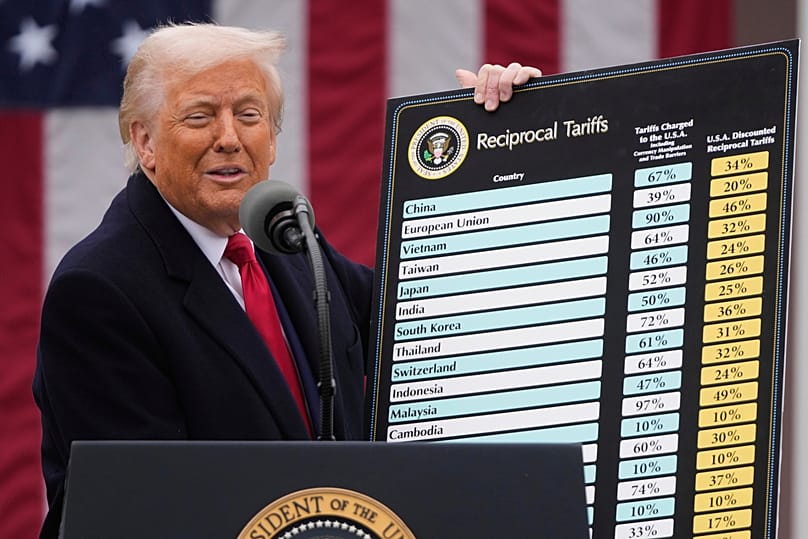
It is almost a year since Liberation Day, when US President Donald Trump stood in the Rose Garden and declared "reciprocal tariffs" against more than 50 countries.
 ADVERTISEMENT
ADVERTISEMENT
ADVERTISEMENT
Looking back, the tariff war did not kill global trade.
That is the counterintuitive conclusion of McKinsey Global Institute's "Geopolitics and the Geometry of Global Trade" report, published this month.
Against US tariff rates at their highest since the Second World War, global trade grew faster than the world economy.
Both US imports and Chinese exports reached all-time highs. Trade dynamics were effectively reshaped, but did not collapse.
Speaking to Euronews, one of the authors of the report, Tiago Devesa, stated that "the biggest change in 2025 was how much the US and China traded directly with each other, although the flows between the two countries dropped significantly, this trend precedes the introduction of the tariffs."
According to McKinsey, US–China trade fell by around 30% and roughly $130bn (€112.3bn) in Chinese exports to the US evaporated.
Devesa further explained that “as the US shifted sourcing away from China, Southeast Asia essentially took on the largest share of US demand.”
ASEAN countries' exports jumped nearly 14% as Vietnam, Thailand and Malaysia absorbed supply chains displaced from China and rerouted finished goods, particularly consumer electronics, towards American consumers.
Meanwhile, India took on a narrower but still very significant role. For example, the US reduced smartphone sourcing from China by around 40%, dropping imports by $18bn (€15.5bn), but India increased smartphone exports to the US by $15bn (€13bn).
Yet, China's overall trade surplus still reached a record high, as Chinese firms pivoted to what McKinsey terms as a "factory to the factories", ramping up industrial components and capital goods to emerging economies.
To be competitive and hold market share elsewhere, Chinese exporters also cut average consumer goods prices by 8%.
As for the US, the figures present the starkest gap between political promise and statistical reality.
In his Liberation Day speech, US President Donald Trump stated that "chronic trade deficits are no longer merely an economic problem. They’re a national emergency that threatens our security and our very way of life. For these reasons, starting tomorrow, the United States will implement reciprocal tariffs on other nations."
However, the Bureau of Economic Analysis confirmed a full-year goods and services deficit of $901.5bn (€779bn) last year, a negligible 0.2% reduction from $903.5bn (€780.5bn) in 2024.
The deficit with China narrowed to $202.1bn (€174.6bn), its smallest in over two decades, but the US Department of Commerce's own data shows the gap migrated, primarily to Vietnam and Taiwan, where bilateral deficits widened to records.
Where the US genuinely prevailed was in artificial intelligence.
The US provided approximately half of the world's new data-centre capacity in 2025, and predominantly drove AI-related goods demand.
AI-related trade skyrockets
Global trade received a significant boost from artificial intelligence in 2025, with AI-related shipments emerging as the single largest driver of growth.
McKinsey found that AI-related goods exports accounted for roughly a third of overall trade growth, with semiconductors and data-centre equipment expanding to make up more than 35% of global trade.
Hardware essentials for building and operating AI systems, including chips, servers and networking gear, saw a boost in demand as major tech firms spend on building out AI infrastructure at an unprecedented pace and scale.
Asian manufacturing hubs, notably Taiwan, South Korea and parts of Southeast Asia, supplied these goods to markets worldwide, with particularly strong flows to the US.
Much of this AI-driven commerce took place between geopolitically aligned economies, illustrating how the technology has begun to redraw global flows amid tariff disruptions elsewhere.
The report underscores that booming investment in AI has left a lasting imprint on trade patterns, sustaining momentum at a time when traditional routes between major powers were contracting.
"Every year, trade is shaped by both long-term waves and short-term splashes," said Devesa, adding that "the AI boom is a long-term wave that will continue to redefine trade for years to come, while the tariffs were last year's disruptive splash."
The EU's 'double squeeze'
Of all the major blocs, the European Union offers the most instructive cautionary tale.
According to the report, the bloc is facing a “double squeeze”.
On one hand, the EU’s trade deficit with China has widened, as imports have risen and exports have fallen. On the other hand, its trade surplus with the United States narrowed over the course of last year.
Moreover, as exports decline and imports rise in trade with China, the bloc also faces a race with the world’s second-largest economy for key markets that are predominant destinations for EU exports, according to Devesa. “There is also increased competition in that regard,” he said.
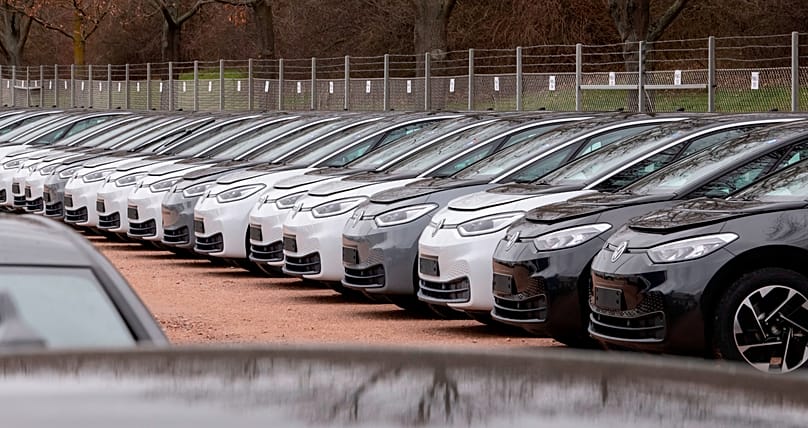
The automotive sector bore the sharpest impact. EU car exports to the US fell 17% while shipments to China dropped over 30% in 2025.
Simultaneously, Chinese electric vehicles flooded Europe, rising by about 50% to more than 800,000 vehicles.
Germany, Europe's automotive heartland, imported more cars from China than it exported there for the first time in its industrial history.
Overall, if stripped of temporary pharmaceutical frontloading purchases, the EU's manufacturing trade surplus shrank by approximately $40bn (€34.5bn), according to McKinsey.
Brussels has clearly felt the pressure of this double squeeze and is attempting to rewrite this vulnerability.
In January, the European Commission signed two landmark pacts, one with India, cutting, for instance, car tariffs from as high as 110% to 10% over five years, and one with Mercosur, also slashing barriers on autos and pharmaceuticals, among other products.
On Tuesday, the EU announced a new free trade agreement with Australia during a visit by the European Commission President, Ursula von der Leyen.
The deal liberalises flows of goods while keeping quotas on sensitive EU farm products.
These agreements represent an explicit attempt to diversify EU trade away from Washington and Beijing, which together account for roughly a third of the bloc's external commerce.
Tiago Devesa told Euronews that "the magnitude of trade with Mercosur and India's markets today is limited. However, they are very fast-growing markets, and they are complementary to the EU’s products and services. For example, India wants to grow advanced manufacturing, and for that it needs components that Europe can provide."
The report cautions that India and Mercosur combined represent less than 8% of EU trade currently, and this share will need time to grow. These are long-term insurance policies, not immediate remedies.