














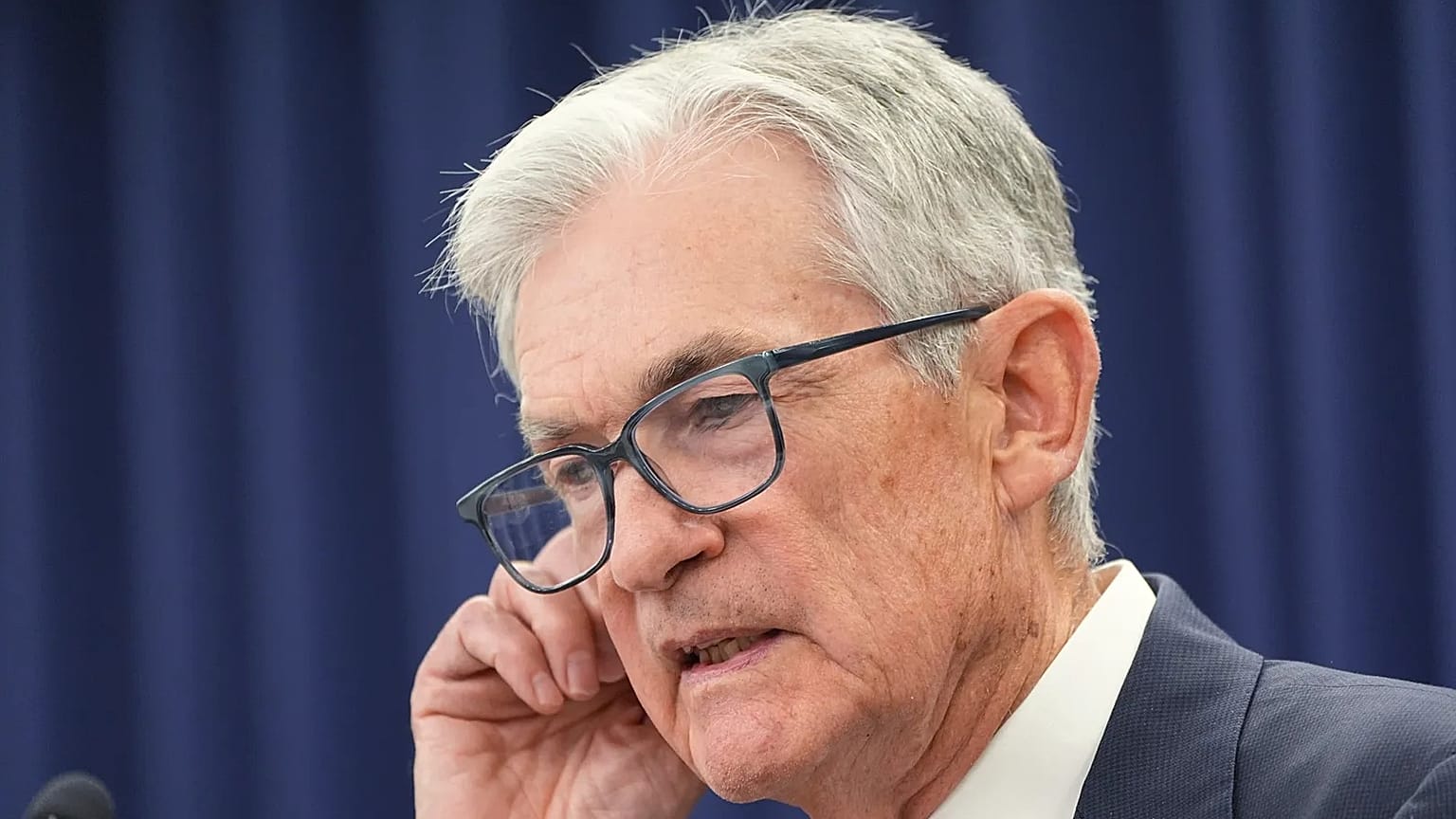













The Federal Reserve is expected to hold interest rates steady and may signal it will not cut rates at all this year as the Iran war complicates the central bank's inflation outlook.
A key question hangs over the Federal Reserve's two-day meeting that concludes on Wednesday.
 ADVERTISEMENT
ADVERTISEMENT
ADVERTISEMENT
Will policymakers still cut interest rates this year, now that the Iran war has sent oil prices higher and petrol prices spiking? Or will they hold steady for months to see how the conflict plays out?
Fed chair Jerome Powell is almost certain to announce on Wednesday that the central bank has kept its key rate unchanged for the second consecutive meeting, at around 3.6%.
But the Fed will also release its quarterly projections, and officials could revise their forecast of one rate cut this year down to zero.
While such a change might seem minor, it would represent a significant course correction after 18 months of stop-start rate cuts.
Wherever the Fed lands, this is a particularly difficult moment for policymakers to issue economic projections.
The Iran war, launched by the Trump administration on 28 February, has already sent petrol prices soaring and will push up inflation for at least the next month or two.
The Fed will be forced to revise upward the inflation forecast it issues on Wednesday from where it stood in December, when officials projected inflation would fall to 2.6% by the end of this year.
Many economists expect the Fed will now forecast inflation remaining as high as 3% even by late 2026.
An increase of that magnitude would be difficult to reconcile with further rate cuts.
At the same time, the jump in petrol prices — if sustained — could slow the economy, as more consumer spending is absorbed at the pump, leaving less for other goods and services. Unemployment could rise later this year as a result.
On Tuesday, petrol averaged $3.79 a gallon nationally, according to AAA, up 88 cents from a month ago.
Those two outcomes — higher inflation and higher unemployment — typically pull the Fed in opposite directions.
The central bank holds or raises its key rate to fight inflation while cutting rates to boost spending and hiring.
Rising prices alongside higher unemployment are generally the worst-case scenario for central bankers.
Powell's final stretch as chair
This week's meeting will also be among Powell's last as chair.
His term ends on 15 May and President Donald Trump has nominated former Fed official Kevin Warsh as his replacement.
Warsh's confirmation has stalled in the Senate, however, after senior Republican senators raised objections over a Justice Department investigation into Powell's testimony about a building renovation.
Last Friday, a judge dismissed two subpoenas the Justice Department had issued to the Fed, dealing a blow to the investigation.
But US attorney Jeannine Pirro has said she will appeal the ruling.
This week's meeting will be Powell's second to last — unless Warsh is not confirmed by 15 May, in which case Powell could remain chair of the Fed's rate-setting committee until a successor is named.
Even before the Iran war, problems had emerged in both inflation and jobs data, leaving the Fed in a difficult position.
Prices rose more quickly in January than in recent months, according to the Fed's preferred measure, with core inflation — excluding food and energy — reaching 3.1% compared with a year earlier.
That is little changed from two years ago, a sign that price pressures remain stubbornly elevated.
Hiring has also faltered. Employers shed 92,000 jobs in February, the government reported earlier this month, a weaker-than-expected result following an encouraging gain of 130,000 in January.
The unemployment rate edged up to 4.4% from 4.3%.