




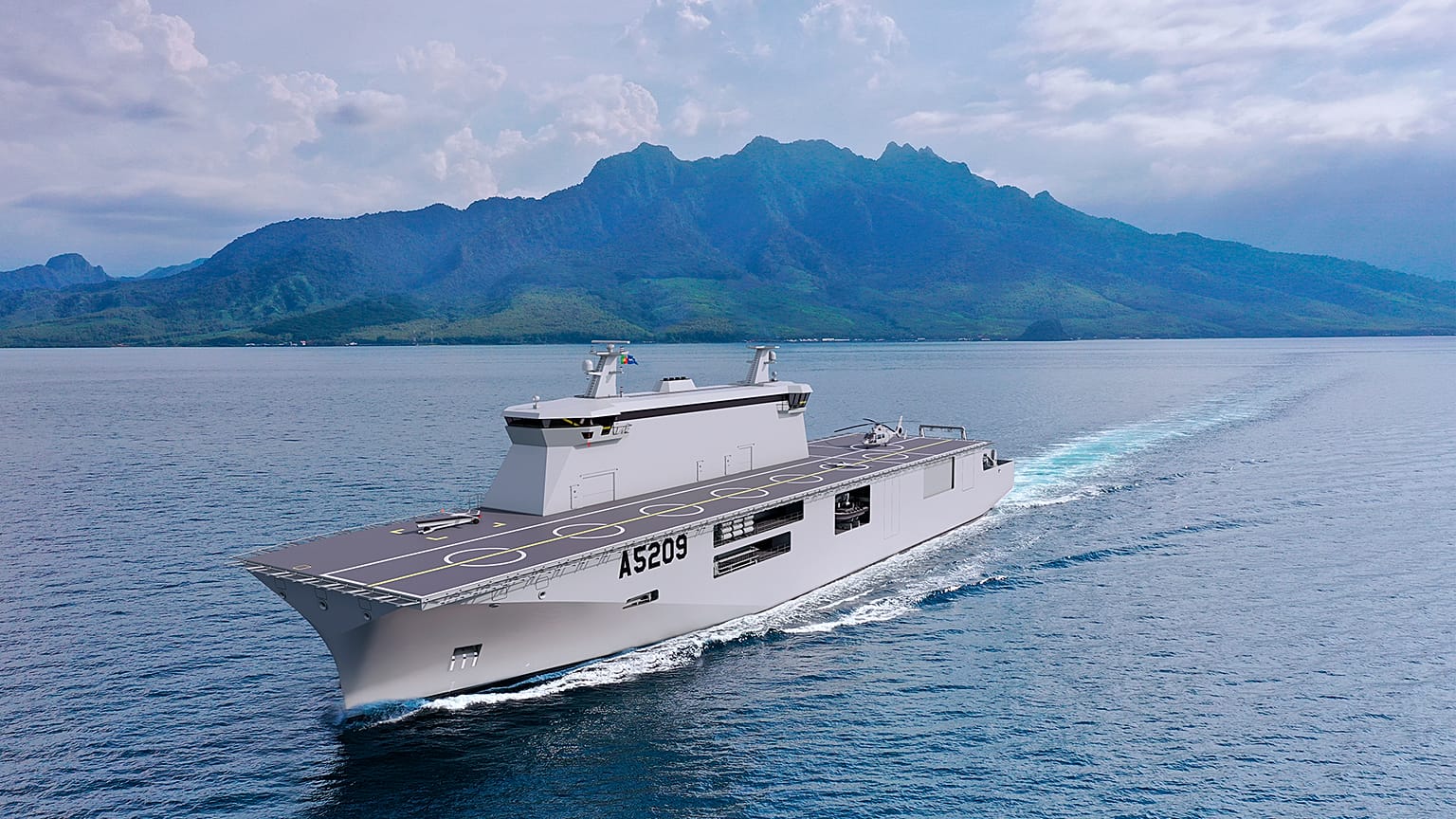













Portugal's new drone carrier, D João II, will challenge traditional aircraft carriers, offering high flexibility and lower costs. Built by Damen for €132 million, it can switch mission profiles within a week.
Portugal is building Europe's first dedicated drone carrier, a warship designed to operate unmanned aerial, surface and underwater systems that could challenge the dominance of traditional aircraft carriers.
 ADVERTISEMENT
ADVERTISEMENT
ADVERTISEMENT
The 107.6-metre NRPD João II is scheduled for delivery in the second half of this year.
Dutch company Damen is building the vessel in Romania's Galati at a total cost of €132 million, mostly funded by EU recovery funds.
The warship can switch between different mission profiles within a week by swapping out systems and equipment.
"This approach allows the ship to maintain high functional flexibility, switching between different mission profiles without significant structural compromises," Ricardo Sá Granja, spokesman for the Portuguese Navy, said.
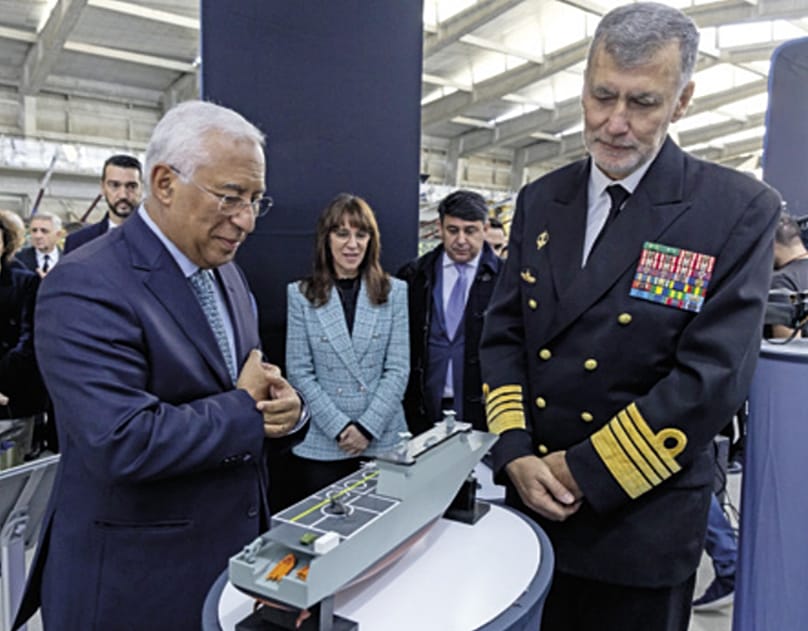
The project was conceived by Henrique Gouveia e Melo, former Chief of Staff of the Navy and candidate in this year's presidential elections.
At the contract signing in November 2023, Gouveia e Melo called it "a point of no return for modernity".
The Portuguese Navy did not patent the concept. The company that won the tender has already received expressions of interest from navies in other European countries.
Cost advantage over traditional carriers
Unmanned systems allow military forces of smaller countries to extend their operational reach at reduced costs.
A US Ford-class nuclear aircraft carrier costs around $13 billion, while Britain's Queen Elizabeth has a price tag of over $1 billion.
Drones allow forces to concentrate and project power more quickly with lower risks for operators.
At least three navies have already acquired or are developing flat-deck ships designed to carry autonomous aerial systems: China, Iran and Turkey.
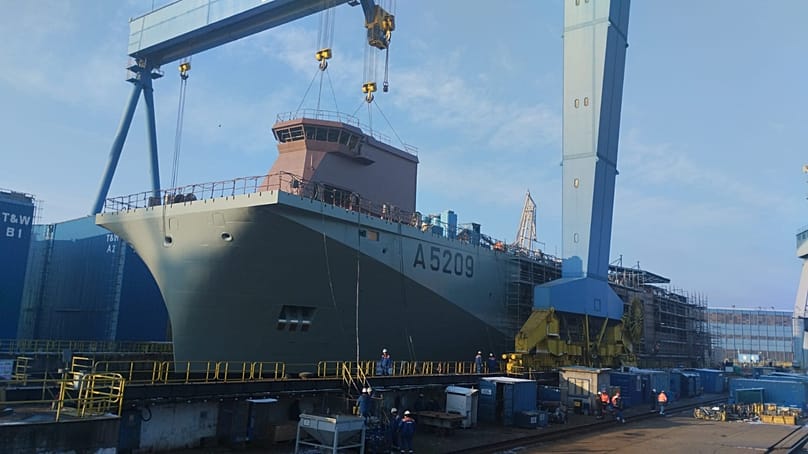
The D João II is designed to reach 15.5 knots and carry a crew of 48, with space for 42 specialists, including scientists and drone operators. In emergencies, it can temporarily accommodate a further 100 to 200 people.
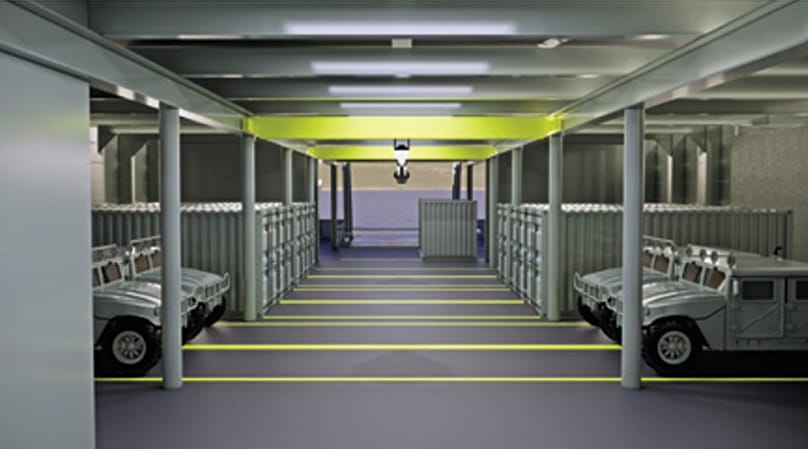
The 94-metre deck allows landing and launching of aerial drones. The ship has a hangar for assembling and maintaining vehicles, plus systems including a stern ramp for launching surface and underwater drones.
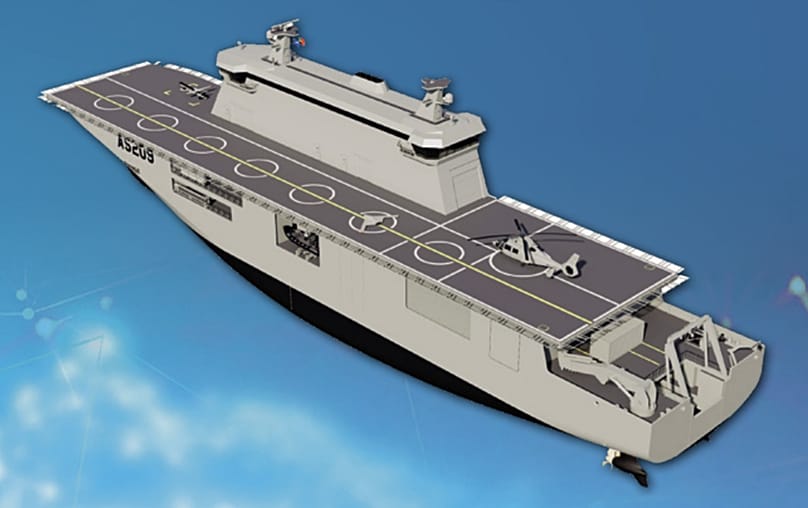
The vessel can accommodate 18 containers including hyperbaric chambers and hospital structures, 18 light vehicles and 10 boats. A remotely operated vehicle can reach depths of 6,000 metres.
The vessel was designed for 45 days of autonomy, allowing long operations without close logistical support.
From science to security
Mission profiles include collecting real-time data on Portuguese waters, environmental monitoring, search and rescue operations, disaster assistance, maritime surveillance and evacuating citizens from conflict zones.
The vessel can operate multiple unmanned vehicles simultaneously. Aerial and surface drones will be used for environmental monitoring, maritime surveillance and oceanographic data collection. Underwater vehicles will conduct inspection, detection and seabed mapping.
Unmanned systems on board will be nationally manufactured whenever possible. The Navy has established cooperation protocols with Portuguese companies producing such vehicles.
International partnerships are also planned. Last year, Portuguese Prime Minister Luís Montenegro signed an agreement with Ukraine for joint production of underwater drones during his first visit to Kyiv as head of government.
"Portugal and Ukraine have unmanned vehicle expertise that is at the forefront of the world today," Montenegro said.
Countering hybrid threats
Portugal's national maritime space covers around 4 million square kilometres, making it the EU's largest coastal state. With the third-largest Exclusive Economic Zone in Europe, 18 times larger than the mainland, Portugal faces increased obligations in the marine ecosystem.
Russia's naval activity in the Atlantic has increased in recent years. The navy tracked 143 Russian ships along the Portuguese coast between 2022 and 2024.
In 2025, at least eight were detected in waters under Portugal's jurisdiction, including submarines equipped with long-range missiles and spy ships capable of destroying submarine cables.
Data collected on board will help counter contemporary hybrid threats such as sabotage of submerged critical infrastructure or covert actions. The ship will be deployed at national level and within the EU framework.
Sá Granja acknowledged that command and control of dispersed unmanned vehicle fleets is a demanding technical challenge.
The Navy has been developing architectures based on redundant data links, robust encryption, network segmentation and the ability to operate in degraded or autonomous conditions.
At a conference in Washington this month, Rear Admiral Christopher Alexander of the US Navy estimated that by 2045 almost 45% of the US surface force will comprise unmanned systems.
The D João II was designed using architecture based on open systems principles, allowing integration of emerging technologies such as artificial intelligence.
These capabilities can be applied to processing large volumes of data, assisted navigation, sensor fusion and decision support, always with human supervision.
The vessel's modularity means it could, in the future, integrate new capabilities without compromising its primary function as a multi-purpose ship.