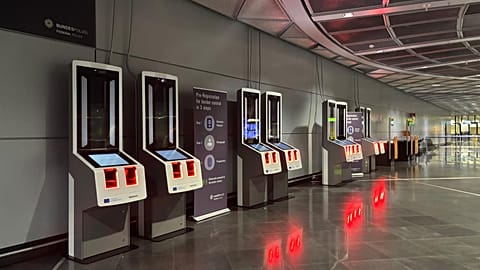













Security flaws at Humberto Delgado Airport already led to the EES rollout being suspended last month.
Lisbon airport is being reinforced with soldiers trained as border guards to reduce waiting times.
 ADVERTISEMENT
ADVERTISEMENT
ADVERTISEMENT
On Tuesday, 24 members of the National Republican Guard were stationed in the arrivals area at Humberto Delgado Airport, a measure approved by the government, the Lusa news agency reports. It is not yet known how long the GNR soldiers will remain on duty.
The airport had already been reinforced with 80 Public Security Police (PSP) officers over the Christmas and New Year period, due to the long queues of passengers waiting to enter the country.
The GNR guards have been trained in border control
According to Carlos Catanário, spokesman for the GNR, quoted by Lusa, the 24 soldiers will work in "flexible shifts", made up of teams of 10 and a supervisor, and will be in the arrivals area to check documentation.
The same source points out that the soldiers have certified training in border control and have received two days of administrative training from the PSP, the National Civil Aviation Authority and airport operator ANA.
In addition to reinforcing resources at the airport, the government also decided last month to suspend the new European Entry Exit System (EES) for non-EU citizens for three months, to avoid longer waits at the airport.
'Serious deficiencies' in border control
The European Commission carried out an unannounced assessment of Lisbon airport between 15 and 17 December and concluded that there are "serious deficiencies" in border security control. Their warning led the government to adopt urgent measures, including the suspension of the EES.
The European Commission team detected serious flaws related to the poor quality of first and second line border controls, according to newspaper Diário de Notícias. They also warned of long queues and excessive waiting times, which reportedly reached seven hours.
In addition, the experts who carried out the assessment mentioned that border controls were frequently being simplified without the EU Executive having been notified, leading to an "absence of exit controls at the Lisbon Airport border crossing point".
The lack of control at the airport had already been flagged by Portugal's largest police union, the Association of Police Professionals (ASPP), in a letter sent to the Ministry of Internal Administration (MAI) in November.
In mid-December, the Minister of Internal Affairs recognised in Parliament that the introduction of the new European border control system "went very badly", admitting planning failures, a lack of human resources and space limitations at Humberto Delgado Airport.
The scenario was repeated in other European Union (EU) countries following the gradual implementation of the new Entry/Exit System (EES), which began in October, with significant delays for passengers.