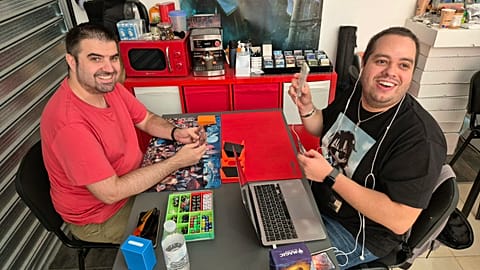
















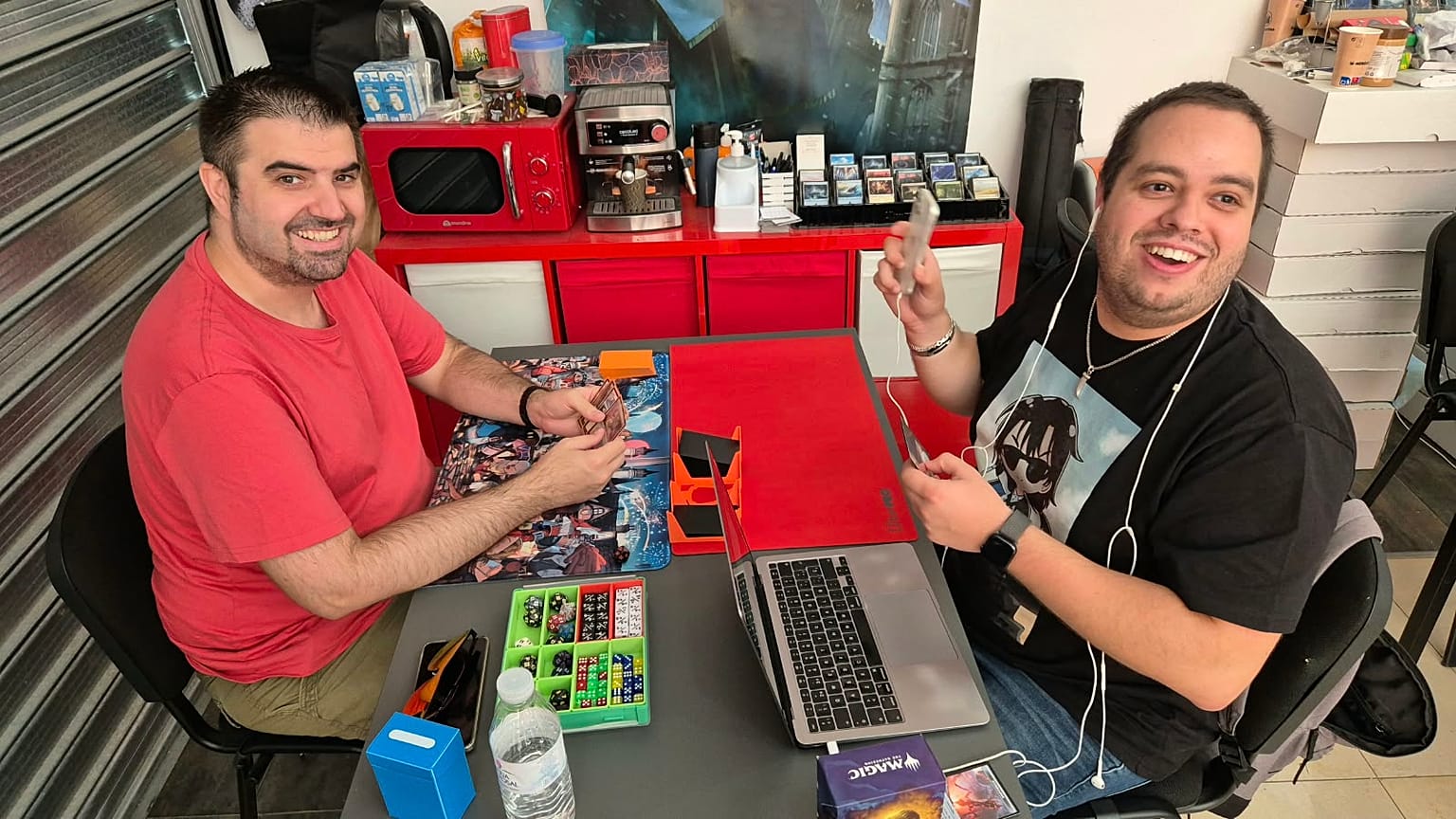













Gamers with visual or motor impairments devise their own ways to keep playing, while Microsoft, Sony and ONCE roll out adapted controllers, video games and board games.
When it is time to draw a card, Cristian M. Amores does not look at anything: he brings his iPhone up to an NFC tag stuck on the card sleeve and waits for VoiceOver to tell him what he has just drawn. He is blind and, since the end of 2020, has been adapting, card by card, the way he plays "Magic: The Gathering", the collectible card game created by mathematician and PhD Richard Garfield in 1993.
 ADVERTISEMENT
ADVERTISEMENT
ADVERTISEMENT
Amores shares the whole process under the name Magic Accesible on social network X, and his case is far from unique: from controllers reprogrammed button by button to board games with raised pieces, accessibility is gaining ground in the industry, although it is still a long way from being a design standard in everything from big-budget video games to after-dinner games.
The Magic deck you read with your phone camera
Amores' first attempt was braille. Using a Dymo-style labeller, he marked each card with a raised number to tell them apart and look up their information in a separate database. It did not work for several reasons: braille takes up space and makes the paper thicker, the deck became too bulky to shuffle easily and, in an official tournament, a marked card can be seen as a signal of one you do or do not want to draw, which automatically leaves you out of the competition.
For that reason he abandoned braille and considered using QR codes, a label that seemed doomed to extinction until the arrival of COVID-19. That QR code was his solution for a while, but it is no longer the one he uses: having to line up the camera without knowing for sure whether it was scanning the card properly made the whole process slower than playing without assistance, so he dropped it too. Now he uses NFC tags, which he only has to bring close to the phone for the screen reader to read out the full card, with no need to aim or wait. "Since then I've made a brutal leap as a player", he sums up.
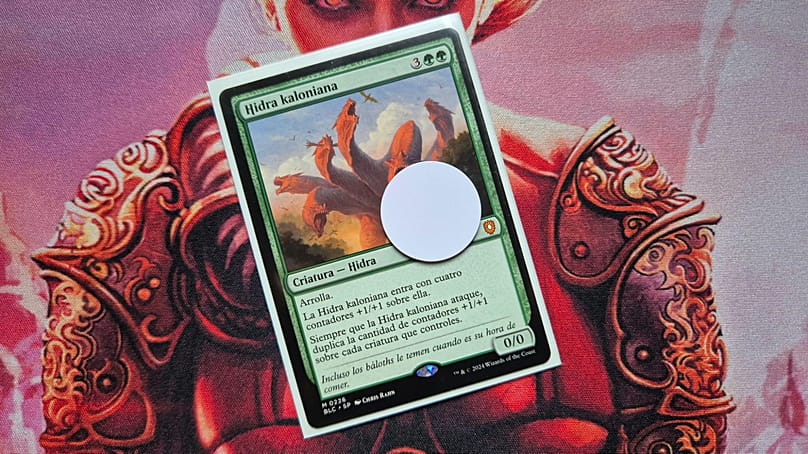
The project still needs outside help, someone to read any new card aloud to him before he adds it to the database, but it has allowed him to play in shops and at the National Modern Championship (another MTG format) held in Soria in December 2024, where he had his own stand explaining the system. In November 2022, the newspaper "El Mundo" published a feature on his story and, since then, he has been running a podcast with the same name as his social media account, Magic Accesible, in which he interviews other players and developers in the sector.
Amores has not yet played in tournaments with strict rules, only in more informal matches. In Soria, several judges came over to see how the system worked; one of them told him there would probably be no problem in using it in competition.
In another game, a different judge did check the rulebook and confirmed that tournaments ban electronic devices during play except where strictly necessary, an exception Amores believes could apply to him: until a card goes past his phone, he does not know what he has just drawn, and all his cards are marked in the same way. If he ever competes, he says, he will inform the organisers in advance, both because of the adaptations and because he usually needs a little more time per round than the rest.
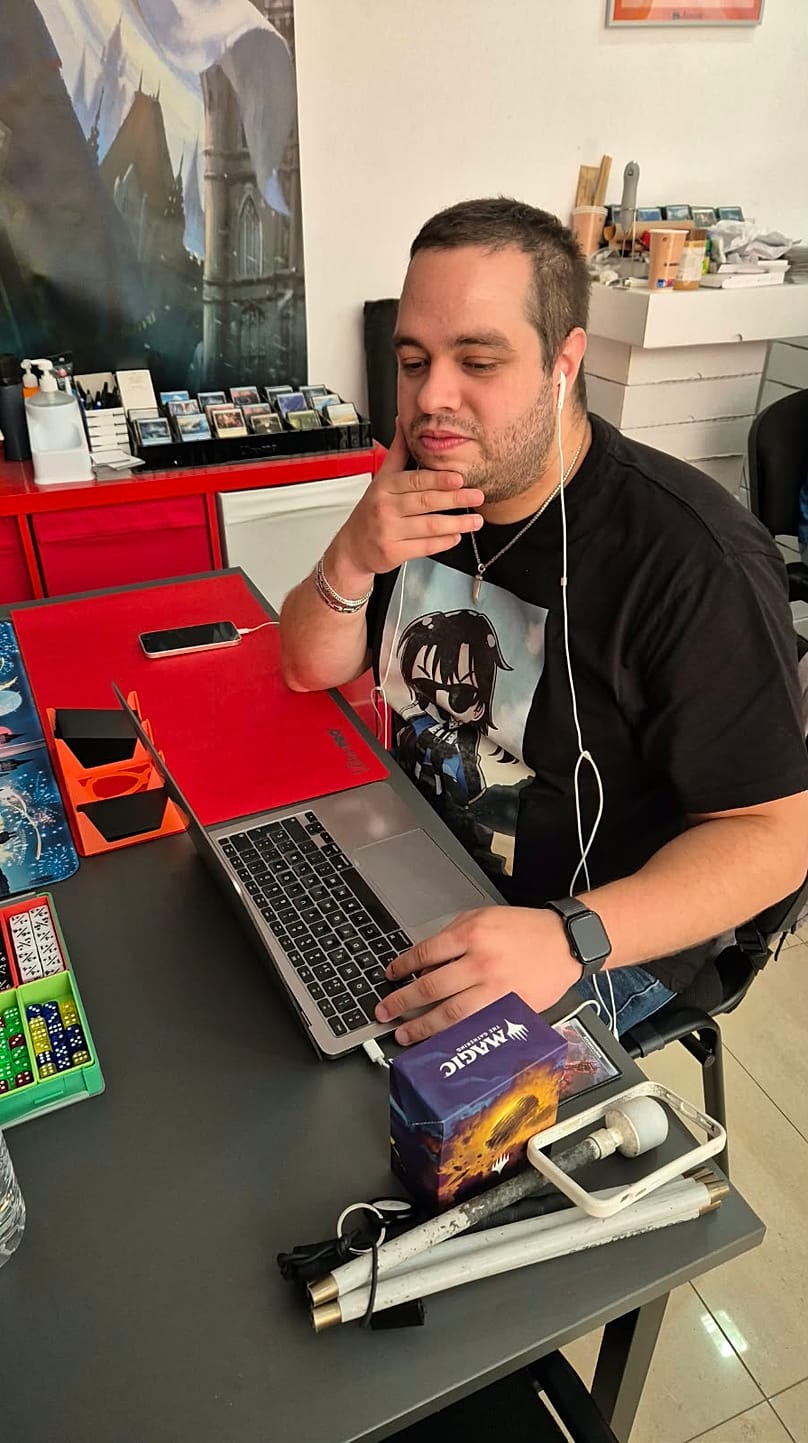
Asked what single thing he would ask of Wizards of the Coast, the company that publishes "Magic: The Gathering", he does not hesitate: an accessible version of Magic Arena, the official PC client for the game, which would instantly reach blind people everywhere. There is already a community-made mod that achieves this, although, like any unofficial solution, it depends on the company not blocking it or breaking it with an update.
"WotC, let the mod carry on existing", he says plainly, although he admits he himself has not tried it yet. On physical cards he is more sceptical: he imagines cards with a factory-printed QR code that would link to Gatherer, the company's official database, but doubts it would be worth Wizards' while at that scale. "Paper can take anything, but reality cannot", he concludes.
From braille to NFC: the Commander deck a group of friends adapted from scratch
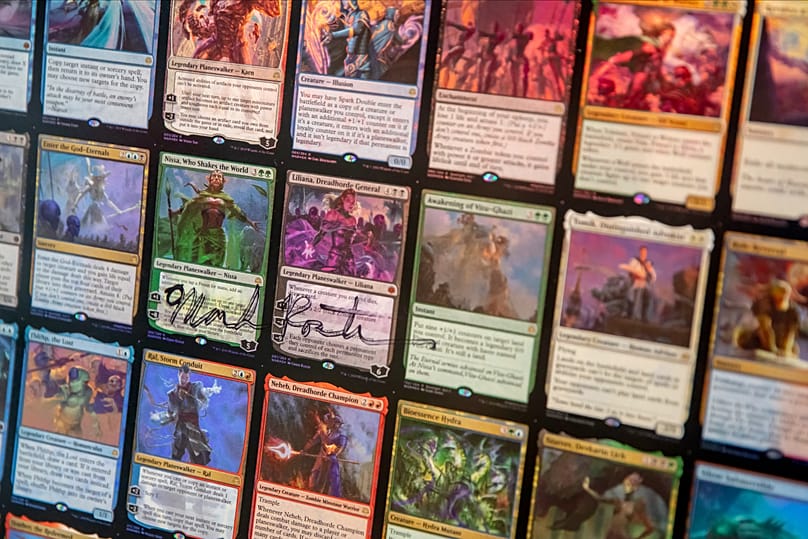
Amores is not the only one to have ended up using NFC tags along similar lines. On Reddit, under the name jerichodarkstar, a group of friends described how they adapted the Commander deck (a format within MtG) of one of them, who had a degenerative visual impairment from birth.
He started playing Commander in 2023, although by then he could only distinguish lands from non-lands by their shape; for everything else he needed someone sitting nearby to read aloud each card he drew. The problem was not only the dependence: as everyone at the table could hear what was in his hand, he played under what the group describe as a permanent telepathy effect that no one else had to deal with.
At Christmas 2025, tired of that disadvantage, they decided to change things. Their first attempt was braille: they embossed, on the outside of each sleeve, never on the card, the name, the mana cost, the type and the power and toughness of the creatures, placing each detail close to where it appears on the original.
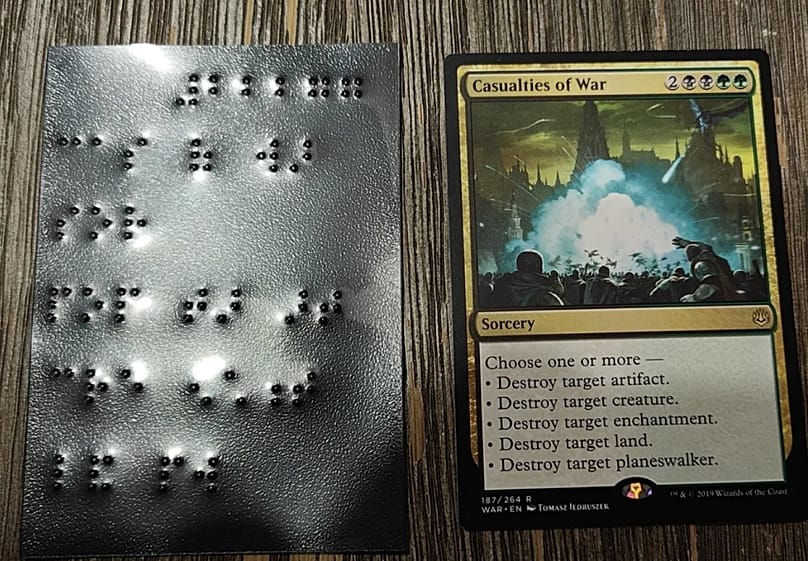
The effects were the real problem: the full text of a card will not fit on a single sleeve, so they invented their own system of abbreviations, combined with the contractions already used in braille; "if you read it literally, it sounds like it was written by a caveman", admits jerichodarkstar.
It took them between three and four days to braille the whole deck, but the system did not withstand actual play: after two months, the raised dots were already wearing down, each brailled sleeve ended up double or even four times its normal thickness, shuffling became a nightmare and the deck would not even stay upright in a single pile because of how uneven it was.
They stumbled on the alternative almost by chance. They posted an update on the problem on Reddit, but the post disappeared. The clue came from a comment on the original thread: a user, whom they name with his express permission, told them that the games shop where he played had a blind regular who used NFC tags.
The group started researching and, within days, they had ordered the tags and set up a new system: an NFC tag inside each sleeve, linked via the iPhone Shortcuts app to an individual note containing all the information for that card. When he brings his phone close, the screen reader reads it all through an earbud, without any need to abbreviate and without having to judge the framing.
The difference was drastic: what had taken three or four days with braille could now be done in about three hours per deck. They have been playing like this for almost a year, with four complete 100-card decks in play and two more under construction.
Gloria and Iria: advising publishers from inside and outside disability
In Spain, much of this work is also done by people outside large organisations. Proyecto Glirp (source in Spanish) is run by Gloria and Iria, who began in 2014 with a blog focused on visual impairment, versinlimitesaccesibilidad. Iria has a visual impairment; Gloria handles the technical side and the audiovisual part of the project.
Over the years, board games gradually took over from the rest of the content they published – technology, books, travel – until they became the pair's speciality: they advise publishers and give talks and workshops on cultural accessibility in fields such as tourism and education, and this year they have published their own book, "Jugar sin límites", centred on accessibility in games.
In that book they go over the most common mistakes in table-top design, and, as they explain, they are almost always the same: poor contrast between letters or icons and the background, and a font size which, whether for aesthetic reasons or lack of space, is usually too small.
For Gloria and Iria this is not just a question of sight: "The less effort you have to make to work out what an element says, the faster you will understand it", they explain, so it is also a question of how long it takes any player to grasp what they have in front of them.
As for whether any publisher stands out for solving these problems, they are cautious: they do not see any company that has consistently made these improvements part of its way of working, although they do acknowledge that those specialising in children's games tend to take more care over these details.
The barrier most likely to go unnoticed by people without visual impairment, they say, is not on the board but at the table. Visual impairment has many degrees, from total blindness to significant residual vision, and each player has their own needs; what almost never happens is that anyone asks what assistance they require.
"Many times, the lack of accessibility" in a game can be mitigated simply by speaking or describing what is happening, they point out, without touching a single physical component. A player might not have access to what is on the board, which cards are available or how others are progressing, and it may be enough for the rest of the table to narrate their moves aloud to solve that. They do admit, though, that there are games whose mechanics make even that impossible.
When a publisher approaches them, accessibility is rarely built in from the start. Gloria and Iria describe a sector that is moving forward but without any clear line of continuity: "With some games, more effort is put into making them inclusive and then the next one that comes out can be the complete opposite."
They work with some publishers and authors who consult them during the design process itself, but the more usual scenario is the reverse: they play a title that is already out and, in their review, point out what could be improved and how.
The stage at which they come in does change the outcome. It is not the same to design something inclusive from the outset as it is to add or alter components later on. "If you are just starting to design something" and you already have guidelines or recommendations to improve its accessibility, you avoid having to go back and redo the work to fix certain aspects.
Controllers redesigned piece by piece
Microsoft released its device on 4 September 2018 for 87 euros, developed together with organisations such as AbleGamers, SpecialEffect, the Cerebral Palsy Foundation and the Craig Hospital. Instead of a hand-shaped controller, it is a flat panel with two large buttons, a directional pad and 19 3.5 mm ports plus two USB ports to plug in the switches, joysticks or mounts that many players with reduced mobility already had, and then remap them using an app.
It can be used with a hand, a foot, the chin or the mouth; even the packaging was designed so it could be opened with a finger or with the teeth. In 2025, as part of the Ability Summit, Microsoft added the Xbox Adaptive Joystick, a one-handed controller costing 26 euros that works on its own or as a companion to the Adaptive Controller.
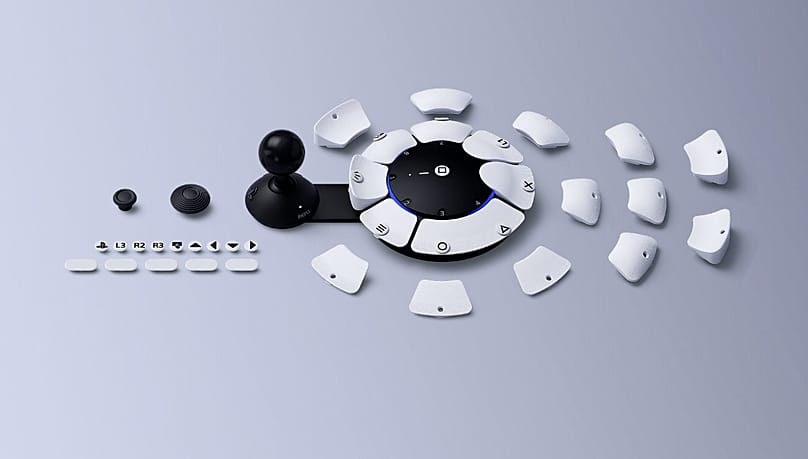
Sony unveiled its answer at CES 2023 under the name Project Leonardo and launched it as the Access Controller on 6 December that year, at 87 euros. It is round, can be used resting on a table or attached to a mount, and has eight buttons and a central joystick, all of which can be swapped for parts of different shapes and sizes depending on each player's strength and range of movement.
It allows up to 30 profiles to be created and two Access Controllers to be synchronised with each other, or one with a standard DualSense, so the inputs from more than one device can be combined. Its weak point, highlighted since launch, is that it does not replicate the touchpad or the motion sensors of the DualSense, which is a drawback in games that depend on them.
Accessibility in video games is no longer a niche
The figures explain why the big manufacturers keep investing in this area. According to the Entertainment Software Association's 2025 annual survey (source in Spanish), 21% of adult players in the United States say they have some form of disability, and nearly half regard it as very important for a game to include accessibility options when choosing what to play.
The World Health Organization (source in Spanish) estimates that more than 1 billion people worldwide, over one in six, have some form of disability (source in Spanish), and Microsoft cited in 2025 a figure of 429 million players with disabilities around the world when presenting its own Xbox tools.
That same year, the ESA, together with Electronic Arts, Google, Microsoft, Nintendo, Sony, Ubisoft and other companies, launched the Accessible Games Initiative (source in Spanish), a common, voluntary labelling system so that a game's shop listing can show at a glance whether it includes adjustable text, large subtitles, narrated menus or remappable controls.
Some titles are already cited as benchmarks: "The Last of Us Part II" added audio description to all its cinematics and an option that turns spoken dialogue into vibrations on the DualSense controller, so that a deaf or hard-of-hearing player can feel the rhythm and emphasis of a line as well as reading it in the subtitles. In Spain, the ONCE Foundation runs a parallel project focused on video games, Ga11y (source in Spanish), which catalogues accessible titles according to the type of disability they address.
When the challenge is telling pieces apart by touch
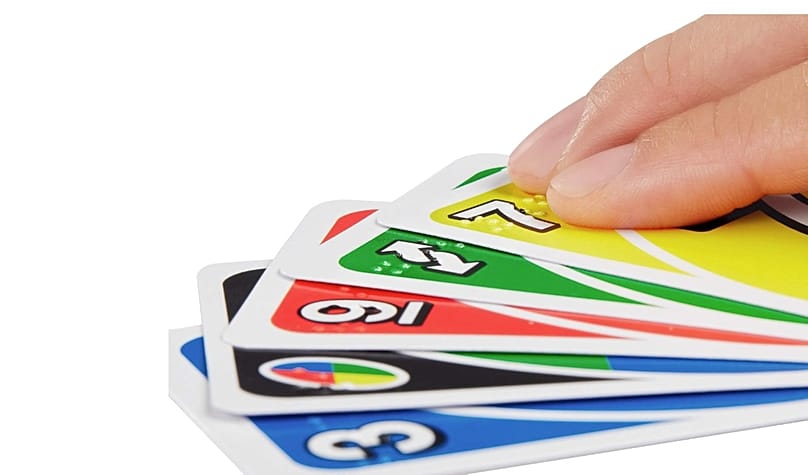
Beyond home-made fixes, manufacturers and organisations have for years been releasing board games that are accessible straight out of the box. In the United States, Mattel developed UNO Braille with the National Federation of the Blind (source in Spanish), with braille markings on every card and rules downloadable in braille or as an audio narration.
In Spain, ONCE, through its Bibliographic Service and its foundation, has adapted the puzzle "Katamino" with braille pieces and board, the game "Apalabrados" in partnership with Etermax, a domino set with raised tiles, an adapted "Scrabble" and a braille edition of the card game "Virus!", not counting the usual classics: chess and Ludo with raised boards, or Spanish-suited and poker decks labelled in braille.
The same challenge runs through all these adaptations: making the pieces distinguishable by touch, giving boards a tactile dimension and transferring the text on the cards – the hardest part, because it is purely visual – into braille, raised print or, increasingly, a QR code with spoken descriptions so that nobody has to miss out on the game.