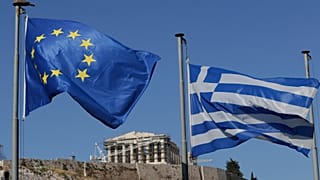













Greek 10-year yields have fallen below Italy's and France's as KBRA upgrades Athens and its debt ratio nears Italy's. Low household savings remain the weak spot.
In early 2012, Greece was the country nobody wanted to lend to.
 ADVERTISEMENT
As Athens prepared the largest sovereign debt restructuring in history, the yield on its 10-year bonds climbed above 35%. Italy, then seen as the next domino, had paid more than 7% at the peak of its own scare a few months earlier.
Fourteen years later, the order has been turned upside down.
On Wednesday, Greece's 10-year yield stood at 4.15%, below Italy's 4.37% and well below France's 4.73%.
Greek borrowing costs first dipped below Italy's in November 2019 and have stayed beneath them without a break since 20 April. They slipped under France's for the first time in January 2025, and have held there every day since 15 June.
"Its debt is largely fixed-rate, with very long maturities, and markets view the sovereign far more favourably than in the past, as you can see in bond spreads," Ken Egan, senior director and head of sovereign credit at KBRA, said in exclusive comments to Euronews.
On 20 November, KBRA, a US-based credit rating agency, upgraded Greece to BBB+ from BBB, two notches above the lowest investment-grade rating, with a stable outlook.
"Credit ratings should be forward looking, and not backward looking, and recognize when credit risks have receded," Joan Feldbaum-Vidra, senior managing director for sovereigns at KBRA, said.
The surplus that changed the story
Greece ran a primary surplus of 5.1% of GDP in 2025, meaning its revenues exceeded its spending by that margin before interest payments. According to KBRA, that is the strongest in Europe.
Tax collection has improved sharply.
The VAT compliance gap, the share of value added tax that should be paid but never reaches the state, narrowed from 24% in 2019 to around 9% in 2024, roughly in line with the EU average.
"It's a very different picture from the sovereign debt crisis years," Egan said.
The economy has followed. Real growth averaged 4.1% a year between 2021 and 2025, well above the euro area. Unemployment fell to 7.6% in September from 8.8% a year earlier.
Greek banks, once the weakest link, are healthier too: their share of bad loans fell from 6.9% in June 2024 to 3.4% in June this year.
Greece is closing in on Italy's debt
According to Eurostat, Greek public debt fell to 140.8% of GDP in the second quarter of 2026, from 152% a year earlier.
Over the same period, Italy's debt rose to 139.9% from 137.6%, while France's climbed to 119.1% from 115.4%.
A gap of more than 14 percentage points between Athens and Rome has shrunk to less than one. KBRA expects Greek debt to fall to around 129% by 2027.
Athens is also repaying its bailout-era loans well ahead of schedule, which Egan described as "one of the clearest signs of Greece's turnaround."
Greece's debt is easier to carry precisely because of its default. The bailout loans were restructured several times, with lower interest rates and longer repayment periods.
The average maturity of central government debt is 18 years, and 32 years for loans from the European Stability Mechanism, the euro area's rescue fund.
With most of that debt at fixed rates, refinancing is not KBRA's biggest concern in the near term, Egan said.
Athens stocks are pricing in the turnaround
Investors in Greek shares appear to have reached a similar conclusion.
The ATHEX Composite, the main index of the Athens Stock Exchange, has gained 15.8% since the start of the year, even after falling 2.8% on Wednesday.
That is far ahead of the Euro Stoxx 50, the benchmark of the euro area's largest companies, which is up 1.8%. Italy's FTSE MIB has gained 7.1% and Germany's DAX 0.9%, while France's CAC 40 is down 2.1%.
The contrast with France is telling.
Paris has spent much of the year dealing with political turmoil and a rising debt burden, and its stock market has gone nowhere.
In Greece, a state that runs surpluses and pays down its debt has lowered the risk investors attach to the whole country, from its government bonds to its banks.
What still stands between Greece and an A rating
Greece has made "remarkable progress" on its public finances, Egan said, but strong budget surpluses alone would not be enough to lift it into the A range.
KBRA would need to see debt fall further and the recent improvements sustained over time.
"The bigger challenge is the broader economy," he said.
Income and productivity levels still lag European peers, he added, while competitiveness and external vulnerabilities remain structural weaknesses that will take longer to address.
Prices are another concern. Greek inflation reached 5.7% in October, against 4.0% in the euro area, driven by energy costs linked to the conflict in the Middle East. The country relies heavily on imported fuels, and energy inflation hit 25.4% in September.
For now, Egan sees the inflation gap mainly as a domestic problem, squeezing household incomes and raising costs for businesses. He does not expect it to last long enough to undermine the country's competitiveness, and tourism demand, which accounts for around 13% of GDP, remains strong.
KBRA is, however, watching services inflation closely. It stood at 6.3% in October, almost double the euro area rate.
"The concern would be if higher services inflation became more entrenched, gradually eroding the country's relative affordability," Egan said.
Wage and price cuts after the crisis made Greece cheaper and more competitive. Losing that edge, he said, "would interfere with its still nascent diversification away from tourism."
A weakness that has moved
The biggest risk, according to KBRA, no longer sits with the state.
"The bigger vulnerability is Greece's exceptionally low level of household savings," Egan told Euronews.
Investment has picked up, with productive investment reaching a 30-year high as a share of GDP in 2025.
But Greeks are not saving enough to pay for it, so the gap is filled by money from abroad. KBRA expects the current account deficit, which measures how much more a country spends abroad than it earns, to reach 6.6% of GDP this year.
That reliance is manageable while investor confidence is strong, Egan said, but it leaves Greece exposed to external shocks, and Europe has faced "quite a few of those recently."
He was careful to draw a line with the past. The shortfall in savings now comes from the private sector, partly covered by foreign direct investment, rather than from the government, which he described as being "in sharp contrast" to the dynamics behind the debt crisis.
Building domestic savings will require stronger incomes and productivity, he said. "This takes time."
In 2012, investors feared the Greek state could not pay its bills.
In 2026, the state pays less to borrow than Italy or France, and the question has moved to whether Greek households can earn and save enough to keep it that way.