












Jensen Huang's return as Nvidia CEO made him about $34 billion (€31bn) richer and added roughly $950 billion (€871bn) to the chipmaker's value in a single day. US President Donald Trump, Nvidia's staff and stock markets from New York to Seoul gained too, while Europe got a smaller lift.
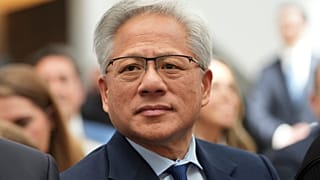
Nvidia's decision to reinstate Jensen Huang as CEO on Monday added about $34 billion (€31bn) to his fortune, according to Forbes' real-time billionaires list.
 ADVERTISEMENT
Nvidia's shares closed 31.5% higher, lifting the company's market value by about $950 billion (€871bn), the largest one-day gain for any company on record.
The rally also lifted US President Donald Trump's investments, the wealth of Nvidia's staff and share prices across the US and Asia, while Europe felt a smaller boost.
Trump, who had pushed for Huang's return, told CNBC on Monday that he had "convinced" Nvidia's board. "I made the deal," he boasted.
Nvidia's board received "input from senior levels of the United States government", according to a company statement.
Trump's accounts could have held between 32,000 and 370,000 Nvidia shares as of 30 September, according to a Financial Times analysis of his mandatory financial disclosures. The US president has added to his Nvidia position several times since returning to the White House.
Assuming no recent change in those holdings, the shares would have gained between $1.3 million (€1.2m) and $15 million (€14m) in value on Monday. The filings give only value ranges and do not yet cover October and November.
Trump's portfolio is run independently by third-party financial institutions, according to the White House.
A workforce of millionaires
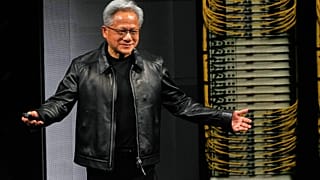
Employees greeted Huang with cheers, applause and chants of his name when he returned to Nvidia's headquarters in Santa Clara, California, on Monday.
"Thank you all for the second chance," he told them, in footage shared online.
Many have grown rich from the company's rise. In a 2024 poll on Blind, an anonymous forum for verified tech workers, 76% of Nvidia employees who took part said they were millionaires. More than four in ten put their net worth at $10 million (€9.2m) or more.
Share-based pay cost Nvidia $6.4 billion (€5.9bn) in the financial year to January, according to its annual report. Workers can also buy a limited amount of its stock at a discount of at least 15%.
Staff turnover among its roughly 42,000 employees was 3.7% that year, according to the same filing.
Individual holdings are not public, but many staff are likely to still hold much of their wealth in Nvidia shares, which Monday's jump made significantly more valuable.
That gives them reason to see Huang as the man who made them rich and should keep running the company. More than 10,000 people who claimed to work at Nvidia reportedly signed a petition calling for his return.
Stock markets ride the wave
On Wall Street, the tech-heavy Nasdaq Composite closed 6.5% higher on Monday and the S&P 500 gained 4.7%, their strongest sessions since April 2025.
The S&P 500 won back about $3 trillion (€2.7trn) in market value as the rally also spread to Asia on Tuesday.
Taiwan's Taiex closed 9% higher and South Korea's Kospi rose 6.3%, back above 5,000 points.
Japan's Nikkei 225, which was shut on Monday for a public holiday, gained 3.9%.
On the other hand, Europe's gains were considerably smaller. On Monday, the pan-European Stoxx 600 rose 1.8%, while Germany's DAX added 2.2% and the UK's FTSE 100 about 1.3%.
Chip stocks such as ASML jumped on Monday, but the main European indices were actually slightly down on Tuesday morning.
A key reason for the muted reaction is that Europe's markets hold far fewer tech companies. Technology accounts for 9.5% of the Stoxx 600, according to index provider Stoxx, while banks are its biggest sector at 16.2%.
Huang now faces three House committees behind closed doors on 1 December, then a public Senate Banking Committee hearing on 3 December, a date its chair, Senator Tim Scott, confirmed on Monday.