




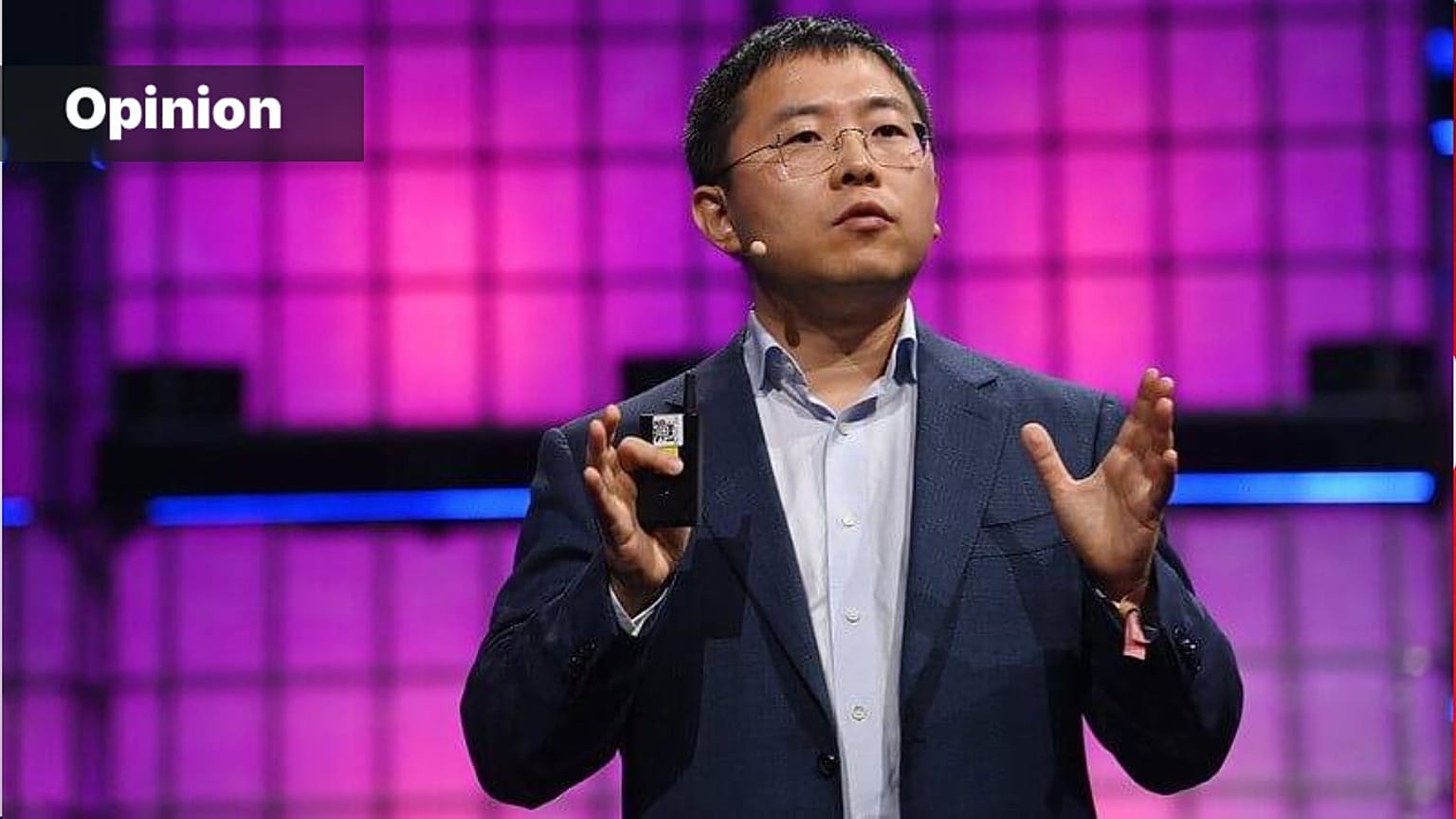













European small businesses have ambition and creativity, but lack time and budgets. As Kuo Zhang of Alibaba.com writes in an op-ed for Euronews, affordable, ready-to-use AI and global supply chain tools give even solo founders the capabilities of global companies, freeing them to focus on growth.
Harrison Nott, the teenage British founder, started with a simple problem he wanted to solve: cooling down after sport. Developing a towel was his answer. But turning that idea into a viable business meant navigating a maze of operational grind: finding suitable materials, vetting manufacturers, and negotiating with suppliers who could deliver at the right price and quantity.
 ADVERTISEMENT
Those hurdles did not disappear once he had a first product to sell. Expanding his business meant returning to square one: more searches, more comparisons, and more back-and-forth negotiations. The admin was necessary, but it competed directly for the time and focus he needed to innovate and grow.
AI must be genuinely affordable for smaller teams
Harrison’s dilemma goes to the heart of Europe’s small business challenge and explains why the conversation around artificial intelligence needs a reset. If AI is going to empower Europe’s small and medium-sized enterprises (SMEs), it cannot remain locked behind enterprise price tags—it must be genuinely affordable for smaller teams. A cheap tool means little if it requires weeks of technical setup, and a powerful model is useless if small businesses cannot afford to run it.
A platform can bridge this gap by making end-to-end commercial AI truly affordable for SMEs, giving founders ready-to-use tools that handle real business tasks without breaking the bank.
An adoption gap will quickly become a competitiveness gap
Right now, a stark adoption gap threatens to hold European entrepreneurs back. Eurostat figures show that just 17% of EU enterprises with 10 to 49 employees use AI, compared with 55% of large corporations with 250 or more staff, and that excludes micro-businesses of fewer than 10 people entirely.
We see a similar picture in the UK, where research by Alibaba.com and Small Business Britain found that while 68% of small businesses want to learn what agentic AI can do for of them, only 5% currently use it regularly.
In a European economy where SMEs represent the backbone of employment and innovation, if AI's productivity gains remain locked inside large enterprises with dedicated IT departments, an adoption gap will quickly become a competitiveness gap.
Why small businesses need more than a chatbot
When the European Commission surveyed SMEs on the adopting AI and automated systems, business owners pointed to investment costs, lack of internal expertise and operational uncertainty. In a large corporation, configuring software and double-checking AI outputs can be spread across teams. In a small firm, that burden barriers falls on the founder, competing directly with serving customers and developing products.
That is why generic, conversational AI is no cure-all for SMEs. Small businesses do not need another blank prompt box that requires them to become systems designers. They need agentic AI, systems designed to autonomously execute multi-step workflows, built directly around everyday commercial realities.
Crucially, however, an AI agent is only as effective as the commercial infrastructure behind it. Simplicity requires substance. When a European SME sources a product, a factory's unit price is only part of the picture. To be genuinely useful, an AI system must be plugged into a live global supply chain: able to analyse market trends, vet verified manufacturers, factor in shipping assumptions and European customs duties, and flag compliance requirements.
Moving from a basic chatbot to an AI agent embedded in real trade infrastructure is the difference between an AI that merely writes a sourcing email and an AI that delivers a vetted shortlist of suppliers ready for sign-off.
Delegating the grind, keeping the control
Handing over complex workflows does not mean surrendering control – vital for a small business that cannot afford an expensive mistake. The right agentic AI model reduces daily supervision while preserving human authority where it counts.
In procurement, for instance, researching the market and bargaining over unit prices is not the same as authorizing a financial commitment. Business owners should be able to set the guardrails for supplier outreach and negotiation, see transparently what their AI agent has done, and step in exclusively when it is time to approve orders, payments, and contracts.
For Harrison, that combination of accessible AI and global trade infrastructure changed the trajectory of his company. Using our agentic AI platform for small businesses, integrated with a global supply chain, he handed over the routine procurement grind. He gave the agent a practical brief: find cooling-towel suppliers, compare prices and minimum order quantities, approach the ten most competitive candidates, and negotiate based on potential bulk volumes.
Leveling the global playfield
Genuine progress in the field of AI should be measured by how affordable it is for small businesses and how much work it saves founders in their day-to-day operations. Reliable AI for SMEs should be affordable and capable of handling complex tasks – such as sorting through cluttered emails, detecting payment fraud and booking shipping routes.
European small businesses are full of ambition and creativity, but they lack time and large budgets. Affordable, ready-to-use AI, combined with global supply chain tools, does more than just reduce software costs. It gives a solo founder working from home the operational capabilities of a global company and gives Europe’s small businesses the freedom to focus on their growth.
Kuo Zhang is in charge of the global B2B platform Alibaba.com, which includes, amongst other things, the AI platform Accio. Accio is an AI-powered B2B platform and an autonomous team of agents for product sourcing, market research and e-commerce automation.