












In 2005, a programming bug unleashed a plague in World of Warcraft that epidemiologists used to study people's behaviour during an outbreak, a case that returned to prominence with COVID-19.
Return to classic Azeroth. That was the promise with which Blizzard launched 'World of Warcraft Forever' worldwide on 4 November. For some, it meant going back to an earlier time, using nostalgia as a selling point, but for others that period is linked to a pandemic.
 ADVERTISEMENT
In September 2005, a programming bug turned the spell Corrupted Blood, designed for a single boss fight in a dungeon, into a contagious disease that spread through the game’s virtual cities. The error ended up killing thousands of characters and, two years later, made the cover of 'The Lancet Infectious Diseases'.
Epidemiologists experienced in Azeroth something that could not have been replicated in any other way. Health professionals’ models can calculate perfectly how a pathogen passes from one person to another, but not human behaviour or what people do when they know they might get infected. And without anyone planning it, millions of players were showing it live.
How Corrupted Blood spread
It all began on 13 September with patch 1.6 and the opening of the Zul'Gurub raid for 20 players. Its final boss, Hakkar, cast Corrupted Blood, an effect that drained health every few seconds and spread to anyone nearby. Inside the raid it was just another obstacle that could be handled but was not meant to escape. Outside it simply was not supposed to exist.
But it escaped through the pets of two classes. Both hunters and warlocks could dismiss their pets while they were infected, then resummon them in a capital city, where the effect reactivated intact. From a player’s point of view it was a nuisance, but for an epidemiologist it was a textbook zoonosis, a pathogen jumping from animals to humans and back again, with pets as a reservoir.
Non-player characters controlled by the game itself (the so-called NPCs), such as guards and vendors, caught the disease but did not fall ill, so they were immortal and asymptomatic. They were carriers with no symptoms, placed in the busiest spots. Ironforge’s Typhoid Mary was a guard.
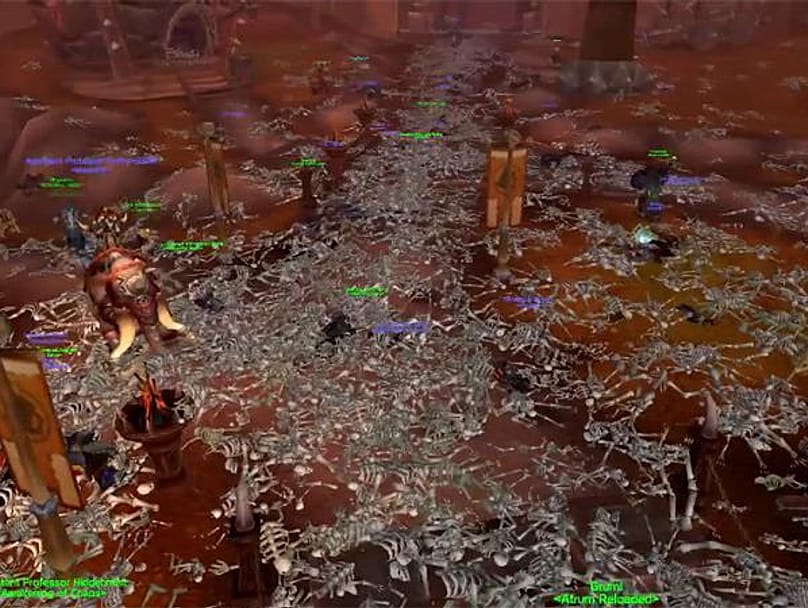
Transport was the missing piece and the game made it easy. Every person could move from one city to another instantly, and many did so while infected. Eric Lofgren and Nina Fefferman, authors of the 'The Lancet' study, compared that leap to the plague that travelled with Mongol battalions or to 19th century cholera. In the capital cities, which were packed, contagion depended on the density of people, as in any real city. They calculated that in those hubs the reproduction rate reached 100 infections per hour, a figure they themselves considered impossible for a real pathogen.
For a high-level character (with real pathogens this would be a middle-aged person without underlying conditions), the disease was little more than a cold. For a low-level one (people with illnesses, older people...) it meant dying in a couple of seconds. As in so many epidemics, the most vulnerable suffered the worst.
'World of Warcraft' had more than four million subscribers at the time. On 16 September, Blizzard acknowledged on its forums that it was aware of the problem and tried what any health authority would have done, erecting quarantine barriers around the most affected areas.
It did not work. The disease was too contagious, it was impossible to truly seal off part of the map and the players were not willing to cooperate. In the end the company resorted to something no Ministry of Health has at its disposal and restarted the world. After several full server resets and a patch that made pets immune, the outbreak was declared eradicated on 8 October.
What Corrupted Blood taught epidemiology
According to the most repeated version, the Centers for Disease Control and Prevention (CDC) in the United States even asked Blizzard for data on the outbreak, convinced it was a deliberate simulation. There was nothing to give them. It had been an error and no one had logged how it spread.
The studies arrived in 2007. In March, Israeli epidemiologist Ran Balicer from Ben-Gurion University of the Negev pointed out in the journal 'Epidemiology (source in Spanish)' the parallels with avian flu, in which birds such as ducks carry the virus without falling ill.
He also found links with SARS, which between 2002 and 2004 jumped from country to country on board aircraft. In September, Lofgren, then a student at Tufts University who had lived through the outbreak with his own character, signed, together with his supervisor Fefferman, the cover article in 'The Lancet Infectious Diseases'.
These studies started from a known limitation. Computer models make it possible to experiment with virtual populations, but they do not predict what each individual will do, and releasing a real pathogen just to observe it is unthinkable. In 'World of Warcraft', by contrast, players were very attached to characters in which they had invested hundreds of hours. Their economic and social behaviour was quite similar to what they showed off-screen.

The proposal went beyond that one case. They called for outbreaks designed on purpose, with known parameters integrated into the game without breaking it. The servers would record what share of infections came through each route, and the experiment would be repeated with different player populations to check the results. Consent could be obtained through licence agreements, although they admitted that privacy and anonymity would still be an issue. They also acknowledged the most obvious limit: in a game, death can be fixed with a bit of patience.
Human behaviour in a pandemic, Azeroth-style
What was seen in those weeks now sounds very familiar. Many players fled the cities or stopped logging in. Healers went to the outbreak zones as first responders.
According to the authors, they probably reduced mortality, but they also prolonged the epidemic by keeping infected people alive. The ability to resurrect encouraged players to take more risks, something known in public health as risk compensation (people become more cautious at higher risk levels and the opposite).
Some people went to have a look and came away infected, a profile any journalist will find uncomfortably familiar. Others got infected on purpose and ran to the busiest places. This last group even attracted the interest of US terrorism researchers, who saw in this behaviour a way to refine their models of how attackers make decisions.
There was no shortage of sceptics. Several researchers doubted that what someone does with a dwarf on a screen resembles what they would do in the street, especially when dying only means running back as a ghost to your own corpse.
From Azeroth to Covid-19
In March 2020, with half the planet in lockdown, the study of Corrupted Blood returned to the spotlight. Lofgren, now at Washington State University, and Fefferman, at the University of Tennessee in Knoxville, found themselves explaining it again, this time against the backdrop of a real outbreak. The parallels were plain to see.
Asymptomatic carriers stopped being an Azeroth oddity and became one of the major headaches of Covid-19. Healthcare workers acted as overwhelmed first responders. The old objection that in real life nobody infects others on purpose could be answered with workplace presenteeism, the habit of going to work when ill so as not to let the team down, which is done without bad intentions but has similar effects.
The coincidence had a touch of dark humour. Zul'Gurub arrived in 'WoW Classic', the official re-release of the original game, in April 2020, in the middle of lockdown. There was no plague, because Classic runs on code written after the pet issue had been fixed.
That same month, Elysium, an unofficial server that keeps the original 'WoW' alive, did what Blizzard had never done. Without warning, it launched Pandemic in Azeroth, a deliberate epidemic that began with an infected item and a patient zero. The virus cut character stats by 5% and reduced movement speed by 10%.
According to figures published by its administrators, the infection reached 88% of players while there were no preventive measures. It fell to 42.2% when handwashing and distancing, among other steps, were introduced. It was not a scientific study, but it came quite close to the controlled outbreak Lofgren and Fefferman had asked for.
Outside Azeroth, the idea has mainly found its way into classrooms. Whyville, a virtual world for children aged 8 to 16, suffers an annual outbreak of Whypox, an invented pox disease that changes avatars’ appearance and makes conversation harder. Researcher Yasmin Kafai spent years studying how users reacted, and in 2021 her team designed Spikey-20, a virtual epidemic to teach young people to seek information and protect themselves.
'Operation Outbreak' was born in 2015, in the middle of the Ebola epidemic in West Africa. It was driven by a professor in Florida, Todd Brown, and by Pardis Sabeti’s lab at the Broad Institute of MIT and Harvard. An app transmits a fictional pathogen via Bluetooth between nearby phones and students have to contain it. In 2020 it was presented as a tool to reopen schools more safely, and it automatically logs data that almost never get collected in real outbreaks.
The best-known case is 'Plague Inc.', a game in which the aim is to wipe out humanity with a pathogen. In 2013, the CDC invited its creator, James Vaughan, to give a talk. In January 2020, downloads soared in China and at the end of February the authorities removed it from the country’s app store. In November that year, his studio released 'Plague Inc: The Cure', a mode in which the goal is to stop the pandemic. It was developed with the WHO and made free until Covid-19 was under control.

The plagues that came afterwards
Blizzard did not forget the episode. In October 2008, before releasing 'Wrath of the Lich King', it programmed its own epidemic. Crates in Booty Bay infected players and turned them into zombies if no one healed them in time. The event was cut short in less than a week, after complaints from those who simply wanted to go to the bank.
Accidental leaks have not disappeared either. In July this year, Withering Contagion, a contagious dungeon effect from Dragonflight, appeared in the middle of Stormwind on the US server Moon Guard, until Blizzard fixed it with a patch.
Now, since the launch of 'WoW Forever' two weeks ago, the veterans of 2005 are keeping a wary eye on hunters’ pets, just in case.