

















Good morning. Angela Skujins on newsletter duties for most of this week. On today’s docket: A Europe-shaped hole continues to complicate Ukraine-Russia peace talks, Brussels looks for dialogue to communicate with Damascus, and a song over Kosovo triggers trauma.
From Abu Dhabi to Dublin to Brussels: Today, foreign affairs ministers will descend on Brussels for a ministerial meeting focused on continued support for Ukraine as well as Europe’s relationship with the Middle East. But much of the formal agenda items are expected to be overshadowed by the shuttle diplomacy that occurred last week between two diametrically different cities, Abu Dhabi to Dublin.
 ADVERTISEMENT
Just in: Swedish Minister for Foreign Affairs, Maria Malmer Stenergard, has told Europe Today that she has just flown into the Belgian capital after speaking with her Ukrainian counterpart, Andrii Sybiha, in Abu Dhabi. The peace talks have demonstrated to her that Moscow isn't serious about ending the invasion. "Russia is not interested in peace," she said. "We need to focus on what really matters," she added, which is filling the 2027 budgetary hole, restarting debate on mobilising Russia's frozen assets, and more.
"I hope that the Commission is working on a proposal that would mean that we would move the assets out of Belgium and thereby share the risk, which is which is absolutely fair to do to to Belgium. And then I hope if we have a concrete proposal that the EU member states would be ready for a new discussion on this," she said. Watch.
Back to the envoy debate: Representatives from the US, Ukraine and Russia met in the United Arab Emirates’ capital on 10-11 November for talks aimed at bringing an end to the full-scale invasion, but as my colleagues Sasha Vakulina and Toby Gregory reported last week, there were no breakthroughs other than a prisoner swap agreement.
Europeans, meanwhile, have spent months scrambling to secure a seat at the table and ensure the continent's interests are represented in any ceasefire negotiations. But the biggest challenge has been deciding who should fill that seat.
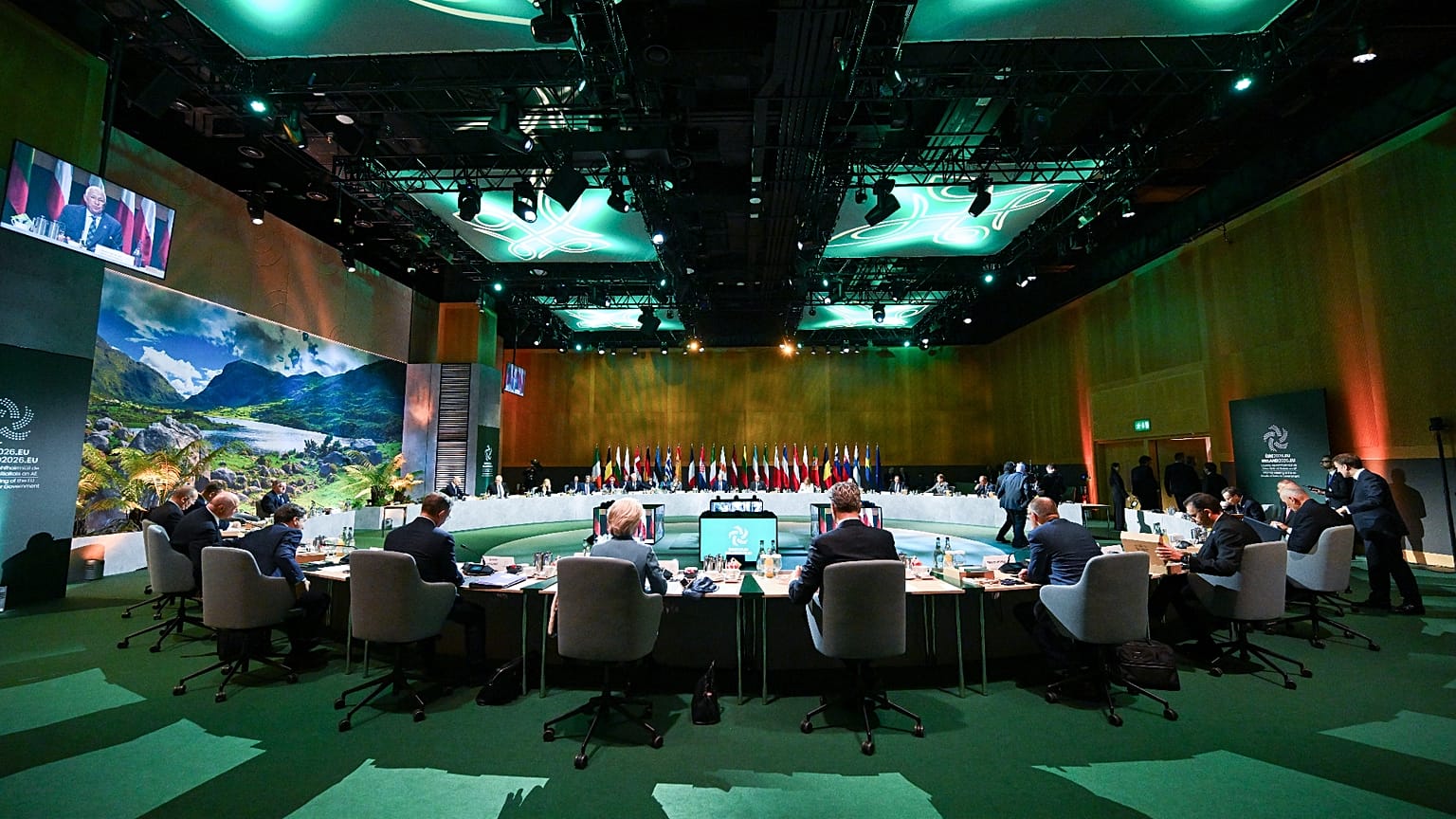
Ukrainian President Volodymyr Zelenskyy had given his allies a tentative 19 November deadline — coinciding with a Berlin meeting of the Coalition of the Willing — to determine how Europe should be represented. Following Friday’s informal European Council summit in Dublin, leaders agreed that Europe would be represented by a team comprising seven members: France, Germany, the UK, Italy, Poland, the EU institutions and NATO.
It’s a trap: Latvian Prime Minister Andris Kulbergs told my colleague Shona Murray after Friday’s meeting that the debate surrounding a potential envoy appeared to distract from the bigger issue: Russia's continued full-scale invasion of Ukraine. Europe, he suggested, was falling for a trap set by Russian President Vladimir Putin, who, Andris said, wanted to divert attention from the war. “He wants us to talk about things which are not important.”
“We should discuss supporting Ukraine, finding ways to ensure they can survive the winter and how the peace talks can be of their benefit. We are the ones for the future as Europe, guaranteeing its security.”
Substance over style: Questions have been swirling in Brussels over what Europeans actually want to achieve if they are brought into the negotiations. As one ambassador said, “It's really important that we focus on the message and not on the person who represents Europe.”
For Estonian Foreign Minister Margus Tsahkna, the meeting comes at a critical moment. An alleged sabotage attempt targeting Estonian defence company Threod Systems, which Estonian authorities say was orchestrated by Russia’s GRU military intelligence service, has prompted plans to close the country's road border crossings with Russia from 1 December. The incident underscores why Europe must continue supporting Ukraine, both on the battlefield and in negotiations.
“Nearly five years on, Putin is still making the demands he made in 2021, seeking to dictate Europe’s security arrangements. We cannot allow him to gain through peace negotiations what he has failed to achieve on the battlefield,” the foreign minister wrote in a statement posted on X.
Also on the docket: In relation to the Middle East, one diplomatic source said they expect France’s declaration that Iran has been behind the cyber attacks targeting European fridges to come up in the conversation. Also, how European engagement can be stepped up in Syria to support the political transition since the fall of Bashar al-Assad's 14-years of government rule.
Enlargement, anyone? The European Commission’s EU Enlargement Forum kicks off officially today after a buzzy evening hosting Balkan bands. The busy line-up includes leading figures from the EU institutions as well as heads of government from candidate countries like Ukraine, Albania, Montenegro and Moldova.
The big question mark relates to Serbia’s Student List, who will make its Brussels debut in a public appearance in what many EU officials hope might lead to an improvement of relations with Belgrade.
Struck a chord: But the event wasn’t totally smooth sailing, with Agron Bajrami, Kosovo’s Ambassador to Belgium, writing online that the opening concert featured a “Serbian nationalist song” titled ‘Oh, Kosovo, Kosovo’.
“The song advances explicit political claims over the territory of the Republic of Kosovo,” the ambassador said, stating that Pristina now expects an “immediate clarification” from the Commission and the EU enlargement boss, Marta Kos, as to how the setlist was approved.
Forward looking: the European Commission is expected to present its proposal for a new support loan for Ukraine on Wednesday, Jorge Liboreiro has heard. The loan will be worth €45 billion, covering two-thirds of the country’s €70 billion shortfall for next year. The EU budget will provide the guarantee and be used to pay the annual interest. The Russian assets won’t be part of the scheme.
The Commission has designed a proposal underpinned by all 27 member states. But at least four countries — Slovakia, Hungary, the Czech Republic and Bulgaria — want to opt out of the common borrowing. Slovak Prime Minister Robert Fico seized on the peace talks to dig his heels in. “I say a clear no to war, weapons and war loans and a yes to peace,” he said over the weekend.
And there’s more: the Commission will begin on Tuesday its consultations (or “confessionals”) with member states to fine tune the 22nd package of sanctions against Russia. Banking, crypto, the shadow fleet and circumvention will be in focus. Brussels wants the package adopted with ease and without vetoes, so don’t hold high hopes for any big-bang elements.
Takeaways from a controversy: What lessons can Europeans on this side of the Atlantic learn about the Nvidia scandal? The US-based chip manufacturer was one of the world’s most valuable companies but lost roughly $1.8 trillion (€1.6 trillion) of its market value due to extramarital affairs of its CEO, Jensen Huang, with a woman who is a suspected Chinese spy in addition to an employee of the company.
Dutch MEP Bart Groothuis told me late last week that if the Nvidia scandal should teach Europeans anything, it is not to be surprised by China’s alleged espionage activities. “They do it often,” he said. “The intelligence community in China is very, very aggressive.”
Before entering the European Parliament, Bart worked in the Dutch intelligence community, working as a cyber expert at the Ministry of Defence. From that experience, he learned that “anything” China wants, it will “try to get”.
Are Europe’s critical businesses and industries vulnerable to the same kind of attention? Bart doesn't think so, arguing that major enterprises understand their geopolitical importance and go beyond standard practices to protect their intellectual property. “They're not more vulnerable,” he said, adding, “they are less vulnerable”.
For Clotilde Bômont, Senior Policy Analyst for Cyber and Digital Technologies at the EU Institute for Security Studies, the episode should serve as a warning to Europe about the risks of having “all the eggs in one basket”. She said the scandal exposed just how dependent AI infrastructure has become on Nvidia chips.
The culture matters: Could a European tech company be brought to its knees by an alleged extramarital affair? Clotilde doesn’t think so. “The value of family and fidelity are really high on the moral compass,” she said of the situation in the US. “We have had so many political scandals over Europe, with politicians being unfaithful, and it didn’t affect, that much, their political careers.”
Five EU countries to announce first-ever return hub for migrants in Rwanda
The agreement between Kigali’s government and five EU member states — Denmark, Austria, Germany, the Netherlands and Greece — is set to be announced on Monday in Vienna after months of negotiations, two people familiar with the matter told my colleague Vincenzo Genovese.
Their interior and migration ministers of the respective nations are attending a conference in the Austrian capital, where they will be joined by Rwanda’s Interior Minister Vincent Biruta.
A few metres from the venue, Austrian Chancellor Christian Stocker and Danish Prime Minister Mette Frederiksen will hold a press conference in the afternoon to announce the deal, Vincenzo hears of the unofficially confirmed news.
According to the sources, the first hub would be a “pilot project”, set to host a few hundred people deported from the five EU countries, starting in spring or summer 2027.
It would consist of open facilities housing migrants, who would receive a residence permit and be free to move around the country, with the aim of integrating them into local society and the labour market.
In principle, return hubs are temporary accommodation for migrants awaiting deportation to their countries of origin. However, there is no time limit on stays, and those involved could end up stranded in Rwanda and never be sent home.
However, Rwanda's return hub may face legal challenges over its compatibility with EU law and the protection of human rights.
The law enabling EU states to set up return hubs outside the bloc establishes that only non-EU countries — where international human rights standards and principles in accordance with international law are respected — are eligible. According to the UN, Rwanda has a questionable track record when it comes to upholding human rights, too.
More from our newsrooms
Australia and Philippines sign new defence pact amid South China Sea tensions. The Philippines is building closer military ties with Australia, Japan and the US, as tensions with China continue in the South China Sea, with the partnership spanning joint exercises and closer coordination between their forces. More info here.
Dutch government holds weekend crisis talks to stave off collapse. Prime Minister Rob Jetten has struggled to rein in political infighting within his minority coalition, a crisis that culminated when disagreements arose over a so-called "millionaire's tax" proposed by left-wing opposition parties. Emma De Ruiter has the latest.
Canada ready to turn to Chinese carmakers if US trade talks fail to protect auto sector, PM Carney says. The Canadian prime minister’s remarks come days before a planned meeting with Chinese President Xi Jinping in Shenzhen, where auto manufacturing is expected to be on the agenda. Jeremiah Fisayo-Bambi has the details.
We’re also keeping an eye on
- Foreign Affairs Council kicks off at 7:30am CET with foreign affairs ministers arriving. Press conference scheduled for 4:30 pm CET.
- European Commissioner for Defence Andrius Kubilius delivers the keynote speech at the DIGITAL SME summit — Breaking Europe’s Digital Frontiers.
- The EU Enlargement Forum starts at 10 am CET in Brussels, with opening remarks by the European Commissioner for Enlargement Marta Kos, European Commission President Ursula von der Leyen, and Finnish President Alexander Stubb. A slate of high-level guests will be in attendance.
- The Ukraine Mine Action Conference 2026 starts Monday with an opening address by a range of dignitaries, such as EU foreign policy chief Kaja Kallas, Irish Minister for Foreign Affairs and Trade Helen McEntee, German Minister of Foreign Affairs Johann Wadephul, and more.
That’s it for today. Luca Bertuzzi, Jorge Liboreiro and Vincenzo Genovese contributed to this newsletter.