















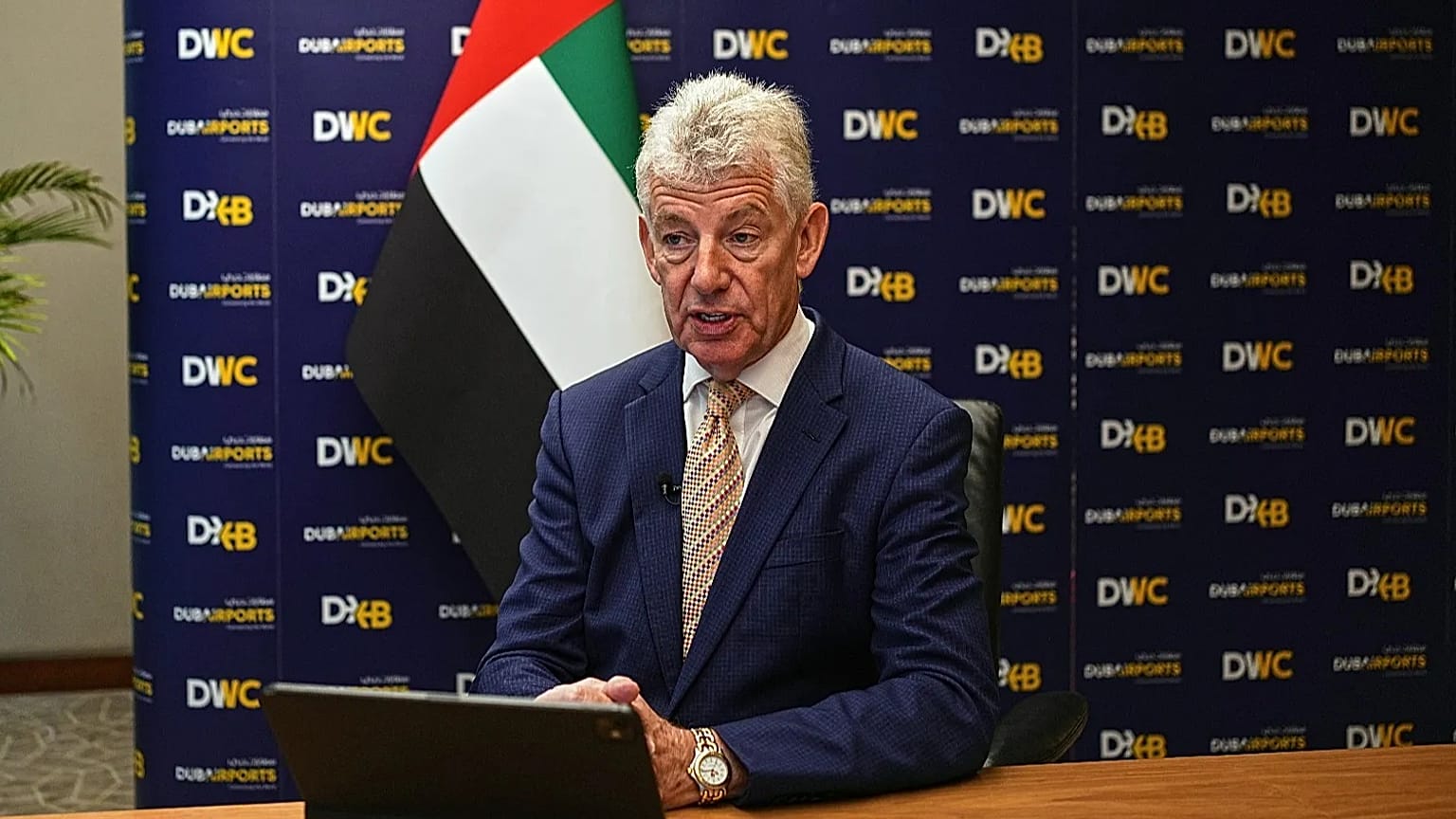













Speaking on the sidelines of the WTTC Global Summit in Malta, Dubai Airports chief Paul Griffiths shared that he believes the expansion of regional airports will be key in the next decade of travel.
The CEO of Dubai Airports has said that aircraft technology improvements, with smaller planes able to fly longer distances, will “change the shape of travel”.
 ADVERTISEMENT
ADVERTISEMENT
ADVERTISEMENT
Talking at a roundtable on the sidelines of the World Travel & Tourism Council’s Global Summit in Malta, Paul Griffiths spoke about the expansion of Al Maktoum International Airport (DWC), noting that there are plans to have direct connections from Dubai to more than 600 cities.
“The great thing, of course, is aircraft technology is changing all the time, and with smaller aircraft able to fly longer distances we'll have all of those secondary cities in Europe directly connected to Dubai, so you'll be able to fly from, you know, Exeter or Valencia or Lyon or Marseille or Baden Baden, to Dubai and then on to the world, so it's going to change the shape of travel,” he said.
Dubai Airports announced plans to turn DWC into the world’s largest airport back in 2024. Once complete, the airport will have 400 terminal gates and five runways, with capacity for up to 260 million passengers annually.
The airport expansion should be completed by 2032.
“I think over the next decade or so there will be a fantastic opportunity for regional airports to expand their operations,” Griffiths added.
“With narrow body jets now capable of flying the Atlantic to minor destinations, where you don't need a wide body jet to fill to make it commercially sustainable, there'll be huge opportunities for regional airports.
“All they have to do is get their surface transport access sorted out and that will be a good place to invest and it will be great for regional economies.”
How aviation can reach net zero
Of course, you can’t talk about expansion without mentioning sustainability.
Griffiths highlighted sustainable aviation fuel (SAF) as being “probably the only way” for the industry to eliminate carbon emissions, pointing to Singapore, which has introduced a green fuel tax, as a destination to emulate.
He noted that the private sector must be persuaded to invest in SAF’s production, while governments must mandate its use, slowly increasing the required percentage of SAF blended with conventional fuel.
“My message is please balance the community impact by mitigating it through taking environmental control seriously, but setting a target and a framework to allow the expansion of the infrastructure to facilitate this increase in income from travel and tourism,” he added.
The future of airports
Griffiths said in a panel on digital identity and resetting the border experience that he believes the need for passports could be eliminated within the next five years, but he expanded on his comments in the roundtable.
Discussing the new airport, he said: “I can't comment on the technology that you see, because hopefully if you don't see any technology, then we will have done our job incredibly well.
“The idea is to make all of the process and the entire customer experience all about human contact.”
Facial recognition will be at the heart of the new experience, with no need to show your passport at the border or to present your boarding pass. AI will also be used to scan baggage.
“We can do it so much more quickly and less obtrusively,” he said. “I always think that airport security – and particularly in some airports which I won't name and shame – is probably the most intrusive process that any human being could go through outside of a hospital operating theatre, and we don't really want to do that to our customers.”