















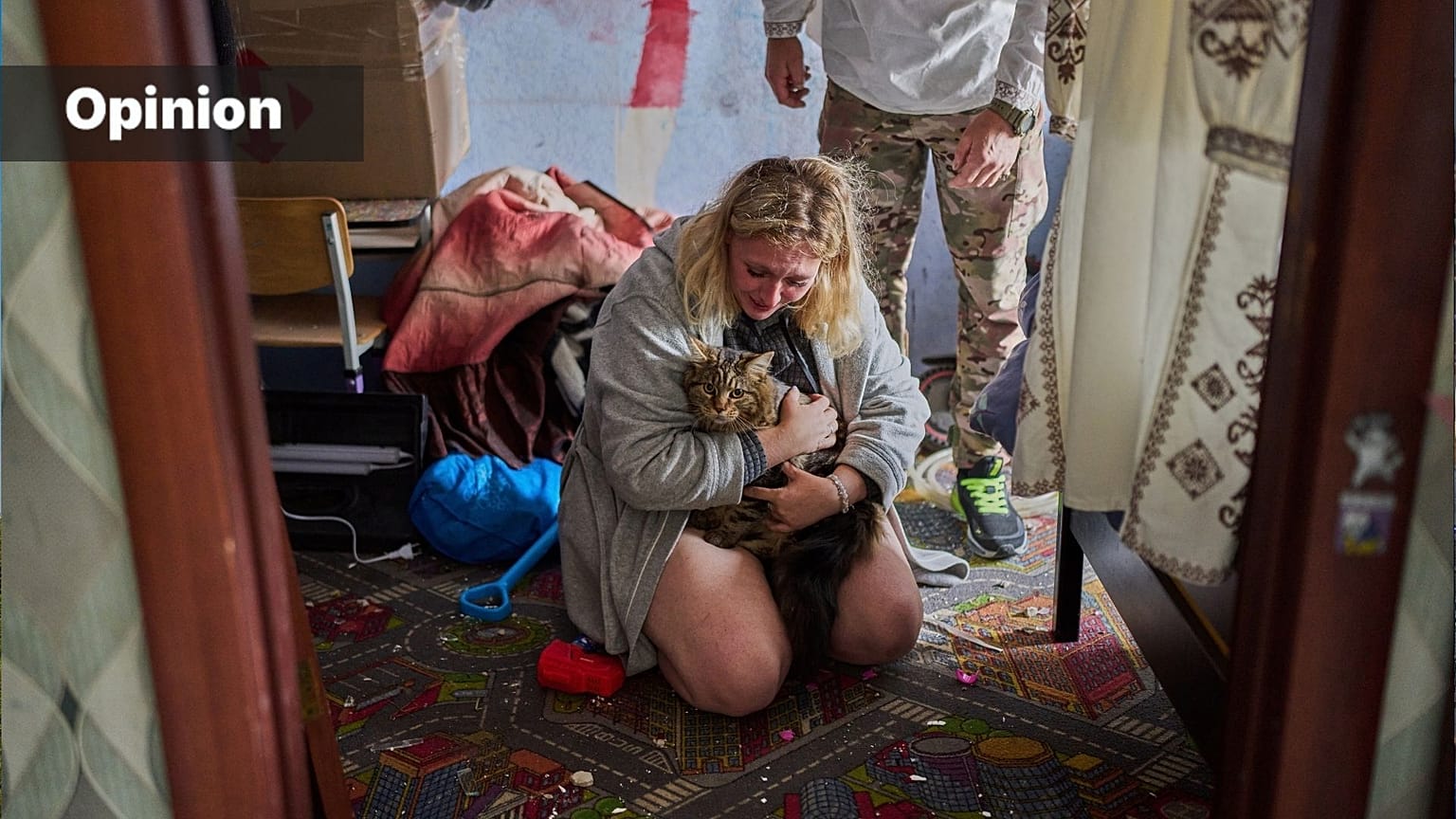













"Our task, therefore, is not simply to survive another winter. It is to keep Ukraine's frontline cities alive," writes Ihor Terekhov, Mayor of Kharkiv in an opinion piece for Euronews.
Ukraine is preparing for a fifth difficult winter under hostile fire. But for the cities and communities closest to the front, the greatest danger is not simply losing electricity or heat. It is the continued loss of people, businesses and economic life — the foundations without which there can be no meaningful recovery.
 ADVERTISEMENT
ADVERTISEMENT
ADVERTISEMENT
As chair of Ukraine’s Association of Frontline Cities and Communities of Ukraine, representing more than 300 communities in the direct midst of the conflict, I see three interconnected challenges that will determine not only how we get through this winter, but what kind of country emerges from this war: energy security, economic resilience and poverty.
The first challenge is infrastructure security
In Kharkiv, we know what it means to lose power and heat after a Russian attack. For some, it can mean the difference between life and death so an effective response by local authorities is critical.
That is why we are no longer simply repairing what has been damaged. We are changing the architecture of our energy system, decentralising generation and building reserve capacity so that one strike cannot leave a large part of the city without essential services.
We have had to rethink education in the same way. When an ordinary school can become a target, safe learning has to move underground. Kharkiv began with classrooms in metro stations and then built underground schools.
These are solutions born of necessity. Over the past four years, Ukrainian cities have accumulated practical experience in protecting critical infrastructure, decentralising essential systems and maintaining public services under sustained attack.
I hope no other European city will ever have to acquire such experience in the way we have. But this knowledge now exists, and Ukraine is ready to share it.
The second challenge is economic resilience
A city cannot survive on repaired buildings and infrastructure alone. It needs businesses, jobs and people who see a reason to stay.
For frontline communities, this is becoming an existential issue. An entrepreneur in Kharkiv or another city under regular attack operates with risks that businesses elsewhere in Europe do not face. Investors see the war risk. Banks see it. Insurers see it.
The result is a paradox: the places that need private capital most are precisely those where capital is hardest to attract.
We need to change that — not by creating economies permanently dependent on aid, but by creating conditions in which businesses can operate and invest despite the risk. Guarantees, war-risk insurance, affordable finance and support for small and medium-sized enterprises should be part of Europe's approach to Ukraine's recovery.
The third challenge is poverty
War does not only destroy buildings. It gradually exhausts families. According to the World Bank's latest estimate, 41.6% of Ukraine's population lived below the national poverty line in 2025.
Behind that number are very painful, personal decisions: whether to buy medicine or pay the rent; whether to remain in your hometown; whether to look for work elsewhere in Ukraine or leave the country altogether.
For frontline regions, prolonged economic hardship therefore carries another danger: depopulation.
A building can be rebuilt. A substation can be replaced. A road can be repaired. It is much harder to restore life to a city once its people have left, businesses have closed and young people no longer see their future there.
This is why I do not believe Ukraine's recovery begins when the war ends. In frontline communities, it has already begun.
If we want people to return tomorrow, schools, hospitals and businesses must function today. If we want investment after the war, we need to preserve our workforce, our businesses and our human capital now.
Europe's support is indispensable to this effort
The European Union has already done an extraordinary amount for Ukraine. For a mayor, that support is not measured only in figures on a spreadsheet. A generator means a hospital can keep working. A transformer means homes have electricity again. Decentralised heating means an entire neighbourhood does not go cold after the next strike.
We are grateful to the European Union for the €920 million package under its 2026–2027 Winter Energy Plan to help stabilise Ukraine's energy system and strengthen its resilience.
But we must look beyond this winter
Not every part of Ukraine faces the same conditions. Proximity to the front affects whether families stay, whether companies continue operating and whether banks, insurers and investors are prepared to take risks.
Future European support for Ukraine should recognise that frontline territories face a distinct combination of security, demographic and investment pressures — and design recovery instruments accordingly.
Supporting these territories is not simply about rebuilding what Russia has destroyed. It is about ensuring that viable communities, functioning economies and people with a future are still there when the war ends.
This matters even more because Ukraine is moving towards membership of the European Union.
European integration is often discussed in the language of negotiating clusters, legislation and the acquis. For most Ukrainians, however, Europe will ultimately be experienced locally — in the quality of public services, transport and energy infrastructure, and in how public money is managed.
That is why transparency, accountability and zero tolerance for corruption must be built into recovery from the start. Not simply because Brussels expects it, but because the trust of our citizens, partners and investors is one of the most valuable resources Ukraine has.
Our cities should not be passive recipients of European assistance. They should be active participants in European integration — and accept the responsibility that comes with it.
Another difficult winter lies ahead. Russia will again try to damage our energy system, weaken our economy and make life in Ukrainian cities increasingly difficult. Indeed their aim is to make it unbearable. For frontline communities, these are not separate problems.
Without energy, businesses stop. Without jobs, poverty grows. Without prospects, people leave.
And once a city loses its people, rebuilding its vital community becomes far harder than rebuilding any structure.
Our task, therefore, is not simply to survive another winter. It is to keep Ukraine's frontline cities alive — with people who stay, businesses that work, institutions they can trust, and a future inside Europe.