































Global concern after an incident at a Russian plague lab is making headlines. German plague experts tell Euronews what lessons the "Black Death" holds today.
After a 28-year-old laboratory assistant working at the Irkutsk Anti-Plague Research Institute in Siberia died from a "lung infection of unknown origin", many questions remain unanswered. Most recently, even US President Donald Trump sounded the alarm.
 ADVERTISEMENT
ADVERTISEMENT
ADVERTISEMENT
But how dangerous is the situation really? And how can plague research help to put the current case into perspective?
Where and when was the Black Death worst in Germany?
During the lockdowns, many people compared the coronavirus with the plague epidemics of past centuries. At the plague column in Vienna, people laid flowers during the Covid-19 crisis.
Yet, as archaeogeneticist Johannes Krause from the Max Planck Institute for Evolutionary Anthropology in Leipzig explains to Euronews, the plague in Central Europe is far older than is often assumed. "The plague bacterium Yersinia pestis can be identified via DNA from skeletons dating back to the Neolithic and Bronze Age, including in southern Germany – for example in the Augsburg region."
Krause says: "The best-known outbreak is the Black Death between 1346 and 1353. It reached the territory of the Holy Roman Empire from 1348 onwards via Italy and France. According to tradition, Mühldorf am Inn was the first German-speaking town to be affected, on 29 June 1348. The port cities of Lübeck and Hamburg followed in the summer of 1350, probably via sea routes."
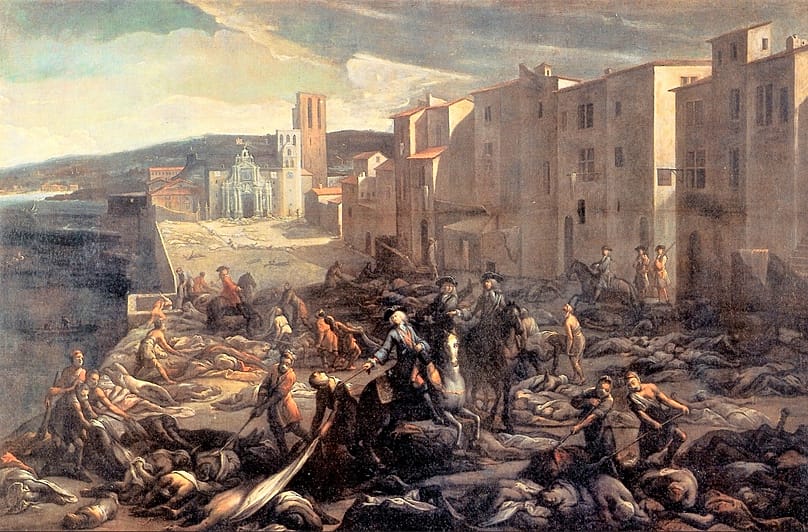
Exactly where the plague epidemic raged most fiercely is unclear. "It is not really possible to name a single 'worst' city; the sources are patchy," says Johannes Krause. "Chronicles, for example, report around 12,000 deaths in Erfurt in 1350, and Vienna is thought to have lost around a third of its inhabitants. Overall, probably between a third and a half of the population died, with considerable regional variation."
Pathogens spread along travel routes
"The spread of the plague was also rooted in long-distance trade links," explains Martin Bauch from the Leibniz Institute for the History and Culture of Eastern Europe (GWZO), "in a sense it was a side-effect of early 'globalisation'."
Looking at the history of the plague, Johannes Krause notes "that pathogens spread along human trade and travel routes – then via the Silk Road and the Black Sea, today by aeroplane."
While the plague case in Russia has not been confirmed, even if there was spread of the bacteria, because of the sanctions imposed in response to Russian President Vladimir Putin's full-scale war of aggression in Ukraine, travellers from Europe are currently a rare sight in Siberia.
The plague also teaches us that many pandemics originate in animals and that pathogens change through mutation and adaptation, as Krause explains. "The plague illustrates this impressively, because we can trace its development over thousands of years in DNA." And the history of the plague shows that early, determined measures are effective. "Quarantine was invented as a response to the plague."
"Epidemics change societies"
Another lesson from the history of the Black Death, according to Johannes Krause, is "that epidemics change societies, up to and including the persecution of minorities. The pogroms against Jewish women and men in 1348 and 1349 are a sobering warning."
Martin Bauch agrees: "What we can see very clearly is society's search for scapegoats: in the context of the Black Death there were pogroms against the Jewish population, and even with coronavirus there were deep social tensions."
And finally, as Johannes Krause points out, "the plague has not disappeared: it survives in rodent populations and repeatedly causes outbreaks, but today it can be treated very effectively with antibiotics and therefore does not pose a threat to humanity."
Possible plague mass grave discovered near Erfurt
At the beginning of the year, an interdisciplinary research team from Leipzig, which includes Martin Bauch, discovered what may be a plague mass grave near Erfurt.
Commenting on the find, he said: "For the first time we may be able to understand the reasons for the high mortality during the 'Black Death': did it make a major difference that people at the time were repeatedly exposed to periods of malnutrition, also because of climatic fluctuations and cooling processes? We can ultimately see this in the bones, but also in the records examined by historical research."
According to chronicles, during the 1350 plague outbreak, around 12,000 dead were buried in eleven large pits outside the city of Erfurt. Using sediment cores, the researchers reconstructed the medieval landscape and identified an area of around 10 metres by 15 metres by 3.5 metres containing fragments of human bone. According to the researchers, analyses date the human remains found to the 14th century.
On the discovery, Johannes Krause said: "Particularly interesting is the fact that the grave was deliberately searched for and found. Experts point out that there are fewer than ten securely dated mass graves of the Black Death in Europe. However, whether this is really a plague grave can only be shown by an excavation with DNA analysis. Alternative explanations, such as famines or other disasters, cannot yet be ruled out. If the suspicion is confirmed, the material would make it possible to compare the plague genomes from this region with those from other parts of Europe."