




























Drones have changed the face of war in Ukraine. At the Tallinn Defence EXPO, Estonian companies showed the counter-drone systems and battlefield robots they say Europe now needs.
Unmanned systems are both a growing threat and an increasingly vital part of the defence arsenal.
 ADVERTISEMENT
ADVERTISEMENT
ADVERTISEMENT
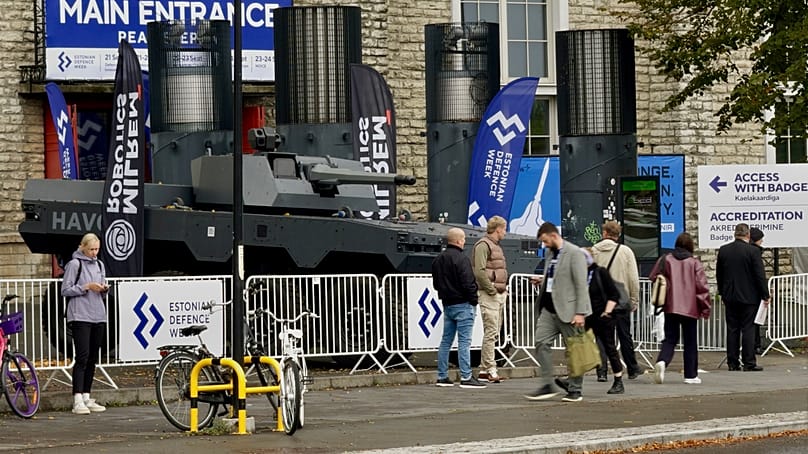
That theme ran through the Tallinn Defence EXPO, where more than 100 companies showed their latest products.
The stakes are high for Estonia, which borders Russia. According to an industry briefing, its defence spending rose from 1.9% of GDP in 2013 to an average of 5.4% through 2029.
The EXPO was one of six events in Estonian Defence Week, held in Tallinn over five days in late September.
The week drew around 4,500 visitors from 56 countries and featured 133 speakers across 68 sessions, including a NATO innovation conference and a Baltic defence conference.
Seeing and stopping drones
Estonian firm Marduk Technologies presented a detection system that uses powerful optics and AI to find and identify flying objects.
"It's a camera-based drone detection system. It's fully passive, and with this we can see whatever is flying. We can differentiate automatically whether it is a bird, drone, helicopter or any flying object," Leet Rauno Lember, CEO of Marduk Technologies, told Euronews Next.
"Passive" means this optical system sends out no radio signal, remaining hard to spot — unlike radars.
Lember said their optical detection system is not "better" than other technologies but complements them.
Acoustic sensors reach only a few hundred metres, he explained, while electric drones can be very quiet. Radar covers long distances but may miss drones made of lightweight foam.
"All of the layers are complementing each other, and end users are able to make better decisions," he said.
Marduk Technologies has been developing the drone-detection devices for more than a decade.
The war in Ukraine confirmed the company's early warnings, Lember said. "Back in 2016, everybody said that drones will not be a problem, at least in the near future."
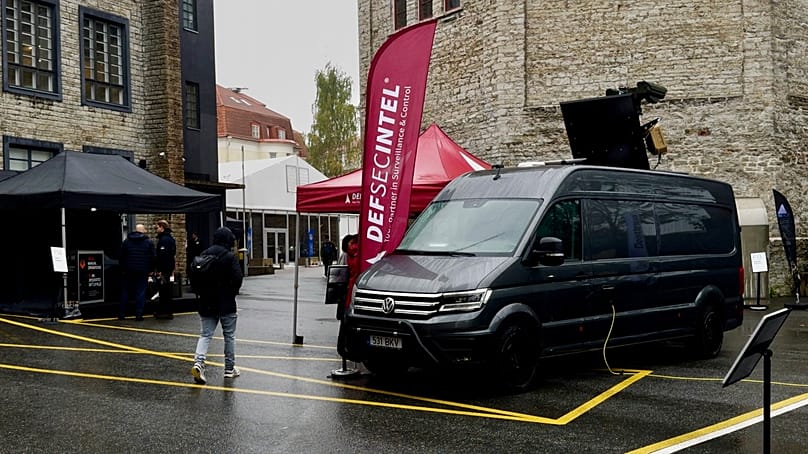
Another Estonian company, DefSecIntel, combines optical, radar, acoustic and radio-frequency sensors in one mobile, highly autonomous system called Eirshield.
"This is a turnkey counter-drone system," Jaanus Tamm, CEO and founder of DefSecIntel Solutions, told Euronews Next.
It helps users detect hostile drones, track them, then decide how to intercept them. Its effectors range from jammers to interceptor drones and, if needed, lasers.
"Eirshield detection sensors will detect the drones, then the operator will select which one to go after, and then they launch the interceptor drone," Tamm said. "Then the hostile drones will be destroyed and they will not hit any infrastructure elements or do any harm for the civilians."
Tamm called Eirshield "one of the few" TRL 9 counter-drone systems in Europe that can be bought now, in large numbers. TRL 9 is the top of the technology readiness scale.
The design is open, so it can evolve. "If there are new threats coming, we can just add new effectors, or new sensors to detect better," he said.
One of those effectors is Blaze, an interceptor drone from Latvia's Origin Robotics. According to the industry briefing, France's defence procurement agency selected it at Eurosatory 2026.
Robots instead of soldiers
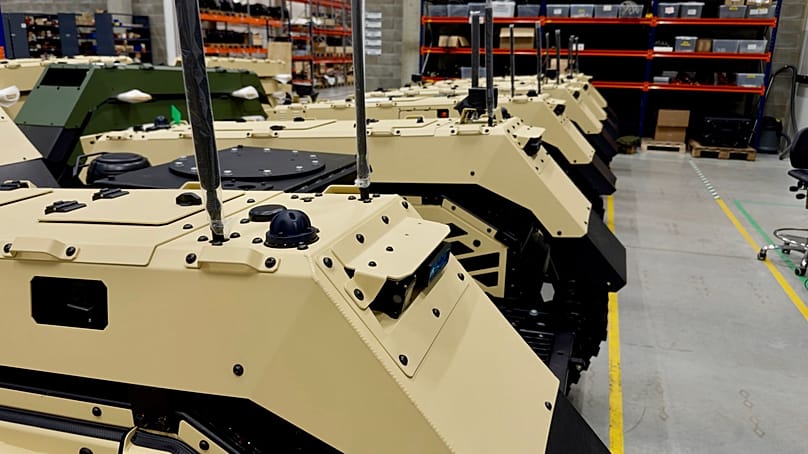
Unmanned vehicles can support, or even replace, soldiers on dangerous missions. Milrem Robotics presented its THeMIS unmanned ground vehicle.
The company says the technology enables "an unmanned kill zone," where robotic vehicles would detect and push back invading troops. That would minimise human casualties among the defenders.
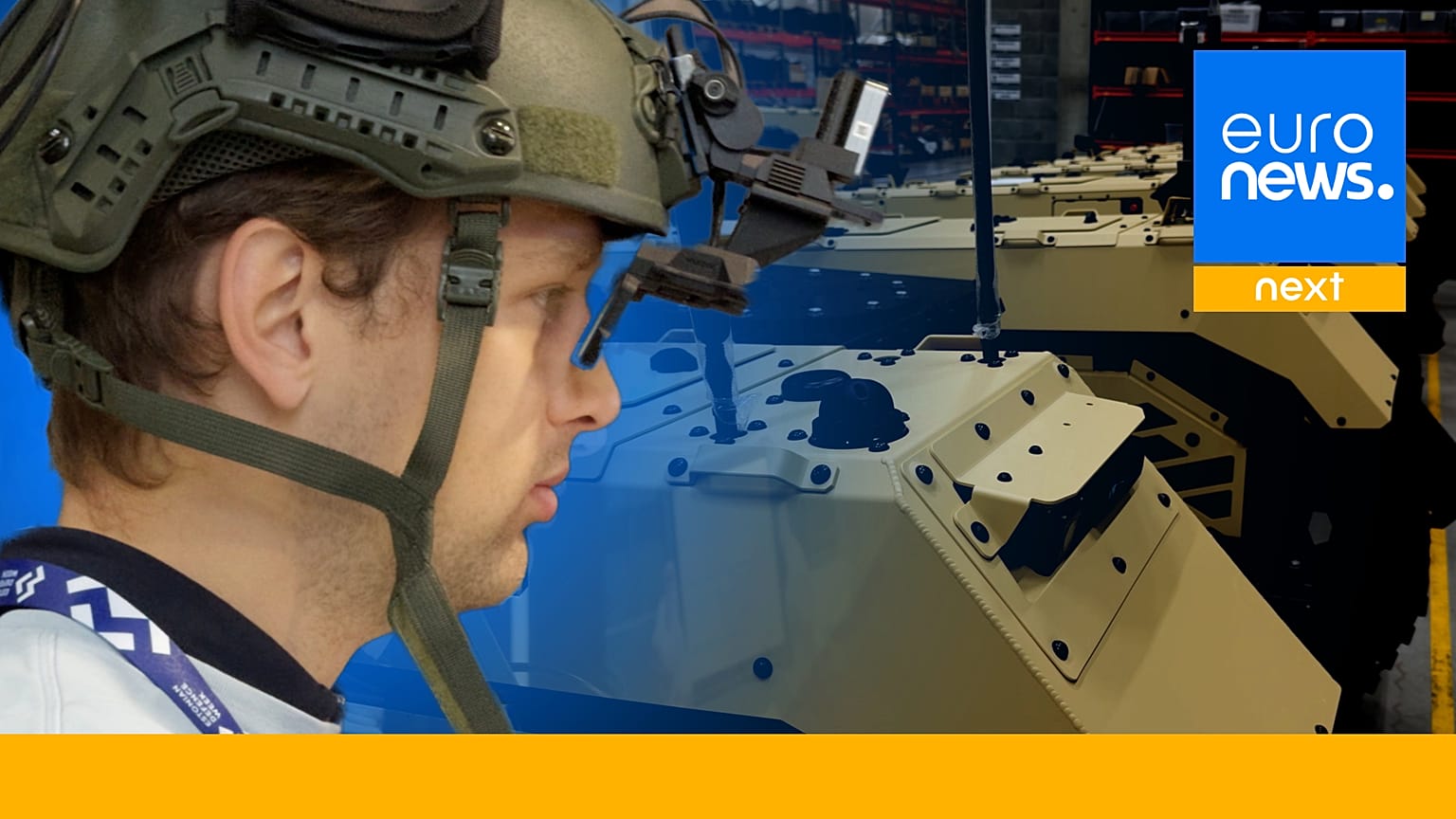
The vehicles are remotely controlled and partly autonomous. "Instead of sending troops on the battlefield, we can send in these machines and save lives," Raul Rikk, Capability Development Director at Milrem Robotics, told Euronews Next at the company's Tallinn factory.
The modular platform can carry a machine gun, an anti-tank system or other weapons. It can also handle reconnaissance, mine clearing, logistics and casualty evacuation.
Rikk said the concept is already proven. "Nothing is theoretical anymore. Ukrainians are using them on the battlefield," he said.
Rikk said the company's current production capacity is not public. "We are talking about hundreds of vehicles, and different sizes," he said. "We can take the production everywhere, so it's not complicated to set up the production, and we can scale up quite rapidly."
For Rikk, the direction is clear. "Tomorrow's war is already in Ukraine," he said.