

















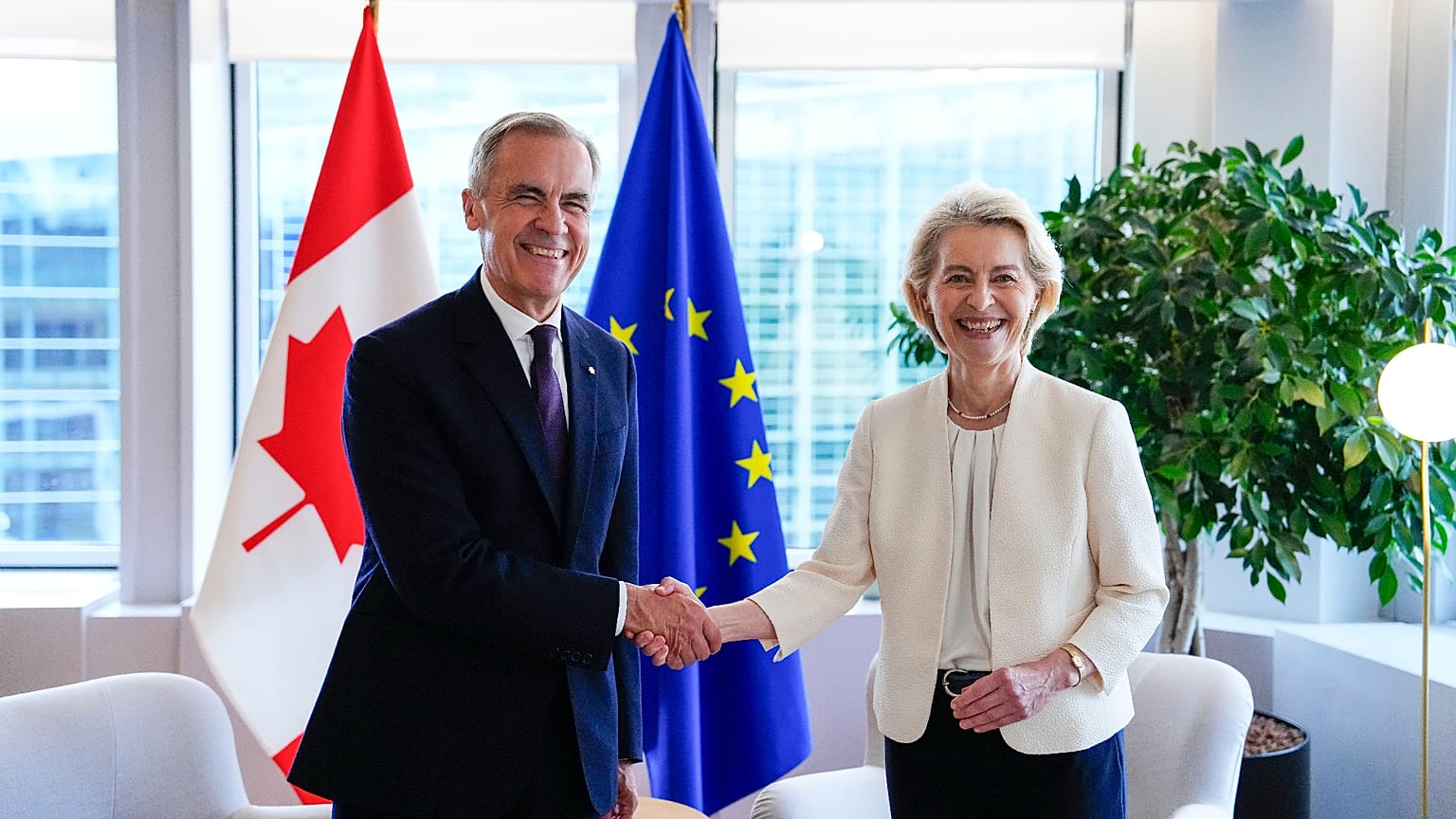













The EU Commission opened the door for Canada to become its first-ever “associate member” as both parties want to reduce dependence on the US. But what's behind the proposal? Ask the Euronews AI chatbot.
EU Commission President Ursula von der Leyen said Canada might become Europe’s first "associate member” during her State of the Union address in Strasbourg, France, on 16 September.
 ADVERTISEMENT
ADVERTISEMENT
ADVERTISEMENT
It’s the first time the EU has offered this status to a third country. If all 27 member states agree, the EU would have to create a new legal framework, including rights and obligations, since current EU treaties do not include “associate membership”.
The proposal does not mean Canada will join the EU. It would establish a deeper EU-Canada partnership that goes beyond existing cooperation, including the Comprehensive Economic and Trade Agreement (CETA) and the military mobility and logistics projects under Permanent Structured Cooperation (PESCO).
The aim is to build an “Alliance for the Future to create a common prosperity and economic security space”, said President von der Leyen. While not yet finalised, the partnership would cover critical policies across manufacturing, energy, minerals, AI, quantum computing, cybersecurity, the Arctic, as well as a tech alliance and integrated defence industrial bases.
The push comes as both partners’ relationship with the US grows more uncertain, and dependence becomes riskier.
Stronger ties with Canada could help the EU reduce its reliance on the US for energy, technology, and defence. At the same time, the partnership could give Canada a like-minded ally as it seeks to reduce its economic dependence while caught up in a tariff dispute with the US, which, as of August 2026, is imposing up to 50% duties on some Canadian goods.
Do you want to know more about the EU’s strategy to strengthen its relationship with Canada? Ask the Euronews AI chatbot!