

















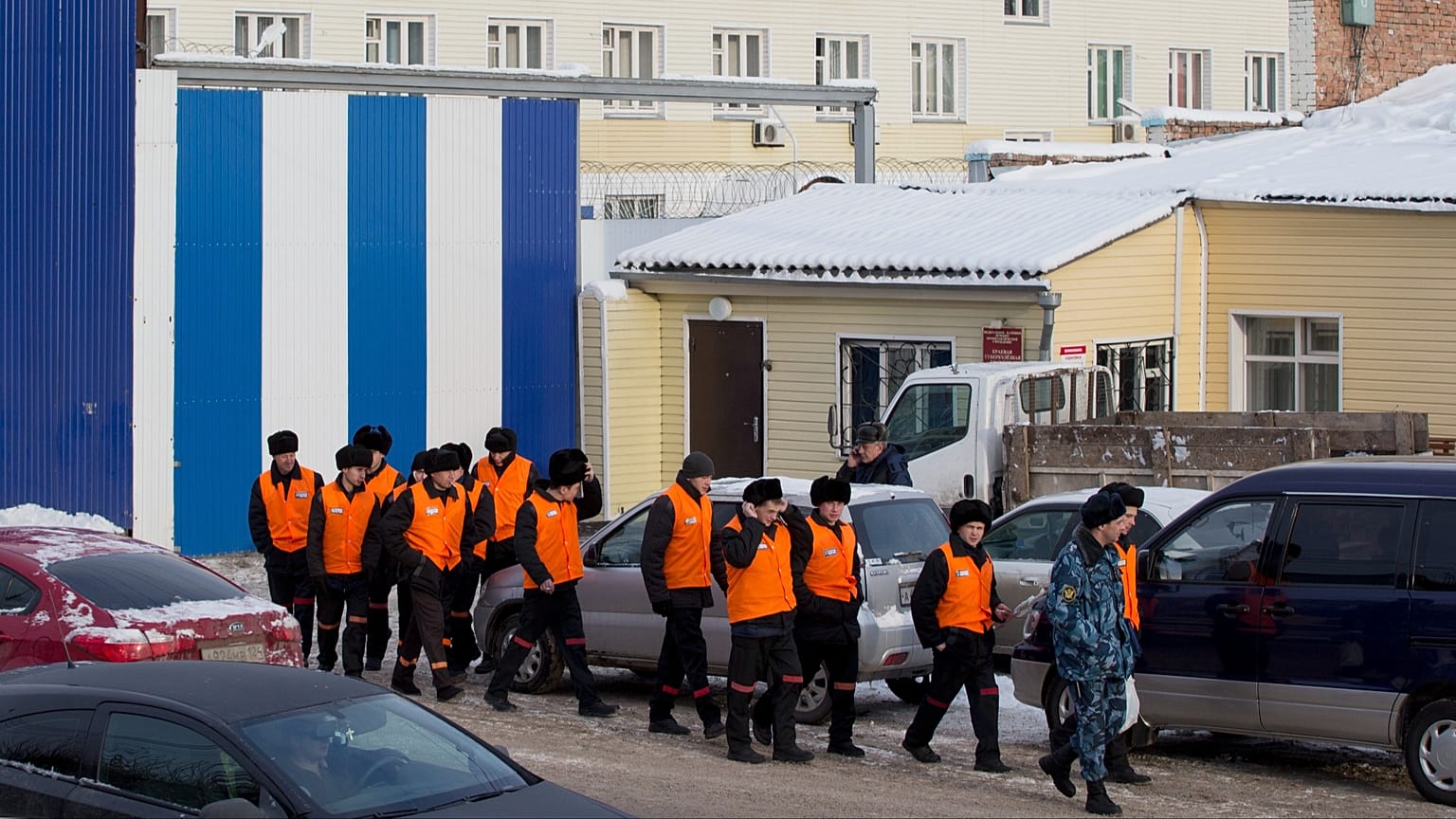













Seven complexes holding more than 20,000 inmates are planned for 2035, including one in Russian-occupied Kherson, even as the prison population has dropped from 465,000 to 282,000 since 2021, largely because inmates have been recruited as contract soldiers for the war in Ukraine.
Russia plans to build seven large prison complexes by 2035 that will house both remand centres and penitentiary colonies, under a government decree amending the federal programme for the development of the penal system.
 ADVERTISEMENT
ADVERTISEMENT
ADVERTISEMENT
The facilities, which Russian journalists have called "superprisons," will together hold more than 20,000 people, 5,380 on remand and 15,120 convicted prisoners.
They will also include courtrooms and offices for prosecutors, defence lawyers and public monitoring commissions. The government plans to use surveillance and security technology throughout.
The complexes are planned for the Kaluga, Astrakhan and Tyumen regions, Buryatia and Zabaikalsky Krai, and the part of Ukraine's Kherson region currently under Russian military occupation.
The first facility is due to open in Tatarstan by 2030. Preliminary estimates put the cost of a single complex at between 13 billion and 20 billion roubles (€134 million and €208 million), with the total programme cost expected to exceed 230 billion roubles (€2.4 billion), according to Russian media reports.
Russia's Justice Ministry says consolidating remand and penal functions in single facilities will cut the cost of holding prisoners by 25–30% and allow the investment to pay for itself within 10 years, mainly by eliminating prisoner transfer costs and reducing staffing requirements.
The planned construction follows a sharp fall in the prison population. At the end of 2021, Russia held 465,000 people in detention but by 2026, that figure had dropped to 282,000 — a decline of nearly 40%.
Head of the Federal Penitentiary Service Arkady Gostev said in May that recruitment of prisoners as contract soldiers for Russia's war in Ukraine had contributed significantly to the reduction.
The recruitment of inmates began in the summer of 2022 — right after Russia launched its full-scale invasion of Ukraine in February of the same year — initially through the Kremlin-run paramilitary Wagner Group and later through the Defence Ministry directly.
Law experts have criticised the plans. They said internal rules at the new facilities were likely to remain unchanged or become more restrictive, and that relocating prisons from city centres to remote sites — particularly in Buryatia and Zabaikalsky Krai — would make it substantially harder for relatives, human rights activists and legal representatives to reach those held inside.
Torture of inmates prevalent
Russia's prison system has faced persistent criticism from international human rights bodies for conditions that fall below international standards.
The UN Special Rapporteur on Human Rights in Russia found in a 2025 report that torture remained "systematic and widespread," with 258 documented cases in 2024-2025. Common methods documented included electric shocks, beatings and mock executions.
The UN Human Rights Council, following a universal periodic review of Russia in 2024, called on Moscow to make torture a standalone criminal offence, strengthen investigation of reported cases and align its legal framework with the UN Convention Against Torture. Russia rejected the majority of those recommendations.
Human Rights Watch documented in 2024 that Russian authorities tortured suspects detained in connection with the Crocus City Hall attack near Moscow in March of that year, recorded the sessions and circulated the footage.
An OSCE monitoring mission found conditions in Russian detention facilities frequently included overcrowding, unsanitary facilities, inadequate food and medical care, and forced labour.
Alexei Navalny died in February 2024 in a remote Arctic penal colony where he was serving a 19-year sentence. The prison was reported by Russian independent media as known for harsh conditions and alleged torture.
Russia formally withdrew from the European Convention for the Prevention of Torture in September 2025 following its expulsion from the Council of Europe, ending monitoring visits to Russian prisons by European inspectors.
The UN Special Rapporteur also documented a revival of punitive psychiatry, including the use of compulsory psychiatric treatment as a sentencing tool against those prosecuted for anti-war expression.