




























These are the most-searched-for Gen Alpha slang words for 2026 so far - and what they mean.
Let’s face facts: unless you’re part of Gen Alpha – the generation born between 2010 and 2024 – chances are you’re frequently overhearing or confronted with words, terms and vernacular that sound completely alien to you, leaving you feeling out of the loop or labelled as “unc”.
 ADVERTISEMENT
ADVERTISEMENT
ADVERTISEMENT
Fortunately, a study from Unscramblerer has helpfully analyzed Google Search trends data from January to the end of August to reveal the most-searched-for Gen Alpha slang terms of 2026.
Some you’ll have heard. Others will leave you thinking the retirement home beckons. All will give insight into the cultural conversations of the younger generations, revealing their preoccupations, habits and in some cases, insecurities.
Sticking to the Top 10 most-searched-for Gen Alpha slang terms, here’s what these ubiquitous expressions mean. (Incidentally, “unc” is short for “uncle” and is essentially a way for the new generation to call someone old. It didn’t make the Top 10.)
6-7
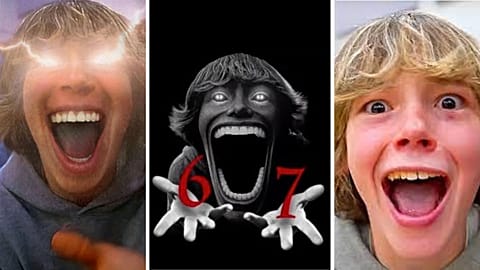
Yep, this one... And it’s still on top. It all started last year, and continues to completely ruin the joke “Why was 6 afraid of 7?” The utterly meaningless term has been traced to the Skrilla song ‘Doot Doot (6 7)’ and went viral thanks to an excitable scamp at a basketball game. It became so pervasive that it was crowned Dictionary.com’s 2025 Word of the Year. Usually accompanied by exaggerated up-and-down hand movements, what was supposed to be a flash-in-the-pan fad has gone from a trolling inside joke to a ubiquitous rallying cry for the brain damaged. At first, there was every reason to celebrate youngsters welcoming a level of absurd randomness into a world that routinely feels like it’s sinking into godless oblivion; its continued pervasiveness now leads to a Darwin-disproving form of despair.
Chud
For a cinematically literate generation, “chud” used to mean ‘Cannibalistic Humanoid Underground Dwellers” - a reference to the 1984 horror film C.H.U.D. Now, surly teens liberally dish out this insult to refer a stupid, ugly or downright repulsive person - to be used interchangeably with “loser”, “jerk” or “arsewipe”. Somewhat fascinatingly, the term “chud” has been embraced by people with left-wing political views when mocking right-wing trolls, fascists, ultranationalists and anarcho-capitalists.
Rizz
A shortened form of the word “charisma”, “rizz” was popularised by YouTuber Kai Cenat and describes a natural sense of charisma or flirting prowess. The term is innocent enough when used casually, but when overused by near-sociopathic and misogynistic pick-up artists, it frequently becomes a byword to excuse the worst tendencies peddled by the manosphere - the toxic internet subculture rooted in sexism and misogyny which is populated by noxious men with the IQ of a steak and ale pie.
Cap, No Cap
Cap = A lie / exaggeration / falsehood. No Cap = No lie / the equivalent of “for real”. Both terms are usually used at the beginning or the end of a sentence for emphasis and clarification. Alternatively, it could be used literally to describe someone with or without stylish headwear. Cap.
Mog / Mogging
A popular internet slang term meaning to outshine, dominate or outclass someone else. This can be in terms of various metrics, but usually in appearance, fashion and fitness. “His outfit mogs mine” / “I totally got jawmogged by that chud’s jawline” - that sort of thing.
Bop
What used to be a term for a catchy song has evolved into a derogatory insult – and a misogynistic one at that. It implies that a person (usually a woman) is promiscuous and Gen Alpha uses it as a way to bully, shame and degrade people online. As for the reason behind the use of the three-letter word, it refers to the motion during fellatio. Charming.
Larping / Larper
The term “larper” originally refers to a person who takes part in live-action role-playing (LARP) games. More recently, it has become an online put-down describing someone who is fake or pretending to be someone they’re not. It can be equated to a poser or someone who tries too hard. The term is usually found in the comment sections of content creators who pretend to be richer than they actually are or who try to sell people a lifestyle they don’t themselves possess.
Aura, aura points, aura farming
A not-so-distant cousin to “rizz”, “aura” describes a cool attitude and the charisma a person can exude. By extension, “aura points” are a fictional measure of coolness. As for “aura farming”, it’s the more pejorative descriptive – meaning trying to boost one’s perceived “coolness” by “larping”. Those who “aura farm” intentionally cultivate their persona through specific actions to appear cool. This can be through attempting to hang out with the popular crowd in order to increase one’s social clout; seeking to assert dominance through try-hard actions to gain attention; or jumping on the latest craze and making a public spectacle of oneself to mask one’s crippling sense of insecurity through the fleeting disillusionment that they’re “in”.
Sigma
It should just be the 18th letter of the Greek alphabet. But because we can’t have nice things, here goes... Positively, “sigma” refers to an independent and self-reliant person who knows what they’re about and couldn’t care less about arbitrary social hierarchies. However, the term “sigma” originates from the manosphere. They use the term as a step up from an “alpha male” and see “sigma” as the pinnacle of manhood – the lone wolf whose self-assured and dogged individualism sets him apart from “simps” (someone who shows “too much” attention for a "female”). If you feel the need to bathe in Clorox, get in line.
Crash out
This extremely popular term is pretty straightforward. It refers to having a breakdown, an emotional low point, or even a tantrum.
There we have it for the Top 10. As Randoh Sallihal, a spokesperson for Unscramblerer, states: “Using slang is a social signal. What people search for can tell us something about what they are trying to understand and participate in culturally.”
He adds: “Slang may look like a collection of throwaway jokes from the internet, but psychology suggests it is doing something much more interesting. Using slang helps people navigate identity and belong to a community.”
Anyone feeling reassured by these new social signals?