

















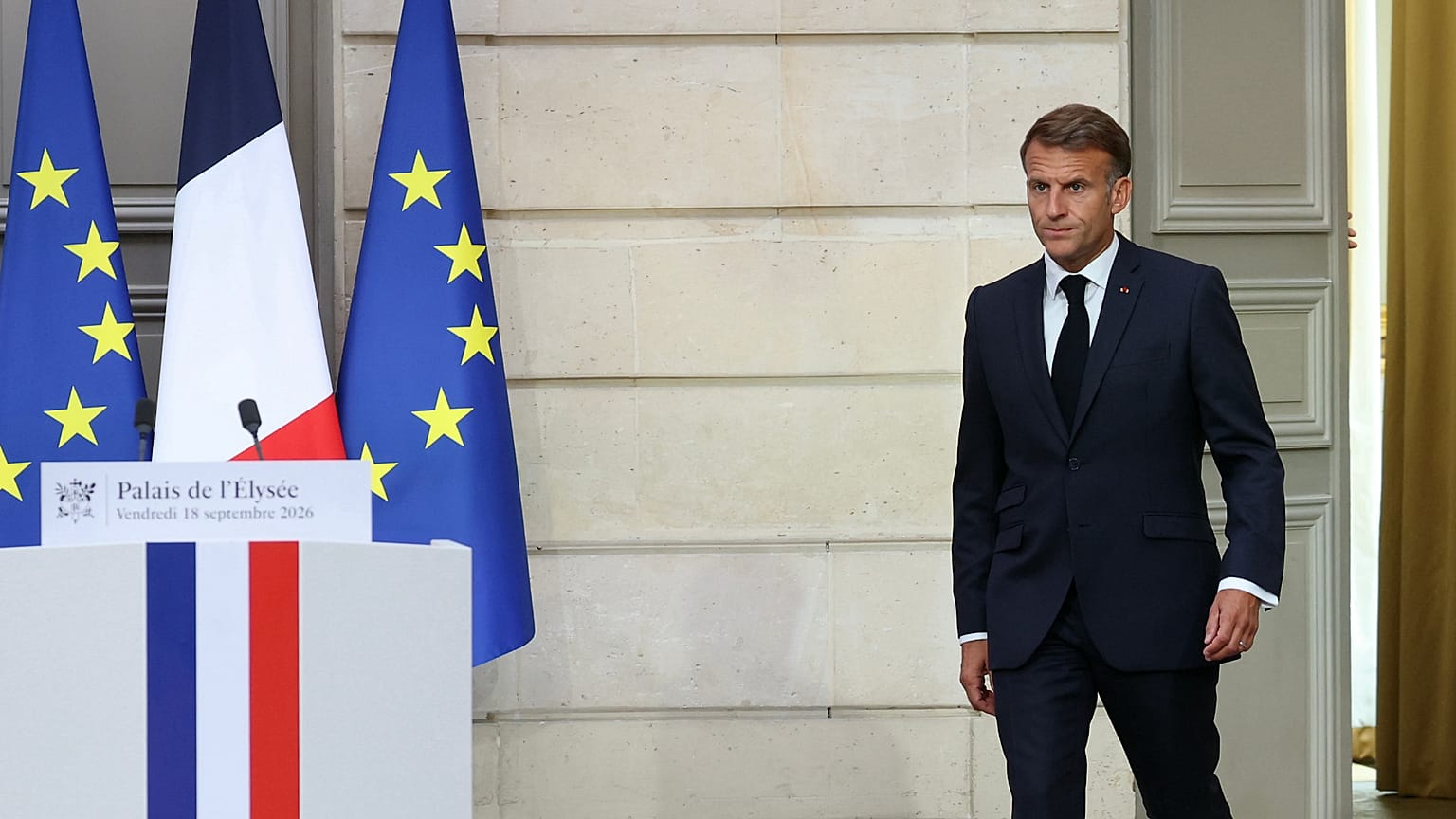













In a letter to Ursula von der Leyen, Macron said the EU’s energy security has so far relied heavily on buffers — including stockpiles, refinery flexibility, weaker demand and redirected global trade — rather than addressing the underlying supply shock, according to the letter seen by Euronews.
French President Emmanuel Macron asked Brussels to take emergency steps to boost Europe’s diesel and jet fuel supply as the prolonged closure of the Strait of Hormuz and renewed attacks on energy infrastructure in the Middle East threaten to further tighten global oil markets, according to a letter seen by Euronews.
 ADVERTISEMENT
ADVERTISEMENT
ADVERTISEMENT
Macron said that the oil market has so far been kept supplied largely through higher refinery output, weaker Asian demand and the drawdown of existing stocks. However, he warned that this cushion is rapidly eroding, with France already having 14% of gas stations suffering with shortages or near-shortages on 22 September at 9 am, according to the French government.
"In recent weeks, international supply has deteriorated once again, driven by the combined impact of the targeting of energy infrastructure — in Russia and the Middle East — and the recovery of consumption in Asia," reads the letter addressed to the European Commission President Ursula von der Leyen and sent on 18 September.
Macron said that if Hormuz remains effectively closed and Saudi Arabia’s East-West pipeline does not return to operation, the depletion of Saudi stocks could remove at least another 4 million barrels a day from global crude supply, potentially triggering another sharp price increase. Global oil inventories have fallen by more than 500 million barrels, according to Macron's letter.
The French president said European dependence on Middle Eastern imports is particularly significant for jet fuel, where 36% of imports come from the region, and diesel, at 18%.
Unlock refinery capacity
The bloc cannot quickly replace the crude oil it has lost, but Macron argued that it could maximize fuel output from the crude and refinery capacity that remain available.
He urged the Commission to temporarily relax some EU fuel-quality specifications to allow refineries to produce more jet fuel and diesel, as oil-logistics companies struggle to confirm deliveries.
"France-based players in the oil logistics sector report increasing difficulties in confirming deliveries for the coming weeks. Furthermore, several member states are seeing gas storage fill levels that are lower than those recorded in recent years," Macron wrote.
He added that changes to parameters including density, volatility and desulphurisation could increase refinery output by around 5% to 20%, depending on the plant.
The proposal would require the Commission to work with carmakers to determine which standards could safely be relaxed without damaging vehicles or infrastructure, while maintaining health and safety requirements. France points to the precedent set during the Covid-19 crisis, when the Commission temporarily eased some fuel specifications.
Macron also asked the EU to allow greater use of B10 diesel, containing up to 10% biodiesel, instead of the standard B7 diesel. Temporary limits could be agreed with vehicle manufacturers to determine which engines can safely use the higher biofuel blend.
Taken together, the measures would seek to increase Europe’s effective fuel supply without having to wait for the geopolitical crisis around the Strait of Hormuz to subside, Macron argued.
Delay methane-import rules
Macron's letter also takes aim at another potential constraint on fossil-fuel imports — the EU's methane law.
"It is also important not to weaken European production capacities while preparing for long-term supply difficulties," reads the letter.
EU member states adopted methane rules in May 2024, introducing the bloc’s first framework for measuring, reporting and verifying methane emissions in the energy sector as part of efforts to curb one of the most potent greenhouse gases.
Facing soaring prices and fuel shortages, France wants Brussels to postpone by one year, until 1 January 2028, the obligation for importers of crude oil and natural gas to transmit information under the bloc's methane rules.
The Commission has already recommended delaying financial penalties by three years, until the end of 2029, but Paris argues that the underlying reporting obligation itself could expose importers to additional legal uncertainty while supply conditions are deteriorating.
Paris also wants the Commission to reassess the EU's joint-gas purchasing mechanism, created following the war in Ukraine and the sudden decoupling from Russian gas.
Macron suggested examining whether the approach could be extended to diesel and jet fuel, potentially giving the EU greater collective leverage in securing oil and refined products.
Reacting to the French letter, the Commission said on Tuesday the potential supply shortages across member states are "extremely high on the agenda and on our radar" and the topic will be discussed soon at a high-level meeting with the industry, EU countries and the Commission.