

















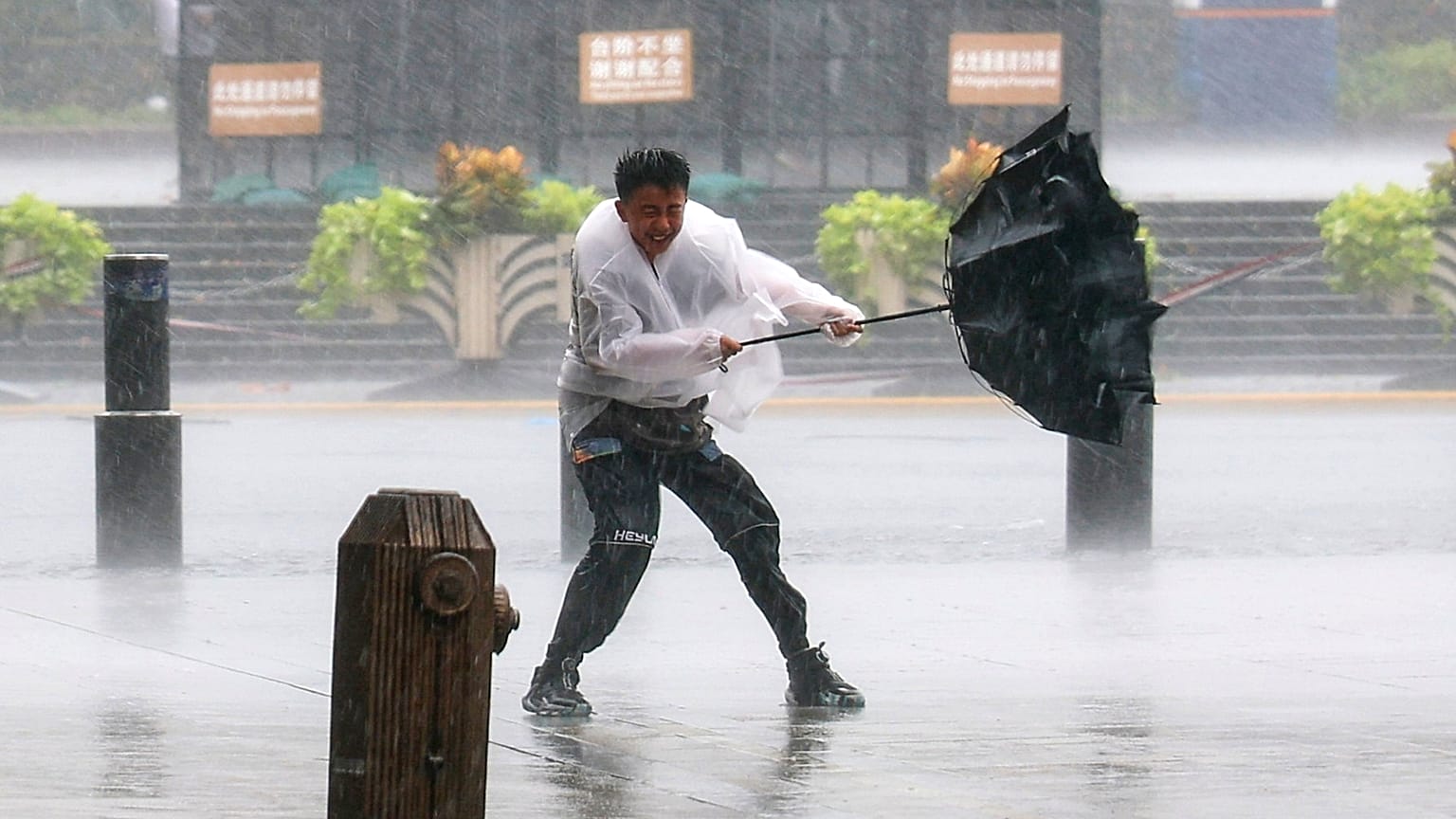













Typhoon Dolphin made landfall in densely populated eastern China on Sunday, meteorological authorities said, after the storm triggered more than 1,000 flight cancellations, 1 million evacuations, and a top-level alert.
China's east coast has been preparing for the storm's arrival in recent days, with work and transport services suspended in some areas along its predicted path.
 ADVERTISEMENT
ADVERTISEMENT
ADVERTISEMENT
The centre of the typhoon moved over the coastline near Yuhuan City in Zhejiang Province at about 5:30 pm (09:30 GMT), China's National Meteorological Centre said in an online post.
Maximum wind speeds near the centre were more than 150 kilometres per hour at the time it made landfall, the NMC said. Parts of central and eastern Zhejiang could receive 250 to 500 mm of rain.
Authorities relocated more than 900,000 residents from the city of Wenzhou and opened more than 1,000 emergency shelters.
Nearly 1,400 flights in and out of Shanghai's two main passenger airports were cancelled on Sunday, state broadcaster CCTV reported.
Hangzhou's airport in nearby Zhejiang province saw 270 inbound and outbound flights cancelled, the report said.
Heavy rain, strong winds
The effects were felt as far away as Hong Kong on China's southern coast, where the weather observatory posted a record high temperature of 36.9°C, caused by warm air pushed over the city by Typhoon Dolphin.
With the storm "moving towards the vicinity of Zhejiang and moving inland, its outer subsiding air will persistently bring extremely hot weather to the territory today to Tuesday", the Hong Kong Observatory said.

Typhoon Dolphin brought heavy rain and strong winds to Japan's Okinawa before reaching China.
Seven people in Okinawa suffered minor injuries, including a man aged over 100 who was blown over by gusts, fell to the ground, and hit his head, according to the island's government.
By Sunday afternoon, 5,290 households in Okinawa were without electricity, according to regional utility Okinawa Electric Power.
In Taiwan, dozens of ferry services were suspended, and more than 180 flights were cancelled as the storm brought downpours and strong winds to the island's north on Sunday.
Red alert issued
China's NMC issued a red typhoon alert — its most severe warning — on Sunday morning, forecasting "extraordinary torrential rain" in some areas of central and eastern Zhejiang.
Heavy precipitation is also expected to fall in Shanghai and parts of Fujian, Anhui and Jiangsu provinces through Monday afternoon, it said.
Typhoon Dolphin was expected to weaken after making landfall while moving in a northwesterly direction over eastern China.
In Fujian, nearly 99,000 people were relocated from "risky areas" on Saturday evening ahead of the storm's arrival, state news agency Xinhua reported.
Services on more than 200 ferry routes were suspended in Zhejiang and Fujian, Xinhua said. Work on offshore projects was halted, while 474 construction vessels had been called to port by Friday morning, Xinhua said.
Some train services in affected areas were also suspended on Sunday to ensure passenger safety, state media reported.
Scientists say human-driven climate change is making extreme heat events more frequent and more intense worldwide.
Typhoon Dolphin's arrival in China comes two weeks after Typhoon Noul lashed southern Guangdong province, declared by authorities at the time as the strongest storm to hit China this year.
Three people were killed, and hundreds of homes were damaged by Typhoon Noul in the Philippines before it reached China.