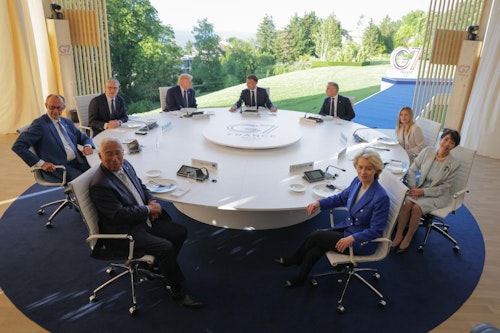













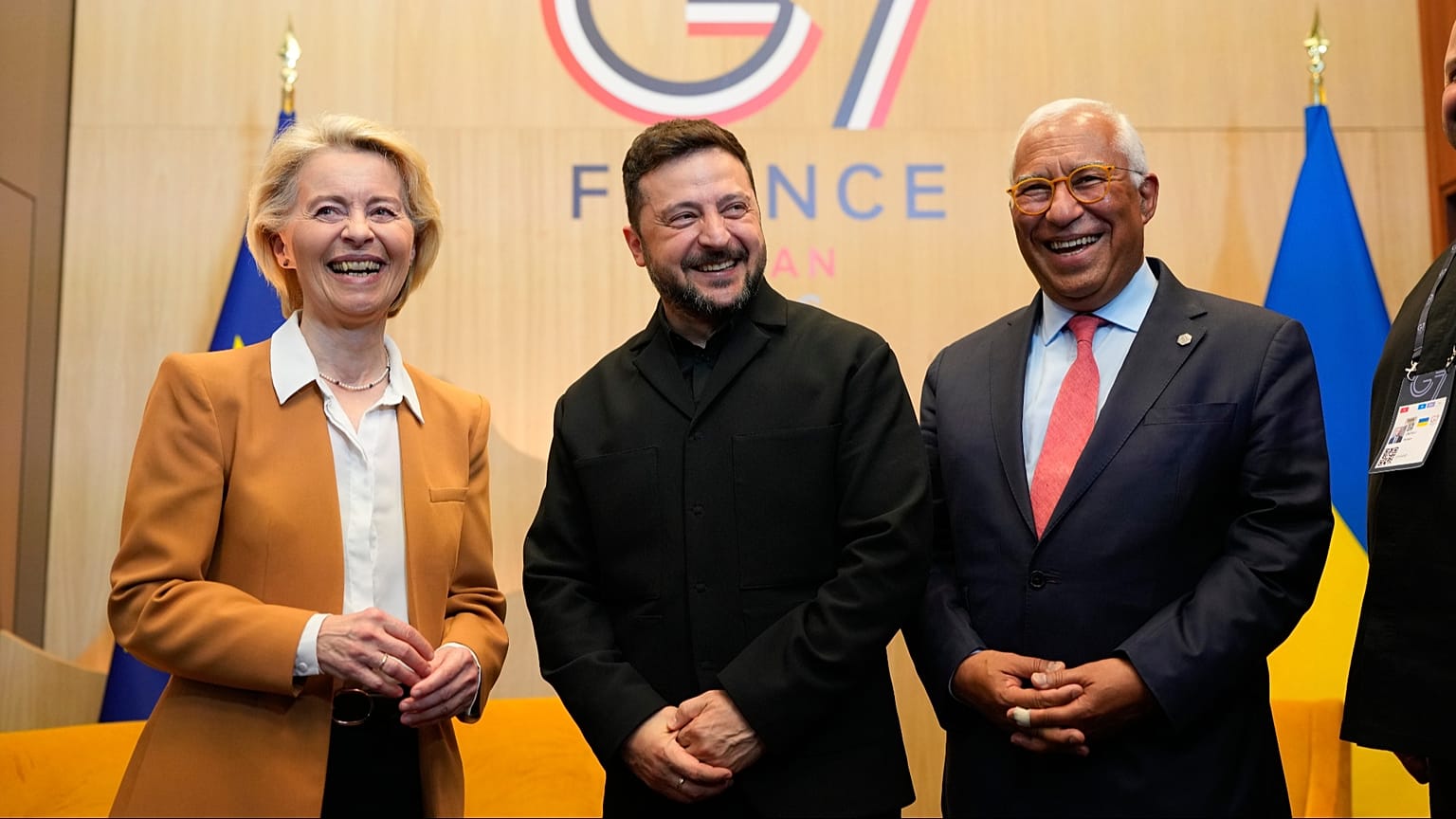














The second day of the G7 summit in Évian, France, focused on Russia's war on Ukraine, the situation in the Middle East and international partnerships.
Ukraine is gaining the upper hand against Russia, European Commission President Ursula von der Leyen and European Council António Costa told Ukrainian President Volodymyr Zelenskyy at the G7 summit in Évian, France.
 ADVERTISEMENT
ADVERTISEMENT
ADVERTISEMENT
"The tide is turning for Ukraine," von der Leyen and Costa said at the end of the talks.
Earlier on Tuesday, US President Donald Trump, whose policy on Ukraine has often frustrated allies, said that his administration would "soon" be able to reimpose sanctions on Russia after having eased them in response to the closure of the Strait of Hormuz.
"We'll be able to do that because the oil is now flowing," Trump said in response to a journalist. "We took sanctions off because obviously we're not looking to impede the oil (flows), so we are in a position to do that soon."
Here's how the day unfolded.

 ${title}
Live ended
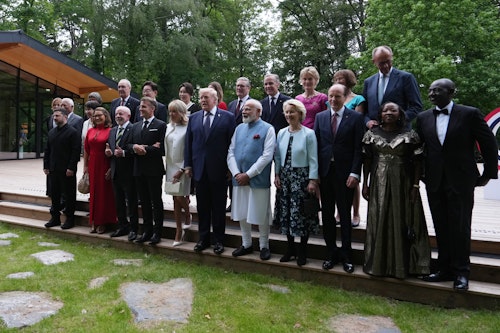
Leaders enjoy gala dinner hosted by the Macrons
G7 leaders will tonight enjoy a gala dinner hosted by Emmanuel Macron and Brigitte Macron. Before then, they gathered outside the venue for a family picture.
In the meantime, this live blog draws to an end.
Thank you for reading us and see you again tomorrow!
Credit: Associated Press
'The tide is turning for Ukraine': Von der Leyen and Costa tell Zelenskyy
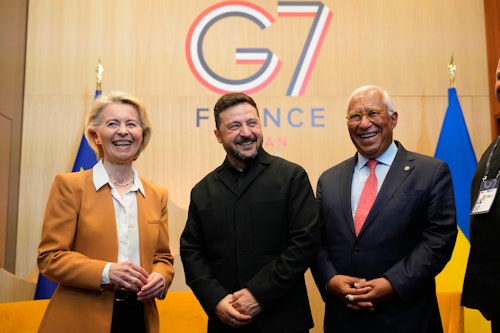
Ursula von der Leyen and António Costa held a bilateral meeting with Volodymyr Zelenskyy, just a day after Ukraine opened the first cluster of negotiations to become a member of the European Union.
Earlier on Tuesday, Zelenskyy doubled down on his call for fast-tracked accession, which EU leaders have largely rebuffed.
"You and the Ukrainian people are doing extraordinary efforts. On the battlefield. And on reforms. It is paying off, across the board," Costa and von der Leyen said in a joint statement.
"The tide is turning for Ukraine."
Credit: Associated Press.
The key question is whether Ukraine has President Donald Trump as a “trump card”, Ukraine’s ex-prime minister told Euronews
Former Ukrainian prime minister Arseniy Yatsenyuk told Euronews' Special Report that Moscow had hoped to exploit divisions between G7 leaders and Volodymyr Zelenskyy, but the G7 summit in Évian instead highlighted Western unity.
Yatsenyuk said “the optics of the G7 are much better than expected”, while cautioning that Kyiv must be clear-eyed about its leverage as Russia continues to stall negotiations.
He argued that Vladimir Putin remains unwilling to engage seriously in talks, pointing to the Russian president’s suggestion in a call with Donald Trump that Zelenskyy should travel to Moscow - a proposal Kyiv has repeatedly rejected.
“The most important issue is whether we have President Trump as a ‘trump card’,” Yatsenyuk said, adding that it remained unclear whether Trump would exert meaningful pressure on the Kremlin. He suggested that ending the war could align with US interests, including the upcoming midterm elections.
While praising what he described as “overwhelming” European support, Yatsenyuk stressed that Ukraine still “desperately needs” backing from Washington.
“Ukraine is fighting hard. We can win this war — but only if we stand shoulder to shoulder with the United States.”
Watch Euronews special report, live from the G7 with Maria Tadeo
European Council President António Costa praises EU-Brazil relations
In a post on X, European Council President António Costa praised the EU’s relations with Brasília, as Brazilian President Lula da Silva was among the BRICS leaders invited to the G7.
“Europe and Brazil see the world with the same eyes,” Costa wrote, adding that the EU-Mercosur agreement signed a couple of months ago by the EU and Brazil, Argentina, Paraguay as well as Uruguay “was not the finish line”, but “the starting point” of cooperation between Brussels and Brasília.
“From clean energy to innovation and climate action, there is so much more we can achieve together,” he said.
“In a time of uncertainty, it is good to know we can rely on one another.”
Russia’s foreign minister accused Europe of trying to be a ‘hegemon’
Russia’s foreign minister Sergey Lavrov criticised Europe for what he claimed are “attempts to reclaim its role as a hegemon”.
“In this context, the trend towards a resurgence of Nazism could not be more timely,” Lavrov said at a press conference following talks with Turkish Foreign Minister Hakan Fidan.
He also claimed that in Europe “there is already widespread talk of the need to restore Germany’s former military might so that it may have the strongest army in Europe”.
Lavrov stated as well that the EU is “seeking to become a separate military bloc and is structuring all its security measures with a view to countering Russia”.
Russian warship fired 'warning shots' at yacht in English Channel, reports say
We just got some breaking news in the middle of the G7 summit: The British Ministry of Defence (MOD) is looking into reports that a Russian warship fired warning shots near a yacht in the English Channel.
Our newsroom is developing the story.
Russian warship fires shots at vessel in English Channel, UK media say
The incident reportedly happened at 11:40 am on Tuesday between the Isle of Wight and Normandy. #EuropeNews
G7 calls for update of the international development system
In a statement shared with journalists, the G7 has called for an update of the international development system, saying it has sometimes had too limited an impact in reducing financial dependency on external assistance and that the system's architecture has become too complex.
“We are united in reforming the development cooperation system and shaping mutually beneficial partnerships that take into account our strategic interests and those of our partners and foresee a strategic and catalytic use of concessional resources where they are most needed,” the statement reads.
“We aim to support our partners ability to self-finance and reinforce partner countries’ ownership, accountability, long-term economic sovereignty and resilience while respecting their development priorities.”
The G7 leaders also insist on “achieving the empowerment” of all women, writing that “the full and equal enjoyment of all their human rights and fundamental freedoms is a key driver of development and economic growth”.
Macron holds bilateral meeting with Takaichi
Emmanuel Macron just concluded a bilateral meeting with Sanae Takaichi, the Japanese prime minister.
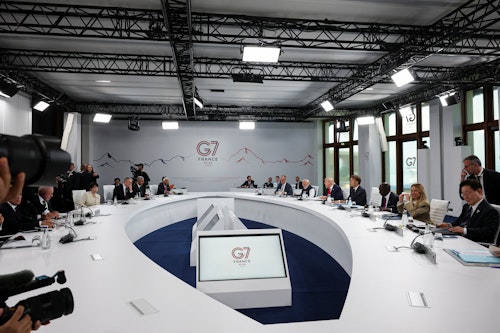
G7 leaders finish last working session before gala dinner
G7 leaders have finished the last working session of the day, titled "Forging New Partnerships and Rebuilding International Solidarity".
A gala dinner will take place later today.
Credit: Associated Press
G7 calls for 'rapid international response' to Ebola outbreak
In a statement published on Tuesday, G7 countries called for a swift response to the latest Ebola outbreak in the Democratic Republic of the Congo (DRC) and Uganda.
“We, the Leaders of the G7, call for a strong and coordinated response to address the health security risks posed by the re-emerging outbreak of Ebola,” the statement read.
It added: “We commend G7 members, partners and other institutions that have already brought financial and technical support, including the deployment of medical personnel and expertise, to ensure a rapid international response to this outbreak.”
The G7 said its priority was to prevent the spread of the disease in eastern DRC and neighbouring countries, which would require contact tracing, infection control and quarantine measures.
The leaders also said that public health efforts were being hampered by the ongoing conflict in eastern DRC, calling on “all parties to honour their commitments and fully implement the Washington Accords for Peace and Prosperity and the Doha Framework.”
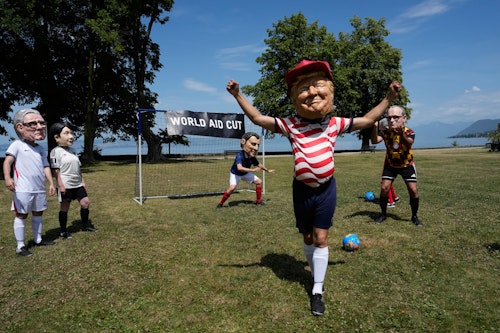
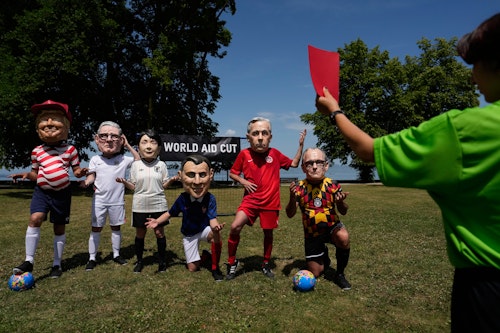
Oxfam deploys satirical 'big heads' of G7 leaders to denounce cuts to global aid
Credit: Associated Press
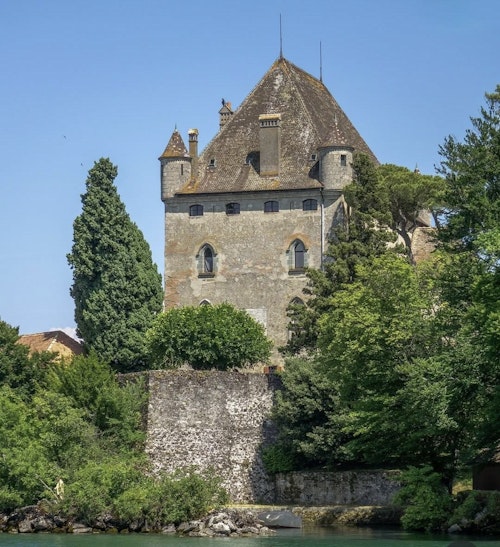
Spouses of G7 leaders visit the 'Most Beautiful Village of France'
French First Lady Brigitte Macron took the spouses of G7 leaders on a visit to Yvoire, a village in Haute-Savoie awarded the “Most Beautiful Villages of France” label.
Victoria Starmer, the wife of the British Prime Minister, Charlotte Gass, the wife of the German Chancellor, Diana Fox Carney, the wife of the Canadian Prime Minister, and Heiko von der Leyen, the husband of the President of the European Commission, were among those visiting the village. Melania Trump, the wife of the US President, did not travel to Evian, where the G7 is taking place.
“The visit of these distinguished guests to this little corner of history is incredibly important. This village is not actually that old — it dates back to 1069 — but it is a magnificent event, worthy of the personalities we are welcoming,” Yvoire Mayor Erick Magli told French media.
Credit: Office du tourisme - Yvoire
Zelenskyy insists on fast-tracked EU accession
Volodymyr Zelenskyy has doubled down on his call for a fast-tracked path to EU accession, a request other leaders have rejected over concerns it could undermine the bloc’s merit-based enlargement process.
On Monday, Ukraine and Moldova opened the first cluster of negotiations after almost two years of delays caused by Hungary’s veto.
"I know that not all the leaders love such a format -- fast track -- because they want very understandable, clear steps for everybody. But we are not everybody, with all respect to everybody," Zelenskyy told Reuters after meeting with G7 leaders in the morning. "We are (at) war and we need more creative steps, fast steps. We need it very much."
Zelenskyy said that if the EU were to "pause" the accession process after the war is over, his country's prospects would fall into limbo.
"Russia will find a way to block Ukraine's way to the EU. They don't want to see us successful. Russia doesn't need Ukraine to be successful, and the most interesting (thing) for them (is) not to make Ukraine a European country, not to be part of the European family. That's why we need fast track," he said in the interview.
"When we speak about the EU, I'm speaking not like a president, I am speaking like a citizen. So we want to be a part of Europe," he went on. "If you want us, if you need us, our strong army, our strong people, if you see us, please look at us as, I mean, at yourself. We want to be the same, not better, but not worse. So we want clear membership. This is my reaction."
Russian oil goes down after US-Iran deal
G7 leaders seeking to tighten the screws on Russia's war economy will be relieved to see the price of Russian Urals oil go down at a rapid pace in light of the framework deal between the United States and Iran to reopen the Strait of Hormuz.
Urals crude is currently trading at $67 per barrel. Last week, it was over $80 and last month, over $100.
There's still some way to go until Urals falls below the G7 price cap of $44 per barrel. Still, the trend spells good news for Ukraine and its allies, who have approved back-to-back sanctions on Moscow's oil industry to cripple a vital source of revenue that maintains the costly invasion.
Earlier today, Donald Trump said the US would "soon" reimpose sanctions on Russian oil, although he didn't commit to a specific timeline. Europeans have been impatiently waiting for the White House to abolish the waivers it introduced after Hormuz closed down in March.
EU, UK confirm summit on 22 July as von der Leyen, Costa meet Starmer
The EU–UK summit has been confirmed for 22 July, following talks between Prime Minister Keir Starmer, European Council President António Costa and European Commission President Ursula von der Leyen on the sidelines of the G7 on Tuesday.
The confirmation followed several weeks of speculation over the fate of the summit, with media reports saying a postponement was likely given Starmer's weakened domestic position, as senior members of his own Labour Party called for his resignation after the disastrous outcome of recent by-elections.
Tuesday's discussions with EU leaders touched upon the state of bilateral relations, notably taking stock of the implementation of the EU-UK Common Understanding, the current geopolitical situation and common challenges.
Each G7 leader gets a musical welcome from Macron
France’s social media team shared a different song for each handshake between President Emmanuel Macron and the other G7 leaders on Monday, with the lyrics hinting at the messages Paris intended to convey to its guests.
Tom Petty’s Love Is a Long Road accompanied Macron’s meeting with US president Donald Trump, while Felicità by Al Bano and Romina Power — a classic song meaning “happiness” — was chosen for Italy’s Giorgia Meloni. For Germany’s Friedrich Merz, the French selected Namika’s Lieblingsmensch (“Favourite Person”).
For Macron’s handshake with British Prime Minister Keir Starmer, France posted The World Is Not Enough by the Royal Philharmonic Orchestra, the theme from the James Bond film of the same name. EU leaders — European Commission President Ursula von der Leyen and European Council President António Costa — were welcomed with L’Hymne à la Joie, the EU’s anthem.
Japan’s Sanae Takaichi was paired with Arigato (“Thank You”) by Nxnja Beats, while Canada’s Mark Carney got Céline Dion’s J’irai où tu iras (“I’ll Go Where You Go”).
Watch: Meloni tells G7 leaders she quit smoking
Italian Prime Minister Giorgia Meloni has quit smoking — and shared the news with fellow G7 leaders over coffee.
— euronews (@euronews) June 16, 2026
European Council President Antonio Costa had his own milestone to offer: he gave up 21 years ago.🚭 pic.twitter.com/NcJmQ7qvP0
G7 leaders start last working session of the day
After multiple bilateral meetings, G7 leaders have gathered again in the main room to start the third working session of the day: "Forging new partnerships and rebuilding international solidarity"
The meeting includes the leaders of South Korea, Kenya, Egypt, India and Brazil, as well as the World Bank and the African Development Bank, as special guests. This will be the last working session on Tuesday.
Later today, Emmanuel and Brigitte Macron will host the leaders for a gala dinner.
G7 leaders and guests take family picture
The G7 leaders have taken a family picture accompanied by today's guests:
- Lee Jae Myung, president of South Korea
- Willian Ruto, president of Kenya
- Abdel Fattah el-Sisi, president of Egypt
- Narendra Modi, prime minister of India
- Lula da Silva, president of Brazil
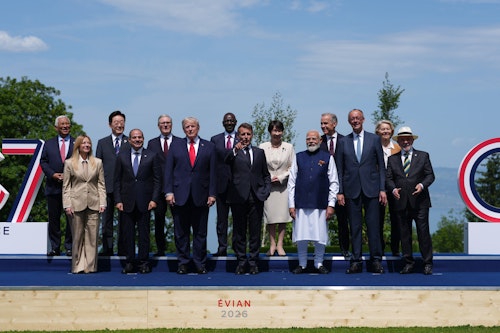
Credit: Associated Press
‘It’s gonna happen fairly on time,' Trump says on second stage of Iran negotiations
U.S. President Donald Trump said the second phase of negotiations under the peace framework agreement reached between Washington and Tehran over the weekend would begin “pretty quickly.” Under the deal, the talks are expected to last no more than 60 days.
“They are going to want to get it done. Iran wants to get it done; they have to get back to business. The relationship is now normalised,” Trump said. “I think it's going to go pretty quickly. Could go faster. Could take longer too, but could go faster.”
He said that the terms of the agreement are that Iran will never acquire nuclear weapons and that the Strait of Hormuz will be opened toll-free.
Asked how to make sure that the Strait of Hormuz will remain open in the long term, Trump said that only the United States with a strong president could ensure that. “The agreements with bad people don’t mean anything.”
He also said he liked the idea of sending the agreement to the US Congress for approval.
The EU to focus on the ‘day after’ the EU-Iran deal, says Antonio Costa
European Council President Antonio Costa wrote on X after the G7 discussion with Gulf partners and Egypt in Evian that the US-Iran deal represented a major step forward and that the EU will move to work on a more “secure and stable” Middle East.
“The agreement between the US and Iran is a major achievement,” Costa said, adding that he had congratulated US President Donald Trump.
He added: “Now we focus on the “day after”: the EU will continue to do its part to work towards a more secure and stable Middle East.”
A timely G7 exchange with our partners from the Gulf and Egypt in Evian.
— António Costa (@eucopresident) June 16, 2026
The agreement between the US and Iran is a major achievement, and I congratulated @POTUS Donald Trump on this.
Now we focus on the “day after”: the EU will continue to do its part to work towards a more… pic.twitter.com/tCEnNIrmlN
Trump mulls reinstating sanctions on Russian oil once Hormus reopens
US President Donald Trump said at a press conference at the G7 summit that Washington might reintroduce sanctions against Russian oil soon, once the Strait of Hormuz is reopened to international vessels.
Asked by a reporter whether he was considering an increase in sanctions on Russia, Trump said: "Well, soon we’ll be able to do that because the oil is now flowing. We took sanctions off because obviously we’re not looking to impede the oil. We are in a position to do that soon.”
In the past weeks, the U.S. Treasury Department issued a waiver allowing nations hit by the energy crunch caused by the War in Iran to purchase Russian seaborne oil that was already stranded at sea.
Over the weekend, Washington and Tehran reached a framework agreement to finalise a peace deal. Although the details of the agreement are not yet known, Trump said that it includes a reopening of the strait toll-free.
G7 to discuss 'international solidarity' with partner countries
This afternoon’s session on “Forging New Partnerships and Rebuilding International Solidarity” will bring together partner countries, including Brazil, India, South Korea and Kenya, as well as the World Bank and the African Development Bank.
France's Elysée Palace said the talks will involve a text on development assistance which “enjoys broad consensus”. It is expected to include so-called “high-quality investments” that exclude harmful practices such as child labour, corruption and disregard for environmental standards.
This afternoon's session will also address “derisking” efforts aimed at supporting investors in countries with less certain security guarantees, notably through mechanisms that absorb initial losses in the event that investments fail.
There are currently two such instruments: MIGA, managed by the World Bank, and ATIDI, managed by the African Development Bank.
G7 and Arab leaders conclude session on Middle East
Leaders have concluded their working session, carried out over lunch, dedicated to "Addressing Crises and Ensuring Stability in the Middle East".
The next session, scheduled for 15:15 CET, will focus on "Forging new partnerships and rebuilding international solidarity". The leaders of Brazil, India, South Korea and Kenya are set to join.
Before the third session of the day, a family picture will be taken.
Meloni tells G7 leaders she quit smoking 'one month ago'
We now have a more detailed transcript of the hot-mic chit-chat between G7 leaders this morning, thanks to Associated Press. It all involves Giorgia Meloni and her notorious smoking habit...
Keir Starmer: "Did you sleep all right, Giorgia? Did you sleep okay?"
Giorgia Meloni: "Yes." (Chatter continues.) "I had to take some coffee. Yes."
Ursula von der Leyen: "This morning, to wake up."
Friedrich Merz: "And a cigarette?"
Giorgia Meloni: "No. I stopped."
Ursula von der Leyen: "You stopped? Bravo."
Friedrich Merz: "Giorgia! No!"
Keir Starmer: "When?"
Friedrich Merz: "Last night?"
Giorgia Meloni: "One month ago"
Ursula von der Leyen: "Good"
And then it continues...
Keir Starmer: "When did you stop (smoking)?"
Antonio Costa: "I stopped in 2005."
Keir Starmer: "And that's it? Never gone back?"
Antonio Costa: "Never went back. 21 years ago."
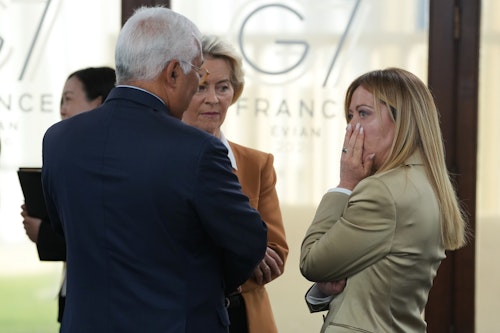
Credit: Associated Press
Zelenskyy reveals details about a joint working session with G7 leaders
Volodymyr Zelenskyy shared details of what was discussed at the G7 summit on Tuesday in a voice message on the presidential WhatsApp chat. According to the Ukrainian president, all participating leaders “fully support Ukraine”.
“Everyone believes that, in any case, the war must be stopped," he said. "That is logical.”
Zelenskyy also stressed that G7 leaders recognise that Moscow has no intention of ending the war and agreed on the need to intensify pressure on Russia, including through tougher sanctions.
Air defence for Ukraine
Zelenskyy said G7 leaders also discussed Ukraine’s air defence needs, including additional systems and interceptor missiles. He revealed that Kyiv had raised with Washington the possibility of obtaining a licence to manufacture anti-ballistic air defence systems and missiles in Ukraine and Europe.
“We discussed this with President Trump. Our team will be working on this,” Zelenskyy said.
Ukraine has long sought additional Patriot systems and the ability to produce interceptor missiles domestically, as current US production remains limited. The Patriot is the only system in Ukraine’s arsenal capable of intercepting Russian ballistic missiles, a vulnerability Moscow has increasingly exploited in large-scale attacks.
Drone deals with Ukraine
Zelenskyy said G7 leaders discussed Ukraine’s expertise in countering drones and new defence cooperation agreements, including a major drone deal with Canada. He also argued that sanctions are increasingly harming Russia’s energy revenues and said leaders agreed the war must end quickly or support for Ukraine would continue to grow.
UK and France committed to ensuring Hormuz navigation, Starmer says
The UK and France have been in the driving seat of setting up a naval operation aimed at restoring supply routes in the Strait of Hormuz once a peace deal between the US and Iran has been finalised.
“President Macron and I put together a group of countries prepared to play their part in terms of reassurance to get vessels through the strait. That is hugely important in terms of reopening the strait,” UK Prime Minister Keir Starmer said at the G7 on Tuesday.
Europe has been hit hard by the closure of the critical waterway, the world’s most important energy chokepoint, which caused a surge in energy costs.
“The strait being closed in the way that it has has had an impact on our economy, had an impact on every household across the country," Starmer said. "So we will play a full part in relation to that."
Starmer also confirmed that the matter was raised in discussions with Donald Trump on the margins of the G7.
Merz stays silent on Patriot missile support
Ukrainian President Volodymyr Zelenskyy and German Chancellor Friedrich Merz held a one-on-one chat on Tuesday following a G7 morning session focused on drumming up support for Ukraine.
The meeting only lasted for one hour – two hours short of the programmed allocation, throwing up questions about what was discussed and what wasn’t.
Asked by a reporter whether Germany had any Patriot air defence missile systems to give the war-torn nation, he said nothing. While shaking Merz's hand and smiling for the cameras, the Ukrainian president too remained silent.
Trump's critical minerals pricing plan not flying, media reports
Donald Trump's plan to establish a system to set price floors for critical raw materials is facing resistance at the G7 in France, according to media reports.
In February, US Secretary of State Marco Rubio hosted the first "Critical Minerals Ministerial" at the State Department in Washington, DC, where more than 50 countries were invited to "advance collective efforts to strengthen and diversify critical minerals supply chains", according to the US State Department.
US Vice President J.D. Vance said the US was proposing a trading bloc for these minerals, and that many countries had already signed on to the plan.
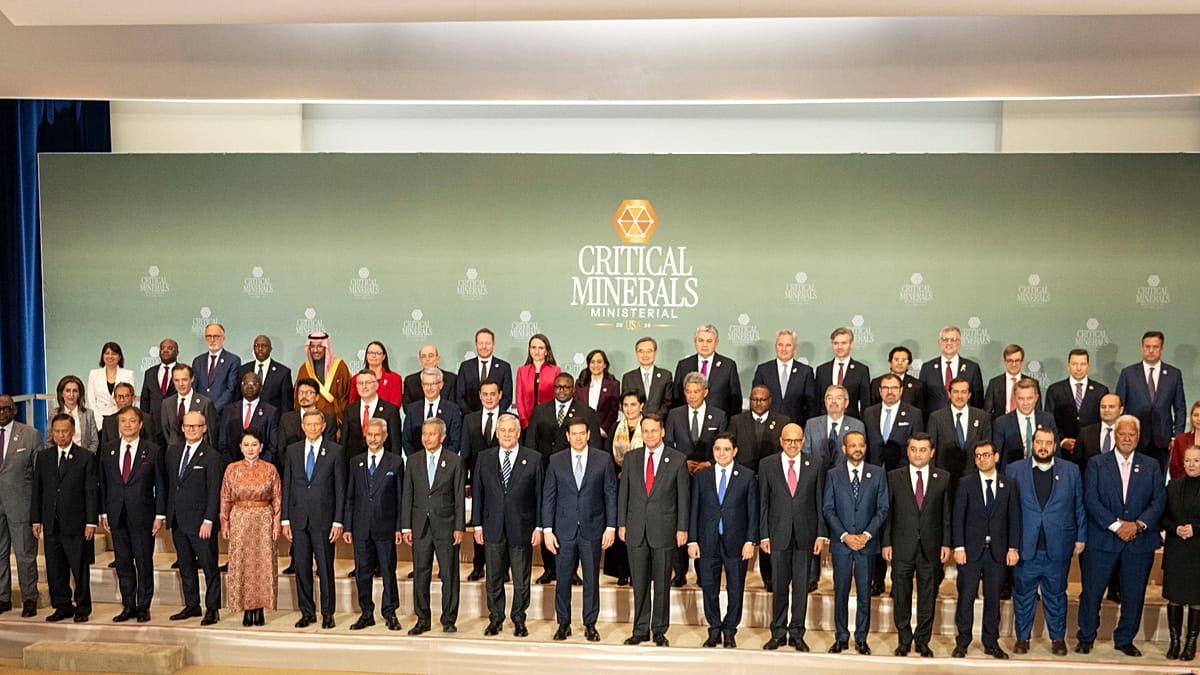
EU, US and Japan to cooperate on critical raw materials
The joint arrangement will focus on boosting demand and diversifying the supply of critical raw materials by identifying and backing projects in mining, refini…
EU to issue €1.5 billion to support Egypt’s reform agenda, von der Leyen says
European Commission President Ursula von der Leyen posted on X about her meeting with Egypt's President Abdel Fattah El-Sisi at the margins of the G7.
"Egypt is a central and stable partner for Europe in a region in turmoil," she wrote. "We are swiftly delivering on our 2024 partnership with €1.5 billion to be issued this month to further support Egypt’s reform agenda. And some 8 billion in investments already mobilised."
EU and Egyptian officials met in Luxembourg on Monday as part of the 11th meeting of the two partners' association council.
During the meeting, von der Leyen and El-Sisi also discussed the diplomatic efforts in the Middle East, including the implementation of the US-Iran framework deal and the reconstruction of Gaza.
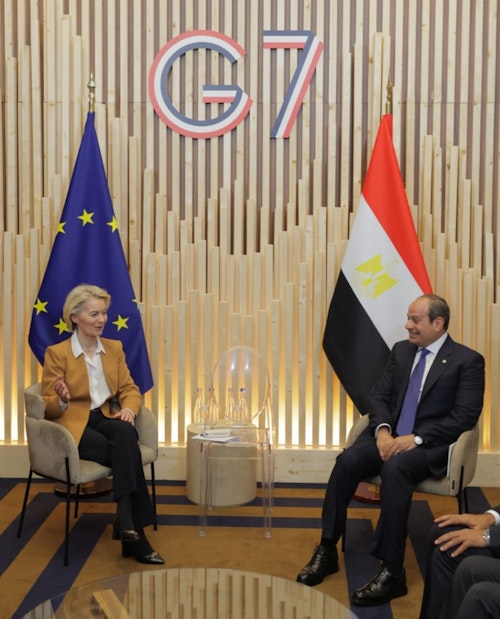
Credit: European Commission.
Meloni and Carney hold bilateral meeting
Leaders are making the most of their time in Évian to have bilateral meetings whenever they can. This morning, Italy's Giorgia Meloni and Canada's Mark Carney got together and lavished each other with praise.
"What an honour!" Carney said. "It's a great pleasure."
Carney hailed the "momentum" in Canadian-Italian relations, especially regarding defence, space, and critical raw materials such as graphite and lithium.
"I'm really proud to have this occasion again to talk," Meloni replied, praising Carney's "leadership".
"We're trying to focus on topics which are long-term (in) range. We want to bind much more our countries for the future and contribute to stabilising a world in which we don't have many certainties, but our friendship is certainly one of those."
Who is following who at the G7
With helicopters buzzing overhead and a media centre crammed with international journalists, the second day of the G7 is a big one, with all eyes on the red carpet and the attending leaders' social media accounts.
This includes Donald Trump and his top-level entourage: Treasury Secretary Scott Bessent, Secretary of State Marco Rubio and Ambassador to France Charles Kushner.
When Trump first showed up at the summit on Monday, he was trailed by a swarm of aides and political staffers. There is also a hefty US press corps watching their every move.
But there's also a large showing of reporters following G7 member Japan and its prime minister Sanae Takaichi, as well as South Korean President Lee Jae Myung, who's attending as a guest.
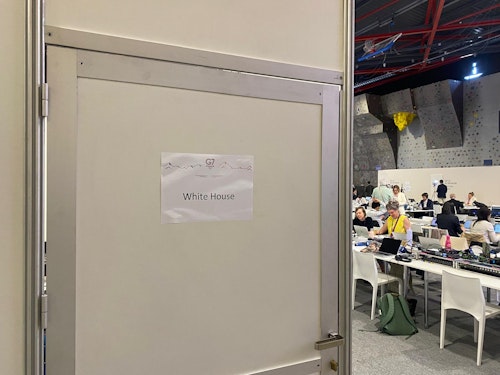
Euronews is hunkered down in a booth at the summit's international media centre, wondering what kinds of conversations are going on just a few doors over.
EU Parliament approves EU-US trade deal
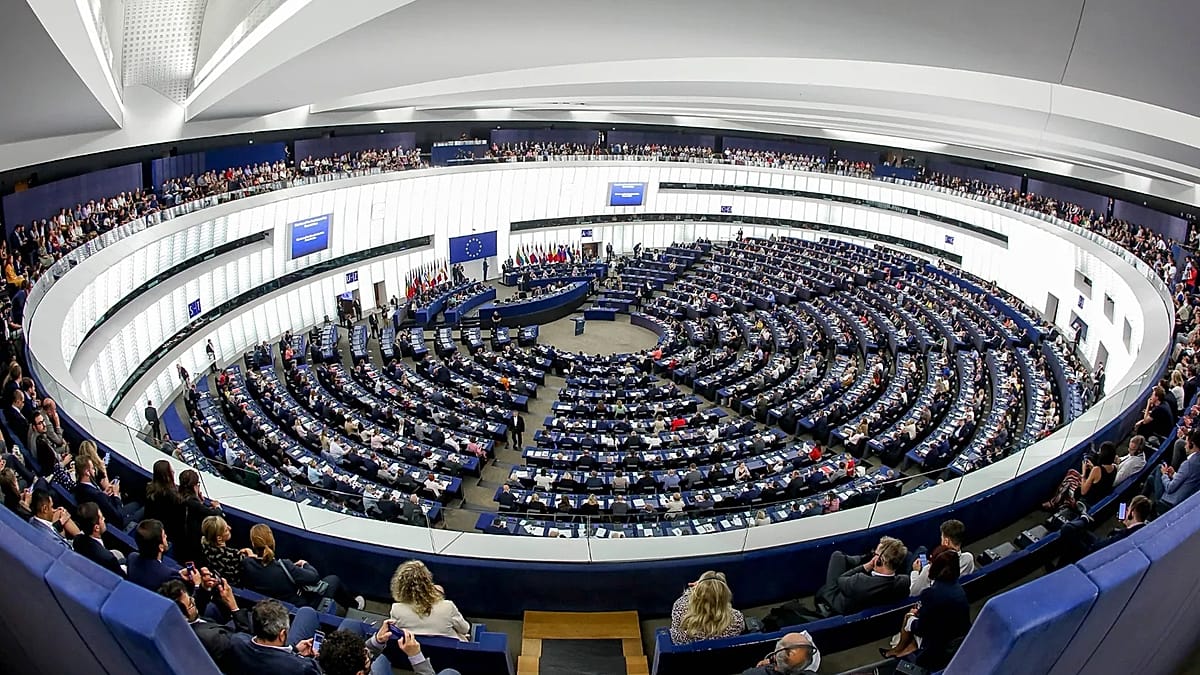
While EU Commission President Ursula von der Leyen is meeting US President Donald Trump at the G7 in Evian, the European Parliament finally approved the EU-US trade deal struck last summer in Turnberry, Scotland.
The agreement removes EU tariffs on US goods, while accepting a 15 percent levy in the other direction.
Four hundred and forty MEPs voted in favour, 151 against, and 50 abstained, backing it despite Trump’s new trade war threats.
The final greenlight came as Trump threatened on Monday to impose tariffs on French wine and champagne if Paris did not remove its digital tax on US Big Tech. Last week, the US administration also proposed new 10% tariffs on some trading partners, including the EU, arguing that insufficient efforts to curb trade in goods produced using forced labour were harming US commercial interests.
Read more below:
MEPs approve EU-US trade deal despite Trump’s new trade war threats
The agreement removes EU tariffs on US goods while accepting a 15 percent levy in the other direction. #EuropeNews
’It is always important to coordinate positions,’ Zelenskyy said after meeting Trump
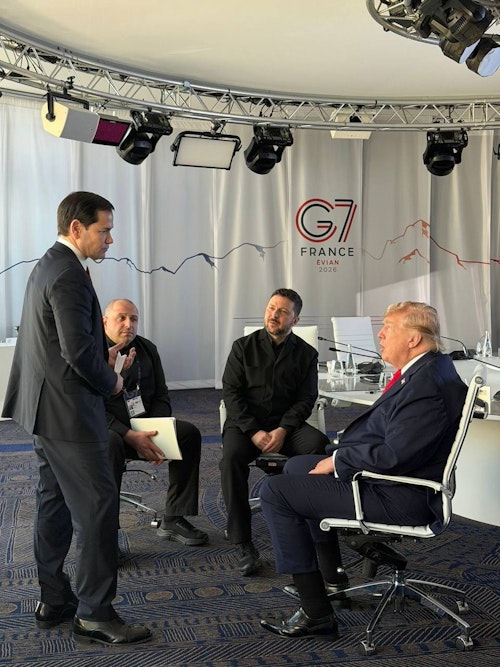
Volodymyr Zelenskyy has revealed some details about his meeting with Donald Trump at the G7 today, sharing photos from a conversation which seems to have taken place before or after a joint working session with other leaders.
Zelenskyy adviser Dmytro Lytvyn confirmed that the meeting took place "in the context of a general meeting at the summit”.
Also present were US Secretary of State Marco Rubio and Rustem Umerov, secretary of Ukraine’s National Security and Defence Council and one of the leaders of Kyiv’s negotiating team.
Euronews team on the ground in Évian understands that another meeting with Zelenskyy has been added to the G7 agenda later tonight, possibly a trilateral between Zelenskyy, Trump and Emmanuel Macron.
It is always important to coordinate positions. ____ Завжди важливо координувати позиції. 🇺🇦🇺🇸
G7 and Arab leaders begin working lunch on Middle East
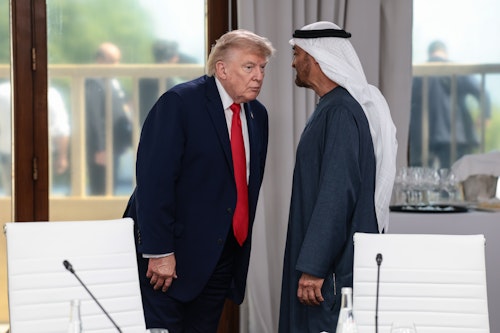
G7 leaders have begun their working lunch titled "Addressing Crises and Ensuring Stability in the Middle East".
Present in the room are the leaders of Egypt, Qatar and the United Arab Emirates.
Credit: Associated Press
Iran's senior official warns no peace deal without end of Israel's occupation of Lebanon, media reports
The Foreign Minister of Iran, Abbas Araghchi, warned that Israel's withdrawal from the occupied territories in southern Lebanon was part of the memorandum of understanding reached with the US government over the weekend, according to several media reports.
Israel, which Washington sidelined in reaching a framework deal to conclude a peace agreement with Tehran, has continued its operation against Iranian proxy Hezbollah. The US has not yet disclosed the terms of the framework deal, nor whether they include Lebanon.
“The end of the war in Lebanon is an inseparable part of complete end of the war,” Araghchi said on Iranian state TV. “Without the withdrawal of Israeli forces from the territories they occupied during this war, the war has not fully come to an end.”
Von der Leyen congratulates Trump on Iran deal
Ursula von der Leyen has shared a message on social media congratulating Donald Trump on the framework deal between the United States and Iran.
"We both agree that it should mean a definitive end to Iran's nuclear programme," the president of the European Commission said.
"The Strait will reopen. Oil prices are falling. And that's how diplomacy delivers," she added, using language that echoes Trump's.
Trump calls on Netanyahu to ‘be more responsible, let Syria handle Hezbollah’
“I suggested to Israel to let Syria take care of Hezbollah. To be honest with you, I think they would do a better job at doing it,” Donald Trump told reporters at the G7.
Saying he’s unhappy with the exodus of doctors, lawyers and intellectuals from Lebanon in the face of Israel's offensive, Trump suggested that the new Syrian government could do the job without killing as many civilians.
"I was very responsible for Syria, and the man who is running Syria now is a person I put there along with President Erdogan and some others. He has done an amazing job at pulling it together. He is not a boy scout, but he has done an amazing job," Trump said. "He is very good with Hezbollah. He does not like them."
'All hell will break loose' if Iran acquires nukes, Trump says
Donald Trump said at the margins of the G7 that Iran will never have nuclear weapons as part of the proposed peace deal.
“They are not going to develop them; they are not going to buy them. And if they do, they will suffer unbelievable consequences,” Trump said.
Trump also said he had never cared about regime change, since the US strikes eliminated the first, the second, and part of the third lines of command in the Iranian power structure.
“We are dealing with people that are very rational. Nice to deal with. They are strong, smart people. I think they are actually smarter than the first and second group. But they are not radicalised but looking to help their country.”
Trump said he had watched regime change attempts across the world for years and concluded they never work.
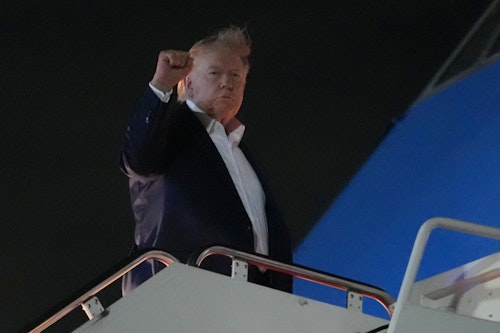
‘Russia should make a deal’, Trump said
Donald Trump said he had a “good meeting” with Volodymyr Zelenskyy at the G7 and will meet him again later on Tuesday.
“Russia should make a deal,” Trump said, potentially signalling a shift in Washington’s strategy of pressuring Ukraine alone to make concessions to end the conflict.
Trump said he passed on the same message to Vladimir Putin when the two spoke on the phone on Sunday.
“They just keep going, fighting, losing soldiers. They lose so many soldiers. This is – not since World War Two is anything like this,” he said.
“I'm going to do whatever I can,” Trump vowed, pointing out that the US has “nothing to do with it. We sell weapons to them. We don’t even give them.”
“The European Union pays us full price for weapons. It has no impact on us other than we sell weapons.”
Macron welcomes Arab leaders
As the G7 shifts focus to Middle East, Emmanuel Macron welcomes three guest leaders from the region who will take part in the discussion:
- Abdel Fattah el-Sisi, president of Egypt (pictured below)
- Tamim ben Hamad Al Thani, emir of Qatar
- Mohamed bin Zayed Al Nahyan, president of the United Arab Emirates
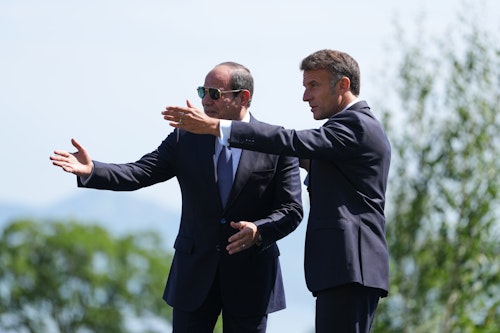
Credit: Associated Press
'Funding is desperately lacking' : UN under-secretary-general calls on G7 to step up humanitarian efforts
In an op-ed published in the French newspaper Le Monde, UN Under-Secretary-General for Humanitarian Affairs Tom Fletcher called on G7 leaders on Tuesday to unlock funding to address humanitarian crises around the world.
“Funding is desperately lacking,” he wrote, adding: “The budget cuts currently hitting humanitarian aid are among the deepest in recent history.”
Fletcher, who cited crises in Gaza, Darfur, Kupiansk in Ukraine, Kandahar in Afghanistan and Mandalay in Myanmar, estimated global funding needs at €20.7 billion this year to save 87 million lives.
However, the UN has so far received only €8.95 billion in donations and pledges.
“To the leaders of the G7, I want to say this: let us rise to this challenge together and save the lives that can still be saved.”
Kallas: 'EU rejects any maritime fees for the strait of Hormuz'
While G7 leaders are in Evian to talk about the Middle-East following the US-Iran framework deal to end the war in Iran, EU Foreign Policy chief Kaja Kallas stated that the bloc "rejects any measures that would impose additional costs to maritime shipping in the Strait of Hormuz," in an address to MEPs at a plenary session in Strasbourg.
Her remarks come as Trump reiterated at a press conference at the G7 yesterday that strait would reopen "completely" on Friday and would be toll-free. French president Emmanuel Macron also told French broadcaster TF1 yesterday that he would "do everything we can so that there isn’t a toll” in the waterway.
"The Strait of Hormuz has to become again open and toll-free," Kallas said, claiming that any peace settlement must be fully consistent with international law and its implementation must be verifiable.
During her intervention, Kallas also touched upon Israeli illegal settlements in the West Bank, saying that "a large number" of EU countries have requested the Commission to put forward concrete proposals.
The list of options, Kallas said, will include "measures aimed at preventing imports of goods originating in the illegal settlements," as first reported by Euronews.
Kallas also stated that Israel's latest plan to expand West Bank settlements is "not in line with international law" and "further undermines the prospects of a two-state solution."
G7 leaders and Zelenskyy conclude working session
The working session dedicated to Ukraine has come to an end.
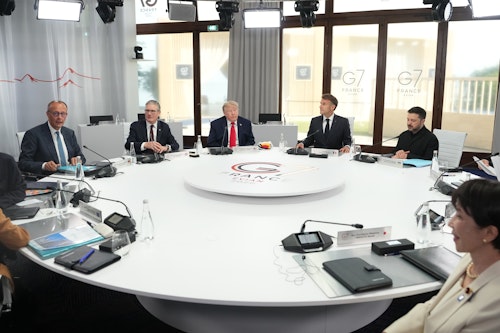
Credit: Associated Press.
Middle East's leaders flock to G7 as US-Iran framework deal still has to take shape
Sheikh Tamim bin Hamad Al Thani, Emir of Qatar, Sheikh Mohammed bin Zayed Al Nahyan, President of the United Arab Emirates (UAE), and Abdel Fattah el-Sisi, President of Egypt, are joining G7 leaders for a working lunch on "responding to crises and ensuring stability in the Middle East."
The summit follows the announcement that the United States and Iran have reached a memorandum of understanding, opening a 60-day window to finalise a peace agreement that would inevitably set out navigation conditions for the Persian Gulf, a critical waterway for global energy supply.
The full details of the framework deal have yet to be disclosed; a formal signing ceremony is expected in Switzerland on Friday. A key point of contention is whether it will include a toll system for ships transiting the Strait of Hormuz, a measure Tehran had previously declared it intended to introduce.
The imposition of transit fees would face strong opposition from Gulf states such as Qatar and the UAE, which rely on the Strait as a critical chokepoint for their energy exports. Meanwhile, Israel, which played no part in the peace talks, continued its campaign in southern Lebanon against Tehran-backed Hezbollah.
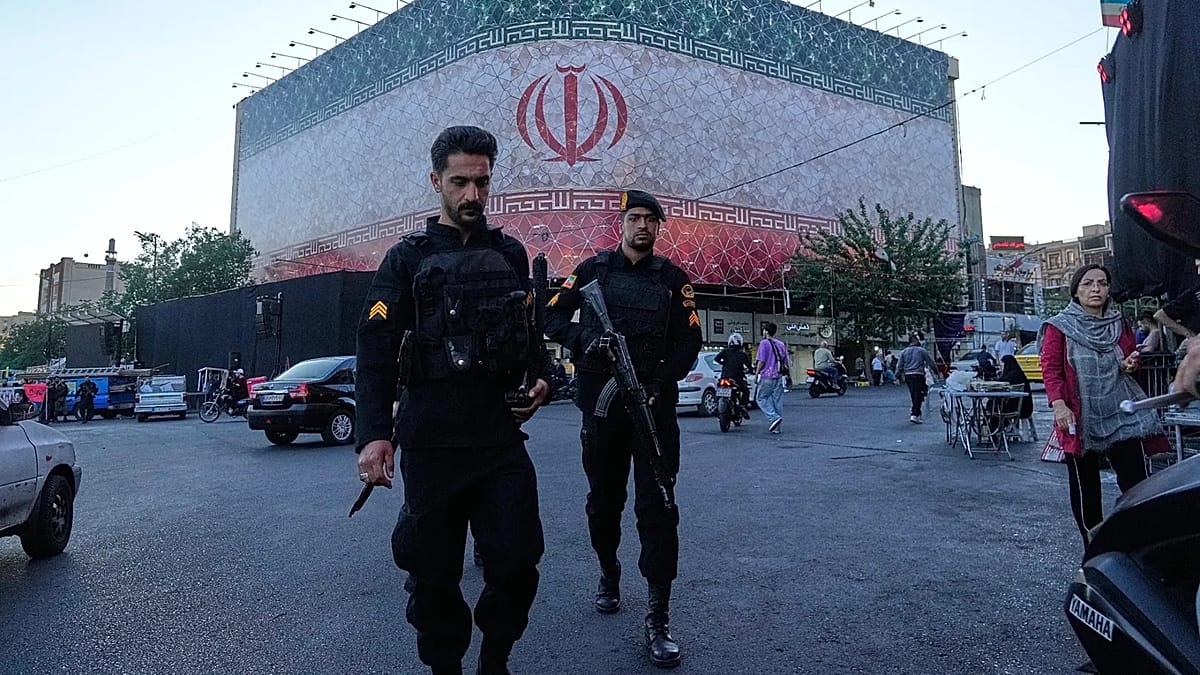
Iran declares victory and Israel digs in as US deal faces first test
Tehran declared the US “was forced to sign” a surrender while Iran’s military said enemies had “no option but to accept defeat,” as Israel said IDF forces woul…
Japan yet to decide whether to send forces to Hormuz
Japanese Defence Minister Shinjiro Koizumi said on Tuesday that his country had yet to decide whether to deploy forces to help secure the reopening of the Strait of Hormuz following the release of the US-Iran peace framework.
"At this point, no decision has been made regarding the dispatch of the Self-Defence Forces," Koizumi said.
He added that Japan intended "to consult closely with relevant countries” and “consider necessary measures within the framework of international and domestic law”.
On Monday, Japan signed a joint statement issued by Germany, Australia, Canada, Cyprus, France, Greece, Italy and the UK saying they were ready for a "defensive and independent mission to reassure commercial shipping and conduct mine clearance operations" in the strait.
The statement also said the signatories would intervene in Hormuz in accordance with their “respective constitutional requirements”.
What's in the 21st package of EU sanctions against Russia?
As G7 leaders discuss Russia's war on Ukraine, a new proposal for EU sanctions is taking shape in Brussels.
The package, unveiled last week by European Commission President Ursula von der Leyen, intends to delay the review of the oil price on Russian oil until January next year to avoid granting Moscow any economic relief as a result of the conflict in the Middle East. Remember: the price cap is a landmark G7 initiative, even if the Trump administration has shown little to no enthusiasm in strengthening its application.
The Commission's proposal also targets Russian banks, cryptocurrency firms and, for the first time, fisheries. Its most striking element is a proposal to ban Russian soldiers who have taken part in the invasion of Ukraine from entering the Schengen Area.
The proposal was pitched by Estonia and is under discussion, but it is not yet clear how this unprecedented measure will be implemented in practice.
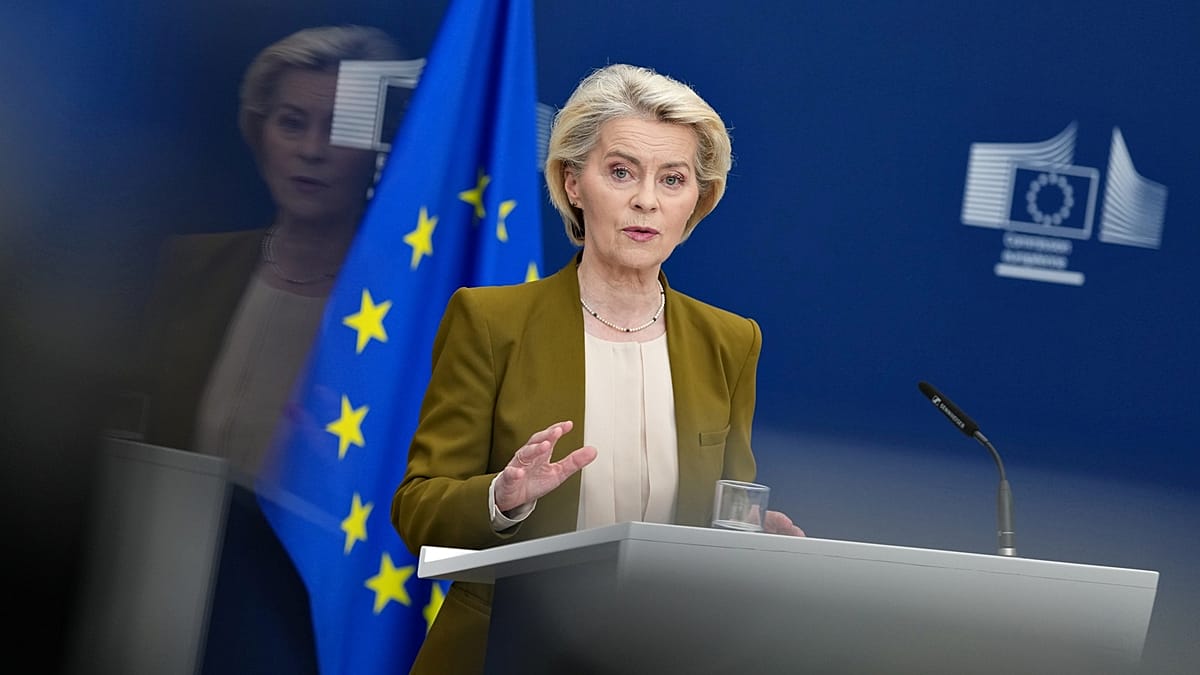
EU proposes new sanctions on Russian oil, ‘shadow fleet’ and soldiers
The new package of sanctions is intended to delay a scheduled review of the price cap on Russian oil, which has surged following the closure of the Strait of H…
Trump said Ukraine had 'no cards' – but Kyiv is now playing a stronger hand
In a now-infamous Oval Office row in Februrary 2025, Donald Trump told Volodymyr Zelenskyy that Ukraine “doesn’t have the cards” to defeat Russia. But as the two meet again at the G7 summit, Ukraine’s president is in a significantly different position.
The war in Iran has cast Kyiv as a drone warfare innovator of international importance, with Gulf states – many of them longstanding US allies – signing defence agreements with Ukraine, while European countries and the EU prepare to follow suit.
At the same time, Ukraine has stepped up mid- and long-range strikes on Russia’s energy and military infrastructure, while continuing efforts to sever Moscow’s hold over occupied Crimea.
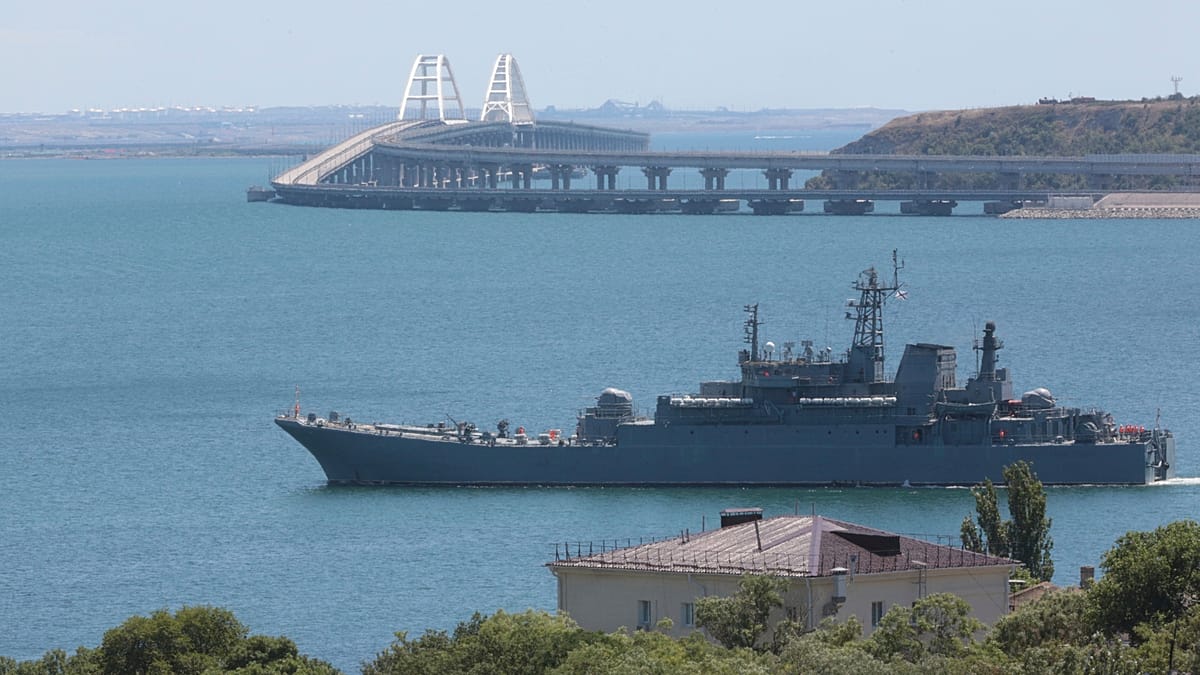
Ukraine's strikes are methodically cutting Crimea off from Russia
Ukraine has significantly intensified its strikes on military and energy sites in and around Russia-occupied Crimea in what is seen as Kyiv’s deliberate strate…
Trump dubs $300 billion reconstruction fund for Iran 'fake news'
US President Donald Trump has denied that the US would set up a fund worth $300 billion to reconstruct Iran as part of the framework agreement to conclude hostilities in the Middle East, dubbing it "fake news".
The rebuke came after reports that a potential peace deal with Tehran could include reconstruction money, the release of frozen Iranian funds, and sanction relief contingent upon respect for the overall agreement.
These initial indications appeared to be confirmed by US Vice President JD Vance during an interview with CBS News on Monday. Asked about the fund, he replied: "That’s the sort of thing they could have access to, funded by the Gulf Coast Coalition, so long as they honour their end of the obligation.”
Can EU countries reach common ground on direct talks with Russia?
For the past few weeks, President Zelenskyy has been urging Europeans to step up their engagement in the peace negotiations between Ukraine and Russia, currently stalled, and appoint a representative who can speak on behalf of the 27. The request sent into overdrive speculation about a "special envoy", with names like António Costa, Alexander Stubb, Mario Draghi and Angela Merkel floated as potential candidates.
Still, the 27 member states cannot seem to make up their minds. Some, like Bulgaria and Slovakia, want direct talks with Russia as soon as possible. Others, like France and Germany, are laying the groundwork for a new format. But another camp, which includes Poland, the Baltics and the Nordics, believes negotiations with Moscow are pointless because President Vladimir Putin has not moved one inch from his maximalist demands and continues to bombard Ukrainian cities at a relentless pace. High Representative Kaja Kallas has warned that the EU could "never" be a neutral mediator because it's clearly on Ukraine's side.
The debate will continue later this week at an EU summit in Brussels, which may (or not) be influenced by the outcome of this G7.
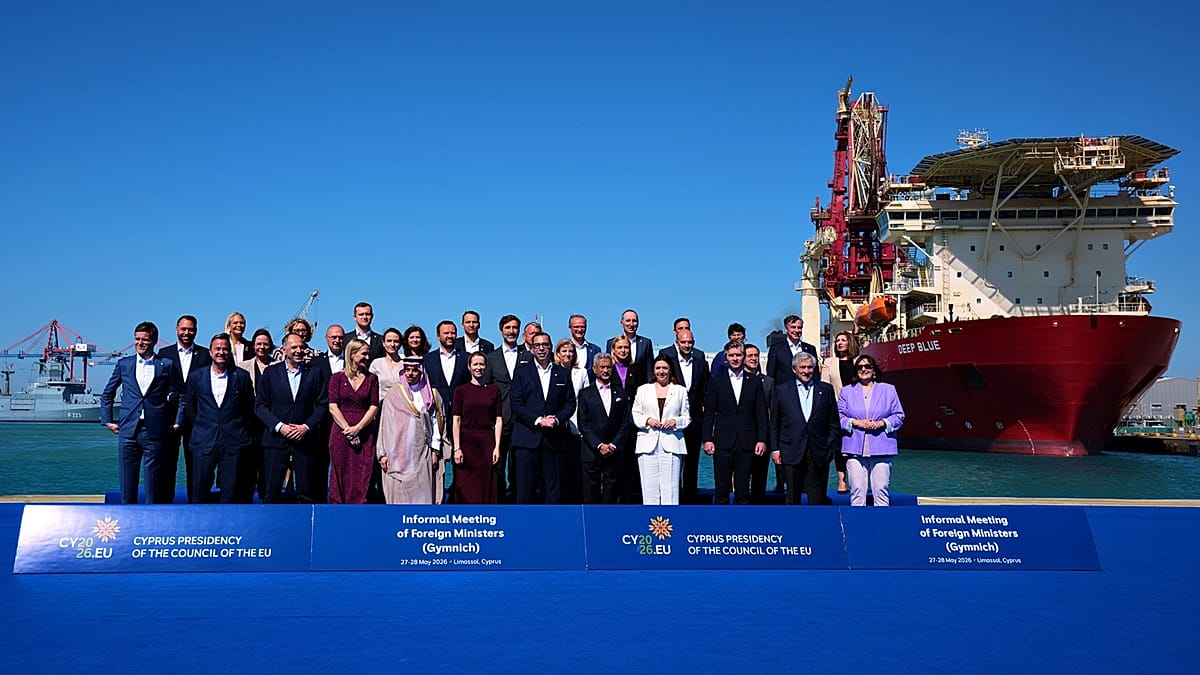
EU countries insist on unity to avoid Russia’s special envoy ‘trap’
The debate on who should be the special EU envoy for negotiations with the Kremlin is “a trap that Russia wants us to walk into”, High Representative Kaja Kall…
Merz's customised gift to Trump
The World Cup mania has officially arrived at the G7 summit.
We’ve just seen German Chancellor Friedrich Merz present Donald Trump with a customised Germany national football team shirt, featuring the number 47.
Remember: Trump is both the 45th and 47th president of the United States.
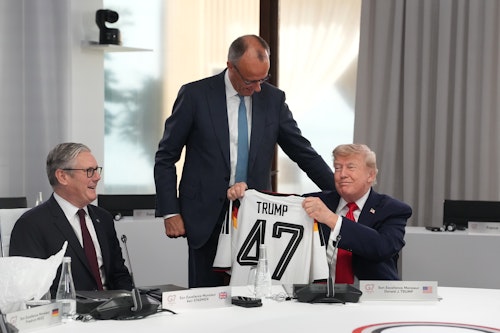
Credit: Associated Press.
‘I will arrange that’ Macron tells Zelenskyy asking about bilateral meetings at G7
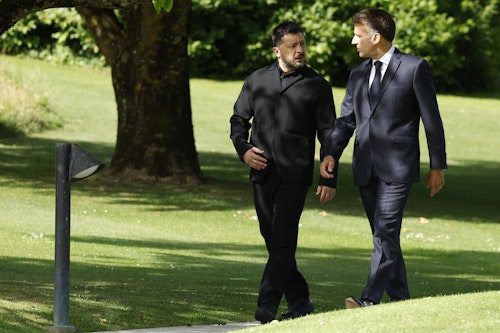
Emmanuel Macron broke with traditional protocol on Tuesday as he stepped away from the main entrance of the Hôtel Royal to personally welcome Volodymyr Zelenskyy at a secondary gate upon his arrival to the G7 summit.
The two leaders then took a brief walk together ahead of formal proceedings, using the moment to exchange views before joining other G7 counterparts for discussions centred on Russia’s ongoing war in Ukraine.
Zelenskyy indicated he would remain in Evian-les-Bains through Wednesday, before travelling to Brussels for the European Council summit on 18 June.
Their conversation, partially captured on a live broadcast, suggested ongoing efforts to coordinate bilateral meetings on the margins of the summit. Among the most consequential is expected to be a potential meeting with US President Donald Trump.
Macron was overheard telling Zelenskyy, “I will arrange that”, in what appeared to be a reference to facilitating such talks, adding that a meeting could take place “tonight or tomorrow”.
Leaders begin working session on Ukraine
G7 leaders and Volodymyr Zelenskyy have begun their working session titled "Peacebuilding and security for Ukraine and Europe".
Among the topics: military support for Ukraine, sanctions on Russia and ways to revive the peace negotiations.
Yesterday, Donald Trump said the United States would shift its diplomatic focus back to Ukraine after reaching a framework deal with Iran, whose details have not yet been released.
Trump, Macron and Zelenskyy enter the room
Donald Trump, Emmanuel Macron and Volodymyr Zelenskyy have entered the room.
"Good morning, Donald," Ursula von der Leyen told Trump.
After the greeting, the leaders took their seats.
Zelenskyy and Macron hold bilateral meeting
As the other leaders enjoy their small talk, Volodymyr Zelenskyy and Emmanuel Macron are holding a bilateral meeting.
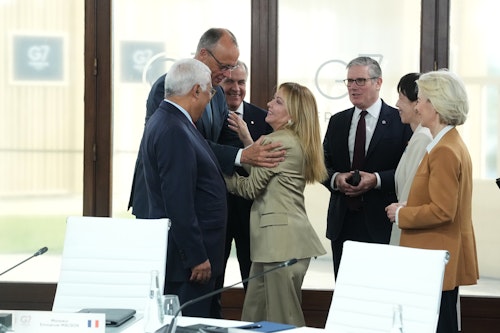
Open mic catches leaders in candid talk
If you're following the AP live transmission, you can perfectly hear the G7 leaders engage in small talk.
António Costa seemed to be retelling old anecdotes, while Giorgia Meloni told one of her fellow leaders: "You've been smoking with me." Can you guess?
Earlier, when Macron greeted Zelenskyy in the garden, we could also hear their interaction. "Tonight, you are free?" Macron asked Zelenskyy.
Credit: Associated Press
Zelenskyy at G7: talks with Putin and more air defence
Zelenskyy’s talks with the G7 leaders in Evian will be focused on two main points: forcing Russia into direct talks with Kyiv and providing more anti-ballistic air defence for Ukraine.
French president Emmanuel Macron said he’ll seek to persuade his US counterpart Donald Trump to continue supporting Ukraine and increase pressure on Russia to help reach a peace agreement.
In an open letter earlier this month, Zelenskyy offered Russian president Vladimir Putin to meet face-to-face to put an end to Moscow’s war, but Putin refused.
Ukraine’s president also suggested to the Russian leader to hold a meeting around the G7 gathering, but the Kremlin hasn’t responded to the proposal.
"We gave message that we are ready to meet with Putin during (the) G7, because Trump is there and Macron is there, so Europeans plus America. This is a good, I think, very good opportunity to meet all together," Zelenskyy said on Monday in Kyiv.
Following a phone call with Trump on Sunday, Zelenskyy said he suggested this idea to the US president as well.
"We discussed with President Trump that such a meeting could be organised in the US in a format that would make it much harder for Putin to refuse, at least to refuse President Trump," he said.
But so far the Kremlin rejects any possibility of meeting Ukraine’s president and instead continues to strike Ukraine with dozens of ballistic missiles, exploiting Ukraine’s shortage of Patriot systems.
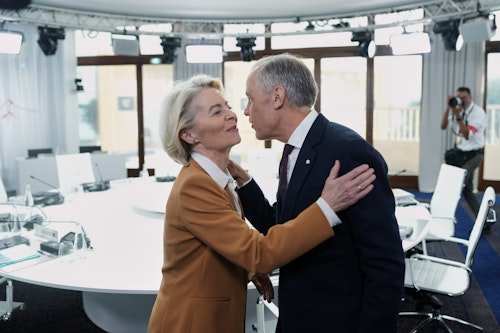
Leaders greet each other
G7 leaders are gathered in the room ahead of today's first working session, focused on Russia's war on Ukraine.
We can see them engaged in small talk ahead of the big talk.
"Did you sleep a bit?" Giorgia Meloni asks Sanae Takaichi.
Credit: Associated Press
Zelenskyy at G7 while Ukraine intensifies attacks on Russian energy infrastructure
As Volodymyr Zelenskyy arrived in Évian for the G7 summit, Moscow came under a drone attack that set an oil refinery about 15km from the Kremlin ablaze and forced temporary flight restrictions at Domodedovo, Sheremetyevo, Vnukovo and Zhukovsky airports.
The Moscow Oil Refinery in the Kapotnya district is the largest in the region, supplying more than a third of the capital’s fuel needs, including aviation kerosene, and processing about 11–12mn tonnes of crude a year into some 30 types of petroleum products.
Zelenskyy confirmed the strike, saying "this time, the Moscow region felt the reach of Ukraine’s long-range capabilities."
"Russia must be forced to end its war against our people. And Ukraine’s long-range weapons are one of the important components of such pressure."
A separate overnight drone strike sparked a fire at an oil depot in Krasnodar Krai, a strategic region along Russia’s Black Sea coast.
The attacks come as Zelenskyy seeks support from G7 leaders in Évian, underscoring how Ukraine’s mid- and long-range drone and strike capabilities have evolved and intensified, targeting Russia's war machine.
This time, the Moscow region felt the reach of Ukraine’s long-range capabilities. An oil refinery was hit at a distance of 500 kilometers. I thank the warriors…
Macron waits for Zelenskyy
Emmanuel Macron, the host of the G7 summit, is currently outside the hotel as he waits for Volodymyr Zelenskyy.
Sanctions: the big transatlantic chasm
As President Zelenskyy joins leaders, it's worth noting a glaring fracture in the transatlantic alliance: sanctions.
Each side of the Atlantic has gone its own way in squeezing the Russian war economy. Under Donald Trump, the White House has issued three consecutive waivers on Russian oil, the Kremlin's main source of revenue, to cope with the global disruption unleashed by the closure of the Strait of Hormuz. By contrast, the European Union has doubled down on sanctions, presenting a new proposal last week and refusing to slow down its pace.
"Our sanctions keep biting hard and cutting deep," Ursula von der Leyen said. "They are weakening the economic foundations of Russia's war effort."
However, there are limits as to how much the EU can do. Von der Leyen's idea for a full ban on maritime services for Russian tankers has lingered on the table since early February. Due to the reservations of Greece and Malta, two coastal member states that service Russian ships, the full ban was made dependent on a G7 agreement. But the G7, as we can see, is nowhere near on the same page.
"There must be stronger sanctions. And Europe can lead on that," Zelenskyy said on Monday.
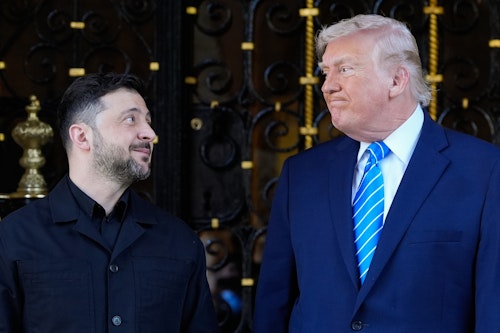
When did Zelenskyy and Trump last meet?
Zelenskyy and Trump last held a formal bilateral meeting at Mar-a-Lago in Florida in December 2025. After the talks, both leaders spoke of “great achievements” and the Ukrainian president said US security guarantees for Kyiv had been “100% agreed”.
Trump stressed back then that one major issue remained unresolved: possible territorial concessions, saying that “some of that land is maybe up for grabs” and that the sides would “have to iron that one out”.
The diplomatic process continued the following month at the World Economic Forum in Davos, where the two leaders held an hour-long meeting. Zelenskyy again pointed to security guarantees as the key deliverable, describing the Davos talks as “the last mile” before announcing a US post-war security framework for Ukraine.
That effort has lost momentume as the war launched by the US and Israel against Iran at the end of February has absorbed Washington’s attention and, critically, diverted priority access to US military supplies away from Ukraine.
What’s on Zelenskyy’s agenda at the G7?
Ukraine’s President Volodymyr Zelenskyy is scheduled to arrive at the G7 summit in Évian at 8:55 a.m., where he will be welcomed by French President Emmanuel Macron.
After a brief informal meeting with Macron, Zelenskyy will join a special G7 session dedicated to Ukraine.
Later in the day, Zelenskyy is set to hold bilateral talks with German Chancellor Friedrich Merz, Canadian Prime Minister Mark Carney, the International Monetary Fund's Managing Director Kristalina Georgieva, and UK Prime Minister Keir Starmer.
Zelenskyy’s office said there would be “other meetings” throughout the day, but did not confirm whether a meeting with US President Donald Trump is on the agenda.
Trump is already in Evian and said on Monday that after the Iran deal he will now turn his attention back to Ukraine.
“Now that this is finished, we are going to be focusing on that and see if we can get that one done,” Trump said, sitting alongside Macron.
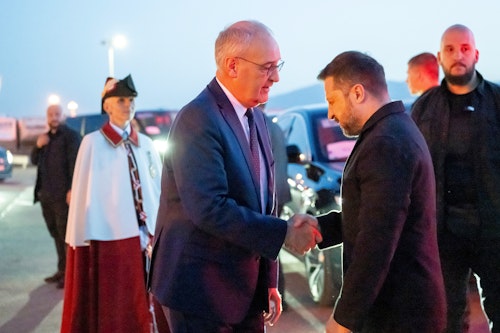
Welcome to the second day of our live blog
The second day of the G7 summit is underway in Évian-les-Bains.
The day will have three main working sessions:
- 09:00: Peacebuilding and security for Ukraine and Europe
- 12:00: Responding to crises and ensuring stability in the Middle East
- 15:15: Forging new partnerships and rebuilding international solidarity
Tuesday will see multiple guest leaders, including Ukraine's Volodymyr Zelenskyy, India's Narendra Modi, South Korea's Lee Jae Myung and Kenya's William Ruto.
The day will conclude late, with a gala dinner hosted by Emmanuel and Brigitte Macron.