






























Turkic states' leaders have joined forces to advance digital and AI expansion projects in conjunction with their regional push for trade, energy, transportation, infrastructure, and regional connectivity developments to address the world's urgent "critical issues".
Leaders of the Organisation of Turkic States (OTS) have announced at a summit in Kazakhstan that they are advancing their joint Eurasian forces towards the alliance’s strategic political and economic coordination amid rapid global geopolitical and technological developments, while emphasising that their alliance is not intended for military or geopolitical purposes.
 ADVERTISEMENT
ADVERTISEMENT
ADVERTISEMENT
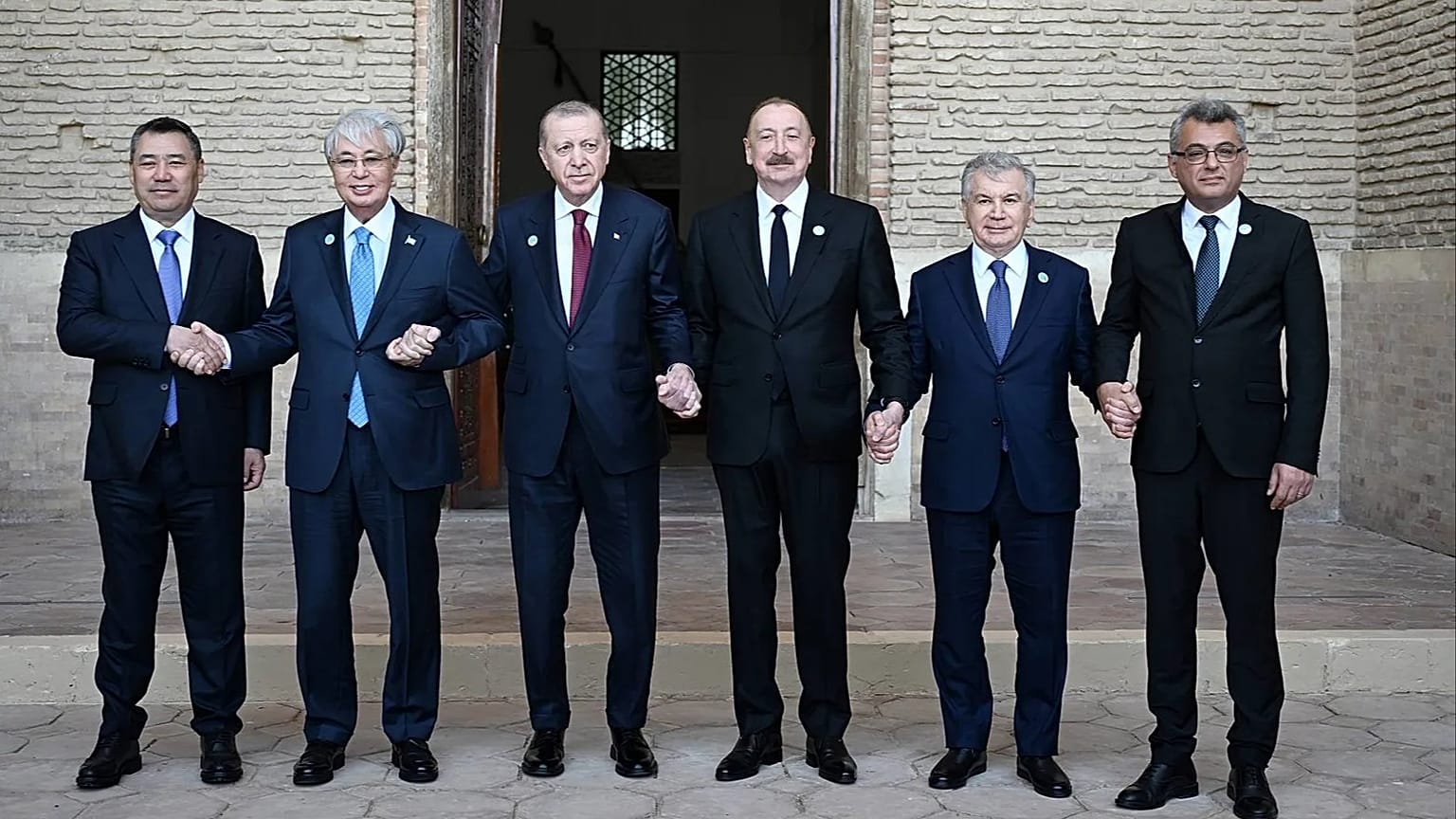
The leaders of Kazakhstan, Turkey, Azerbaijan, Uzbekistan, Kyrgyzstan and others gathered in the historic Kazakh city of Turkistan, the spiritual capital of the Turkic world, to work together on designing joint AI and digital developments and integration for the member states and the wider region, but also for the Turkic states to work together on hosting alternative global supply routes and connectivity to the world’s energy routes disruptions.
Held under the theme “Artificial Intelligence and Digital Development,” the OTS summit was hosted by Kazakhstan’s President Kassym-Jomart Tokayev and gathered his counterparts from Turkey Recep Tayyip Erdoğan, Uzbekistan’s Shavkat Mirziyoyev, Azerbaijan’s Ilham Aliyev, Kyrgyzstan’s Sadyr Zhaparov and the secretary general of the OTS, Ambassador Kubanychbek Omuraliev, for their strategic cooperation whose combined economic potential reached $2.4 trillion in 2025, as announced by Uzbekistan’s president.
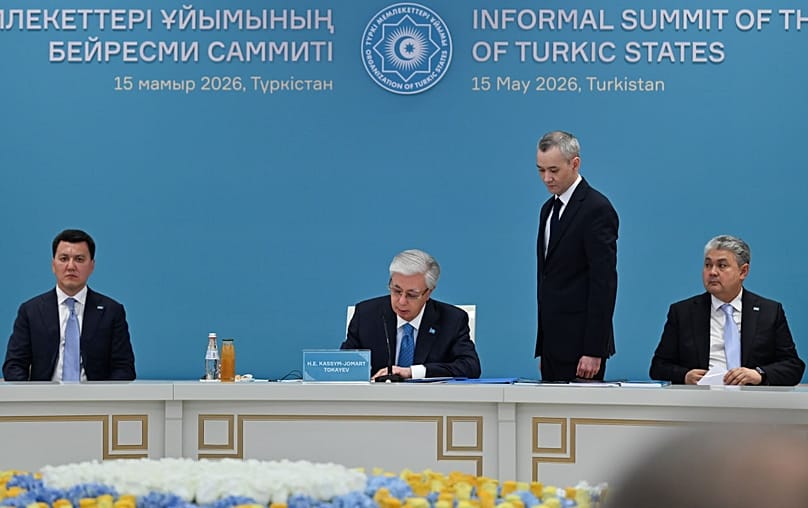
The leaders sent a strong united message by posing holding hands in front of the mausoleum of Khoja Ahmed Yasawi, built in the 14th century and now the key spiritual landmark of Kazakhstan and the Turkic world as a whole, standing also as a symbol of the Turkic heritage of trade and cultural cooperation along the historic Silk Road.
“For us, strengthening the unity of the Turkic world is an extremely important priority,” Kazakhstan’s Tokayev said, countering claims that the increasing Turkic nations' cooperation may take military or geopolitical dimensions.
“The Organisation of Turkic States is not a geopolitical project, not a military organisation. This is a unique platform for strengthening trade, economic, high-tech, digital, cultural and humanitarian cooperation between fraternal countries,” Tokayev stated, outlining his country’s diplomatic stance of cooperation and progress, rather than competition.
Driving what he called great regional integration across the Turkic world, OTS Secretary General Omuraliev told Euronews that “with each sector now connected to AI and digital development, nobody can go it alone in this area, and so we agreed to cooperate in a minimum 58 areas of digital and AI."
"For instance, we have our own projects in transport and logistics for which we will have e-permits, SME support and other mechanisms," Omuraliev said.
The “E-Permit” project will strengthen regional connectivity by simplifying cargo transportation systems and procedures among the member states.
Kazakhstan’s president Tokayev said the Turkic countries must increase their efforts in digital transformation “to avoid remaining on the sidelines of progress.”
Digital initiatives galore
Tokayev and all the attending presidents announced multiple initiatives to advance digital cooperation, such as establishing joint AI centres in Turkish states, cooperating in cybersecurity, implementing UN-originated digital projects, establishing a new Artificial Intelligence University for Turkic students, and others.
“In an era of technological competition, digital transformation and artificial intelligence must ensure the shared progress of the Turkic world,” Tokayev said.
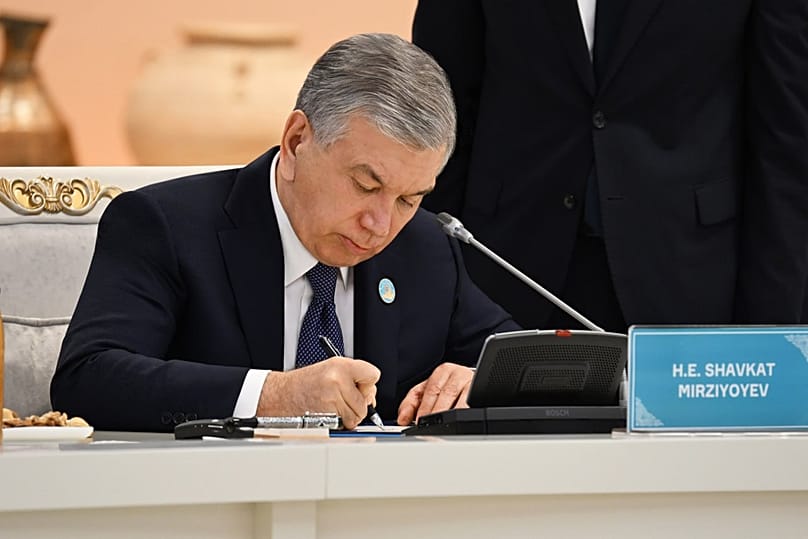
Mirziyoyev announced the “Five Million AI Leaders” programme, designed for future jobs linked to new digital developments, and the establishment of a joint venture fund by Uzbekistan and Kazakhstan for youth start-up projects, as part of both countries’ major education projects.
He also proposed a strategic cooperation network in AI to create what he called a unified digital space across the Turkic nations, and to develop a “Digital Turkic Corridor” for regional data exchange and to support technological evolution.
"We have shared digital projects with the other Turkic countries," Kazakhstan's Deputy Prime Minister and Minister of Artificial Intelligence and Digital Development Zhaslan Madiyev told Euronews.
"Kazakhstan is developed in the area of online services, we are among the top 10 countries in the UN index of digital services and among the 24 most advanced countries in the category of online service platforms and we wish to share that," Madiyev said.
Stating that “the world is entering a new stage of development” and that “the Turkic states must take a leading role in this process,” Azerbaijan’s President Aliyev said that ‘the implementation of the Digital Silk Road project between Europe and Asia is underway
"And as part of this project, the Trans-Caspian fiber-optic cable line between Azerbaijan and Kazakhstan is expected to become operational in the coming months," he added.
Madiyev told Euronews that the fiber-optic project "will help attract big tech giants and hyper-scalers to locate their computing power resources in our countries."
Turkey, Kazakhstan and Azerbaijan are also developing together a so-called CubeSat scientific satellite to be launched next year.
"Each country can contribute its own technology, and it will be a scientific satellite that we hope to launch next year. Over time, it may become part of a wider constellation of satellites," Madiyev explained.
Transport routes strategic priority
The OTS foreign ministers met separately to work together on evolving plans for global transport routes, with the Middle Corridor one at the centre of the regional focus.
The presidents underlined the need to form a united front to address rapid global geopolitical developments and to take the initiative in global energy security opportunities.
Turkey’s president Erdogan called on the “strategic value of the Turkic World acting in solidarity” while referring to the “the crises taking place in our immediate region,” and that the “Turkic world has gained high-level reflexes in the face of common issues.”
“As the ongoing crisis centered on the Strait of Hormuz demonstrates, transportation projects that interconnect the Turkic world, particularly the Middle Corridor, will remain a priority for us for many more years. Palestine, Lebanon, Iran, Ukraine, and many other crises indicate that we need to strengthen our defense and increase our cooperation in the field of industry,” Erdoğan said.
A strategic priority for the OTS countries, the Middle Corridor, also known as the Trans-Caspian International Transport Route (TITR), is a transport network by rail and maritime routes connecting China and Southeast Asia, through Kazakhstan, Azerbaijan and Georgia, and onwards to Turkey and Europe.
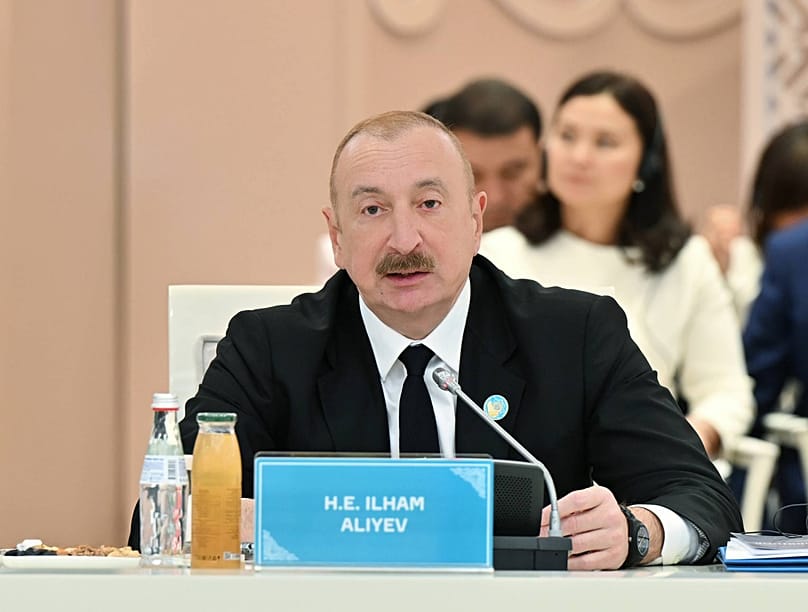
Aliyev said “our family, the Turkic world must transform into one of the influential geopolitical power centers of the 21st century.”
Underlining how the Turkic states cooperation in the transport sector is expanding, Aliyev said that “in the current global geopolitical environment, the importance of the Middle Corridor continues further."
"The Zangezur Corridor, which is moving toward realisation, will become one of the key segments of the Middle Corridor.”
Uzbekistan’s president Mirziyoyev said that cooperation among Turkic nations is a long-term strategic priority, as he discussed with Kyrgyz president Sadyr Japarov accelerating the China-Kyrgyzstan-Uzbekistan railway project, which will be a key Central Asian transport and connectivity route.
“Our meeting is taking place at a time when tensions are escalating around the world. Trust in international relations is waning, and the role and influence of global institutions are diminishing. These challenges require us to intensify our dialogue and develop unified positions on critical issues,” Mirziyoyev said.
Uzbekistan’s president emphasised the growing influence of the OTS, with its combined economic potential reaching $2.4 trillion in 2025.
The OTS was established in 2009, with its headquarters in Istanbul, and has five member states: Turkey, Azerbaijan, Kazakhstan, Kyrgyzstan and Uzbekistan.