














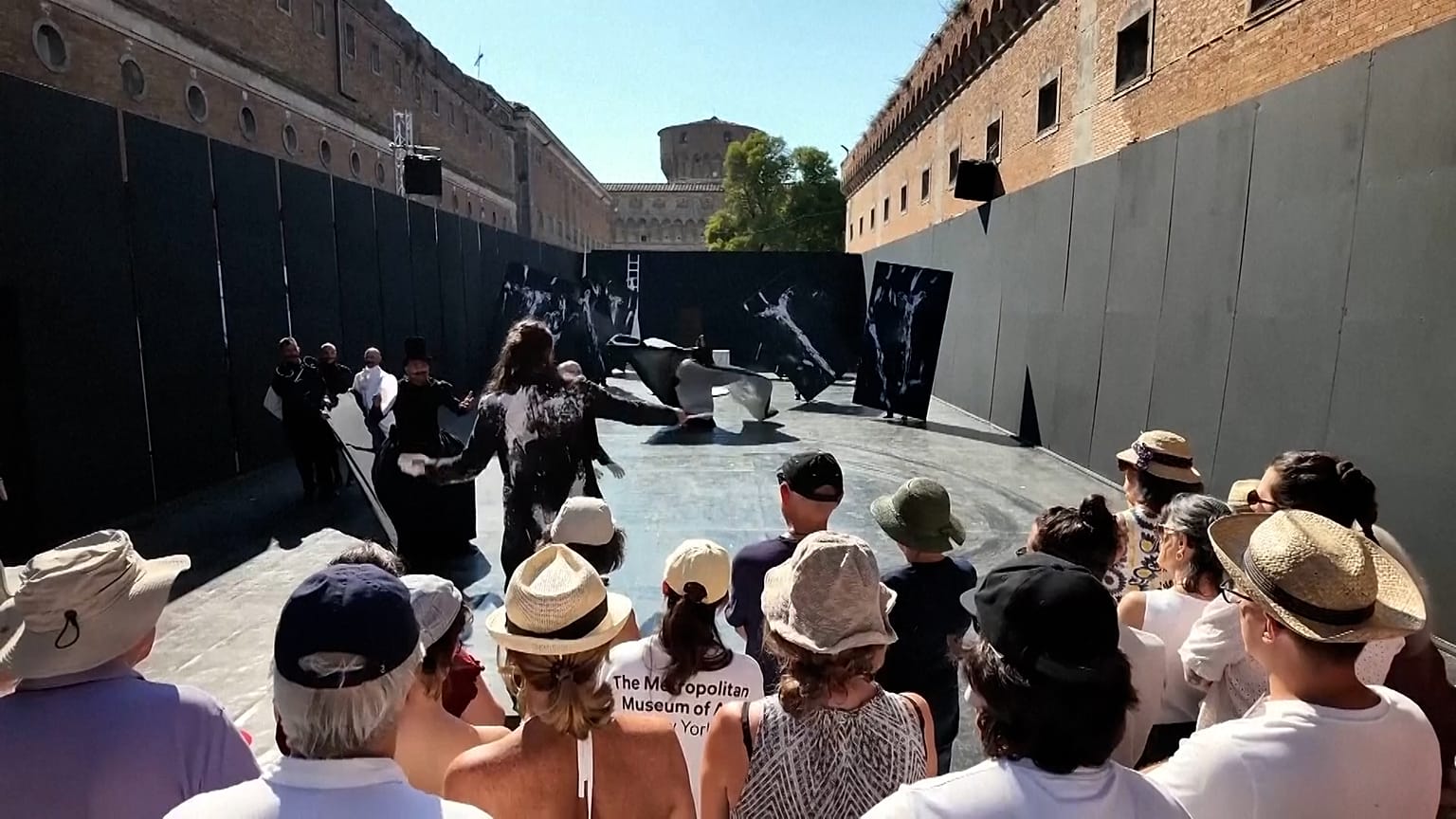














At Italy’s Volterra prison, inmates work alongside professional theatre-makers as part of the long-running Compagnia della Fortezza project.
For some prisoners in Italy, life behind bars has become an unlikely route towards freedom.
 ADVERTISEMENT
ADVERTISEMENT
ADVERTISEMENT
At Volterra prison, one of Italy’s oldest jails, professional theatre-makers have spent almost four decades working alongside inmates to create ambitious performances that challenge conventional ideas about punishment, rehabilitation and the role of art.
The project, known as the “Compagnia della Fortezza”, was founded by director Armando Punzo, who originally entered the prison looking for actors for a theatre company unlike any other.
"I wanted to put theatre to the test in a situation where, even if naively, I thought, and I believe it was the case, that art and culture had absolutely nothing to do with it. And I found that extremely interesting and challenging,” says Punzo.
Instead of professional actors, he found a multicultural group of prisoners with little or no connection to theatre.
"I encountered people who had never once reflected on themselves differently. They were deeply immersed, just as we all are, in their ordinary lives, their lives were vastly different from ours, yet driven by the exact same mechanism,” he says.
"Being immersed in one’s ordinary life, a life that was evidently extremely difficult, both for themselves and for others. Yet, I also found people capable of reflecting on themselves. This tells us that art and culture can truly reach everyone; if they fail to do so, it is simply because the necessary work to make that happen has not been done," he adds.
A new production is created each year, while previous performances are revisited and brought back to the stage as part of a continuous process of research and artistic development.
Prisoners are involved in the creative process itself, working alongside professional theatre-makers across different aspects of the productions.
Finding freedom in confinement
For many, it has become an important part of their lives and an opportunity to engage with a form of expression they had never previously considered.
Giacomo arrived in Volterra from another prison in 2024. He had requested a transfer to this facility specifically because he was aware of the theatre work being done here, and he was immediately integrated into the company.
"Life on the outside leads you to lose yourself, and to lose all those aspects that, however silly it may sound to say, I am actually rediscovering in here. The metaphor, which I find incredibly important, is that by losing my freedom in here, within a state of total confinement, I am finding total openness,” he shares.
That same openness allows prisoners to work side-by-side with other theatre professionals every day to create the shows.
"Theatre can transform any space. Doing so is inherent to the language of theatre, and therefore, this is theatre. When we do this, the prison steps aside, much like an actor who sets aside a part of himself when stepping onto the stage,” says Viola Ferro, a young actress that chose to join the acting company.
Rehabilitation beyond punishment
For prison director Valentina Bruno, the theatre project forms part of a wider approach to rehabilitation, in which prisoners are treated as people rather than simply as inmates.
"They (prisoners) feel that the staff cares for them in the best possible way. They feel valued as individuals, not merely as numbers or files. They feel that they matter, and that their family context matters too, given the frequent contact we maintain with their relatives”, she says.
“Above all, I believe what they strongly feel is hope: the hope of returning to society, whether upon completing their sentence or even sooner, as changed individuals capable of giving something back to the community,” she adds.
The work of the company is perhaps most striking when its performances open the prison to the outside world. The courtyard becomes a theatre, with the fortress walls forming the backdrop and members of the public entering the prison to watch the performances.
Writer Maria Nadotti, who regularly attends the performances, says the company represents something increasingly unusual in contemporary theatre.
"I have absolute admiration for the work of the “Compagnia della Fortezza” and for something that, in my view, is increasingly rare in theatre, and not just in Italy, a combination of imagination, joy, energy, and an absolute passion for wonder, wonder is the soul of the world, and it is all present here,” she says.