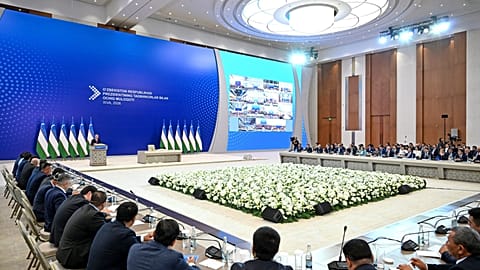































At the Tashkent event, industrial uses and internationally active startups offer signs of a broader technology ecosystem taking shape. But affordable access to computing power remains a constraint for local companies.
Uzbekistan says investment commitments for new data centres now exceed $6bn (€5.3bn), as it tries to build the computing power needed to develop artificial intelligence at home rather than rely mainly on infrastructure abroad.
 ADVERTISEMENT
ADVERTISEMENT
ADVERTISEMENT
Some of that capacity is already operating. A new government computing cluster using Nvidia technology was launched this summer to run AI projects, while much larger commercial data-centre developments are now under development.

The expansion is also drawing international capital into Central Asia’s technology sector. It is one of the main themes at ICT Week Uzbekistan 2026 in Tashkent, an annual event bringing together technology companies, investors, startups and policymakers from Uzbekistan and abroad.
Building the computing power behind AI
Running and developing AI systems requires large amounts of computing power, often provided by clusters of specialised processors known as GPUs.
Uzbekistan’s Ministry of Digital Technologies says its new Nvidia-based government cluster reached 90% utilisation within its first month, an indication of the demand for computing capacity.
“We have the government data centre, which is serving the government needs, and we have installed our Nvidia chips for government needs,” Digital Technologies Minister Sherzod Shermatov told Euronews. “And we are in the process of procuring the next stage.”
Private projects are much larger.
Saudi-based DataVolt is developing a 12-megawatt data centre in Tashkent designed to support AI and other computing-intensive services. The first phase is expected to become operational by the end of 2026.
The project has secured up to $150mn (€131.4mn) in financing from an international group that includes the European Bank for Reconstruction and Development, Germany’s DEG, France’s Proparco and the OPEC Fund for International Development.
“These 12MW will be ready by the end of this year,” Shermatov said. He said the project is ultimately planned to reach 300 megawatts, with later stages extending into other regions.
Another large data-centre project is being developed in Karakalpakstan in western Uzbekistan by Shanghai LinkWise Data Intelligence.
Shermatov said investment commitments for data-centre developments across the country now total more than $6bn (€5.3bn).
From infrastructure to practical applications
The government says more than 100 AI projects are being developed under its national strategy.
Some are focused on public services. Sarvarbek Abdullayev, Director of the AI Department at the Ministry of Digital Technologies, said one platform allows people to request government information, including tax records, through a conversational interface.
Another system is designed to help public-sector employees analyse documents, summarise their contents and prepare responses.

AI is also moving into industrial projects.
The ministry is working with mining and metallurgical companies on drone and robotic systems that can scan mining areas.
“We are working with the Navoi and Almalik metallurgical companies,” Abdullayev said. “Together with them, we are developing the drone technology and robotic technologies in the mining field.”
More than 20 AI laboratories are also planned at universities by the end of the year, according to the ministry.
Another project addresses a challenge specific to countries whose languages are less well represented in global AI systems. The government is developing an Uzbek-language corpus, a large structured collection of text that can be used by developers to improve how large language models understand and generate Uzbek.
The cost of accessing AI
Building data centres does not automatically mean that local companies can afford to use the computing power they provide.
That issue is particularly important for startups and smaller technology companies, which often cannot finance their own infrastructure.
“We see very impressive progress in terms of the infrastructure development, human capital development and adoption of AI, mostly by startups, by the private sector,” said Shamil Ibragimov, Director of Research at the MIT Kuo Sharper Center for Prosperity and Entrepreneurship.
But Ibragimov said computing power remains expensive for many startups in Uzbekistan, with some still relying on international cloud providers.
Richard Stirling, CEO of Oxford Insights, said startup activity provides another indication of how far AI is moving beyond government strategies.

“If you're looking for evidence of Uzbekistan building genuine AI capacity, look beyond the strategies, documents, and regulations,” he said.
According to Stirling, 180 startups using AI are already exporting to 80 countries.
For larger established companies, however, adoption has been slower, according to Ibragimov. He said the computing capacity currently available inside Uzbekistan is still not enough to meet demand at a price that many local companies and startups can afford.