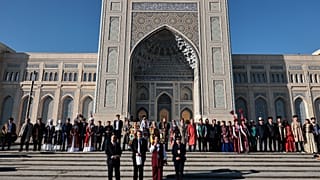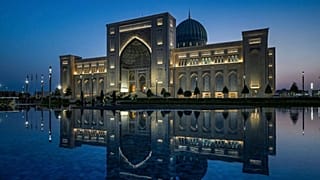













When Uzbekistan’s President Shavkat Mirziyoyev first told the United Nations General Assembly in 2017 that his country planned to establish an Islamic Civilization Center, the ambition was clear: this would not be another national museum, but a global cultural institution.
The aim, he said at the time, was to create a place that would reflect Uzbekistan’s contribution to science, culture and enlightenment – not just for the Islamic world, but for humanity as a whole. Eight years later, that idea has taken concrete form in Tashkent.
In 2025, the Center began to position itself internationally, developing from a cultural landmark into part of a broader effort to reshape how Uzbekistan is understood beyond its borders.
Moving beyond the Silk Road cliché
For many European audiences, Uzbekistan is still framed through two dominant narratives: the Silk Road and the Soviet Union. Both are historically important, but they leave out a third, less familiar story – Central Asia as one of the great intellectual engines of the medieval world.
From the 9th to the 12th centuries, scholars from the region now known as Uzbekistan played a foundational role in mathematics, medicine, astronomy, philosophy and literature during what is often called the Islamic Golden Age. Thinkers such as Ibn Sina (Avicenna), whose Canon of Medicine was taught in European universities for centuries, or the poet Alisher Navoi, whose works helped shape Turkic literary culture, were not peripheral figures. They were central to how knowledge travelled between East and West.
By celebrating these scholars, the Center shows how the ancient lands of Uzbekistan were a crossroads of learning, their influence rippling from Spain to India.
A platform for dialogue, not nostalgia
Speaking again at the UN General Assembly in 2025, President Mirziyoyev described the Center as a new global platform for dialogue between civilizations.
Rather than presenting Islamic heritage as something frozen in time, the institution positions it as humanistic, scholarly and outward-looking.
This approach reflects a wider trend across Europe and beyond: a renewed interest in how intercultural exchange shaped modern science and thought. In that sense, the Center’s ambitions resonate far beyond Central Asia.
International partnerships in 2025
Throughout 2025, the Center actively built links with major cultural and academic institutions abroad.
In Malaysia, it struck a cultural partnership and secured access to a collection of around 100,000 rare books, and hosted a joint roundtable at Kuala Lumpur’s Museum of Islamic Art examining historical links between Southeast Asia and Central Asia.
In the UK, specialists from the Center worked with the Bodleian Library at the University of Oxford to study rare manuscripts, including works by Alisher Navoi, and agreed on reproductions of these texts to be kept in the Center’s library. In Bologna, Italy, scholars identified nearly 200 Turkic-language manuscripts and early copies of Ibn Sina’s Canon of Medicine, underscoring how Central Asian scholarship once circulated through Europe.
Together, these discoveries reinforce a simple point: the intellectual influence of Central Asia travelled far beyond its geography, from Iberia to South Asia.
Using modern tools to tell old stories
The Center combines traditional scholarship with contemporary exhibition design. Interactive installations, multimedia displays and more than 300 short films are designed to make complex historical ideas accessible to a broad public.
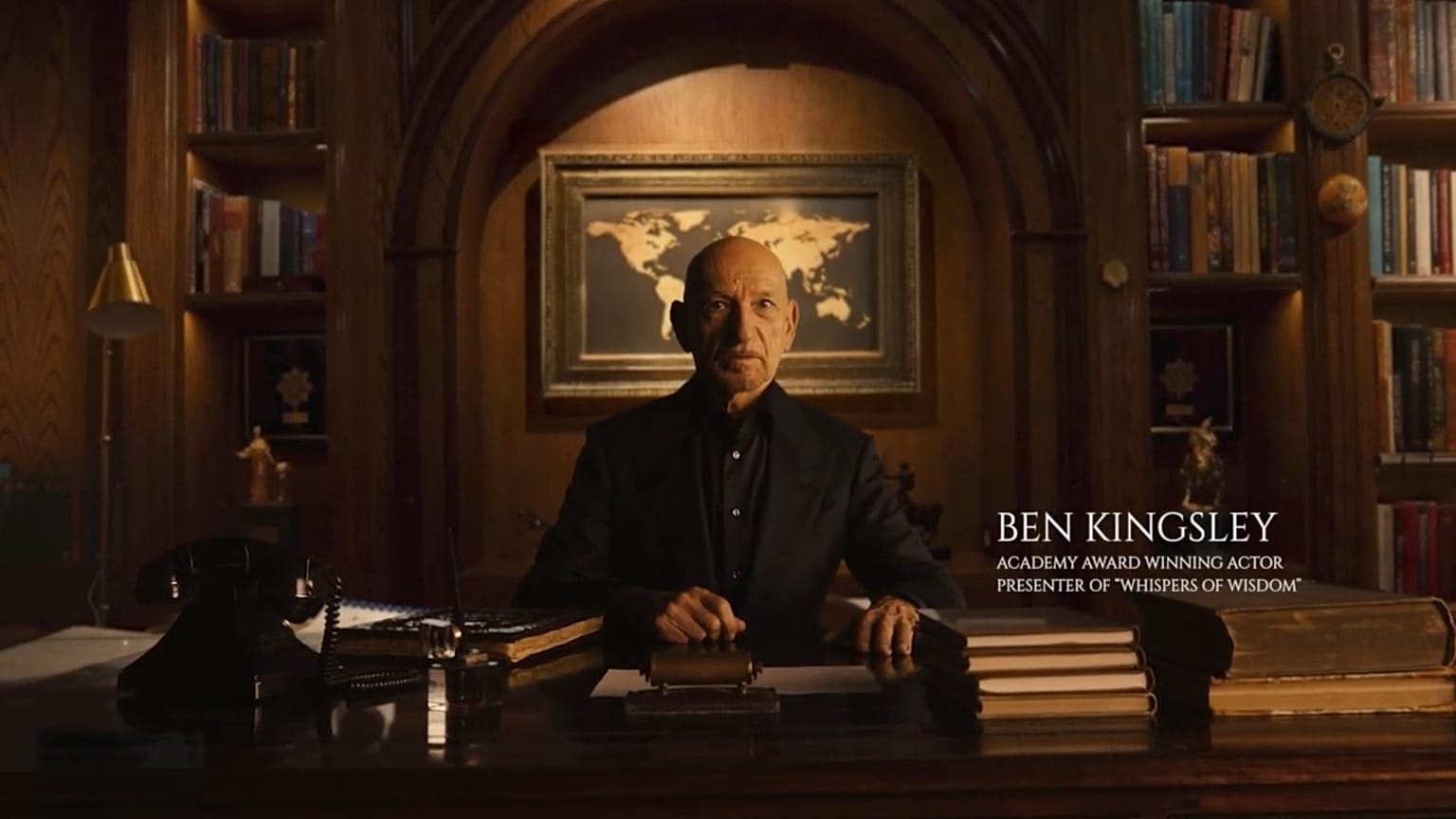
One of the flagship projects, Whispers of Wisdom, narrated by Oscar-winning actor Ben Kingsley, uses short cinematic portraits to introduce global audiences to scholars and thinkers connected to Uzbekistan.
Growing international recognition
By the end of 2025, organisations including ICESCO, TURKSOY and the Oxford Centre for Islamic Studies had engaged directly with the project. More than 100 international experts toured the complex in Tashkent, and dedicated office space has been set aside inside the Center for long-term partner institutions.
Two high-profile events marked the year. An international expert forum titled The Great Heritage of the Past – the Basis of an Enlightened Future brought together participants from over 20 countries, while a regional congress on Central Asia’s shared spiritual heritage saw five heads of state visit the Center together.
Reuniting heritage with its origins
Thanks to the will and leadership of the President of Uzbekistan, the Center has been able to bring back to Uzbekistan more than 1,000 unique artefacts. In close cooperation with private collectors and international partners, more than 1,000 artefacts were returned to Uzbekistan in 2025, including manuscripts, scientific instruments, ceramics, and Qur’anic fragments.
Some items carry particular symbolic weight. Among them are fragments linked to the Kaaba in Mecca – Islam’s holiest site, towards which Muslims around the world pray. These include part of the Kiswah, the black cloth that covers the Kaaba, and a fragment associated with its ceremonial keys, gifted following discussions with Saudi Arabia. For Muslim visitors, such objects carry deep spiritual significance; for non-Muslim audiences, they underline the Center’s international religious connections.
Other discoveries are quieter but equally significant. In the UK, experts authenticated a small bronze stag believed to originate from the territory of modern-day Uzbekistan – a reminder that Central Asian art and culture has long influenced distant nations.
The heart of the Center
At the architectural and symbolic centre of the complex is the Mushaf of Uthman, one of the world’s oldest known Qur’an manuscripts, dating to the 7th century and listed on UNESCO’s Memory of the World Register. It is housed beneath a 65-metre-high dome in the Center’s central hall, alongside a gallery of 114 rare Qur’ans tracing the evolution of Islamic calligraphy.
The building also now hosts the Spiritual Administration of Muslims of Uzbekistan, reinforcing its role as both a cultural and religious landmark.
Global expertise, local identity
More than 1,500 specialists – architects, historians, artisans, conservators and technologists from Uzbekistan and abroad – contributed to the Center’s curation. Its design blends traditional Uzbek motifs with contemporary openness, guiding visitors through pre-Islamic history, the region’s First and Second intellectual Renaissances, and a final section dedicated to what Uzbekistan’s leadership describes as a modern “Third Renaissance”.
A changing narrative
For European audiences, the significance of the Islamic Civilization Center lies less in spectacle than in storytelling. It challenges the idea that innovation flowed in only one direction, from West to East, and instead highlights centuries of shared intellectual exchange.
If 2025 marked the Center’s international debut, 2026 is set to be the year it fully opens to the public. With it comes a broader shift in perception: Uzbekistan not just as a historic trade crossroads, but as a cornerstone of global knowledge.