
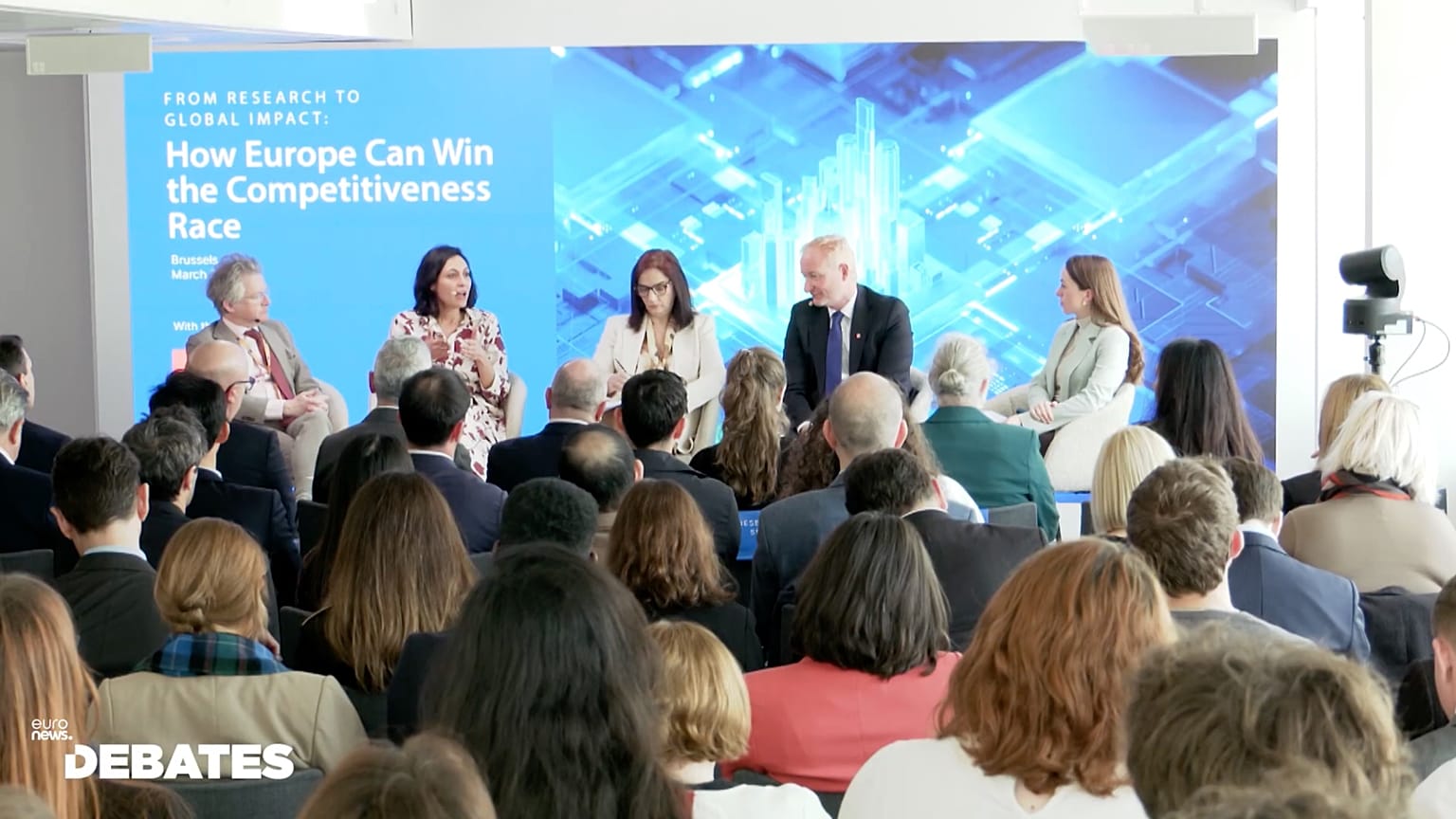














An updated data‑driven edition of the European Patent Office’s annual patent statistics was presented in Brussels, offering new insights into Europe’s innovation performance and current technology trends.
 ADVERTISEMENT
ADVERTISEMENT
ADVERTISEMENT
At a Euronews event, From research to global impact: how Europe can win the competitiveness race, the European Patent Office (EPO) presented its new Technology Dashboard, its global patent data platform for governments, researchers and investors.
The aim is to identify emerging technologies early and provide evidence‑based insights into how innovation is evolving across sectors and regions, helping policymakers, investors and innovators better understand where innovation activity is accelerating and where support is most urgently needed.
“This is the link between what we do as a patent office and the intelligence we can collect that can help and support policymakers and researchers in the lab to identify the spot where we should invest, and when we should support,” said EPO Chief Patent Research and Policy Officer, Gilles Requena.
Turning patent data into foresight
The Technology Dashboard builds on the EPO’s vast dataset of global patent filings, offering a more granular and forward-looking view of innovation trends.
Its premise is that patent activity can provide an early signal of future market developments – often years before products reach consumers.
That forward-looking element is central. The intention is not only to measure innovation, but to guide where Europe should invest next.
What the data shows
The first insights from the dashboard paint a mixed picture for Europe.
Presenting the findings, Requena noted that the EPO received more than 200,000 patent applications in 2025 – a record level reflecting continued research output across the continent.
He pointed to strong growth in several key sectors. Computer technologies have expanded significantly, with AI-related patents rising by around 10 per cent, while quantum technologies – still at an earlier stage – grew by 38 per cent. Digital communications increased by 11 per cent, driven in part by work on future 6G technologies.
At the same time, he highlighted intensifying global competition. Patent activity from China has surged in recent years, while the United States remains the largest single source of patent applications in Europe.
“There is no doubt that in Europe, we have the brains, we have the academic circles, we have the excellence… but how to translate those research results into market success?” Requena asked.
A persistent gap: from research to market
The subsequent panel discussion repeatedly returned to a longstanding issue: Europe’s strength in research and innovation does not consistently translate into growth.
Despite its role as a global centre for research, the continent continues to struggle to convert scientific advances into commercial success.
“It’s all about fragmentation and scale,” said EPO president António Campinos, pointing to administrative burdens that prevent technologies from moving efficiently from lab to market. He explained that while Europe often leads in early-stage research – including in areas such as AI and quantum – it tends to lose ground as technologies approach commercialisation.
The Dashboard’s findings exposed the weaknesses in Europe’s fragmented market, which many speakers mentioned as a key obstacle to growth.
The data underscored the continent’s innovation capacity, but also the difficulty of translating that into market success. For policymakers and business leaders, the message was that data alone is not enough – structural reform is also required.
Efforts such as the proposed “EU Inc” framework and the Unitary Patent system are intended to simplify company creation and intellectual property protection across borders.
Campinos argued that reducing these barriers is essential to building scale. “We can create scale by reducing the bureaucracy… by removing the barriers,” he said.
A long innovation cycle
Another point reinforced during the discussion is the length of time it takes for innovation to translate into economic impact.
“It takes between 16 and 30 years… to move from fundamental knowledge to something that you can buy in a mainstream store,” said Michiel Scheffer, president of the board of the European Innovation Council.
That long cycle makes consistency in policy and investment critical – particularly in a fast-moving global environment.
It also highlights the role of tools like the Technology Dashboard in providing early signals that can inform long-term decisions.
Choosing where to compete
One of the EPO Technology Dashboard’s most important functions may be helping Europe decide where to focus its efforts.
Speakers repeatedly emphasised that the EU cannot expect to lead in every sector. Instead, it must identify areas of strength and concentrate resources accordingly.
Quantum computing emerged as a key example. “That’s the battle you don’t want to lose,” Campinos said, warning that Europe must ensure its research strength translates into commercial leadership.
At the same time, the data suggests areas where Europe is losing ground, including pharmaceuticals, reinforcing the need for more targeted support in terms of policy.
From data to action
Ultimately, the Technology Dashboard offers Europe a clearer picture of its innovation landscape.
But as several speakers noted, identifying trends is only the first step.
“We know where the problem lies… now let’s be more entrepreneurial about it,” said Emmanuelle Ghislain, CEO of Pulse Foundation.
For Elvira Fortunato, former Portuguese Minister for Science and Technology, the priority remains investment in the foundations of innovation. “We need to reinforce science… science has all the answers we need.”
The Technology Dashboard may offer a more precise map of where Europe stands – and where it could go next. Whether that translates into global impact will depend on how effectively those insights are turned into action.