

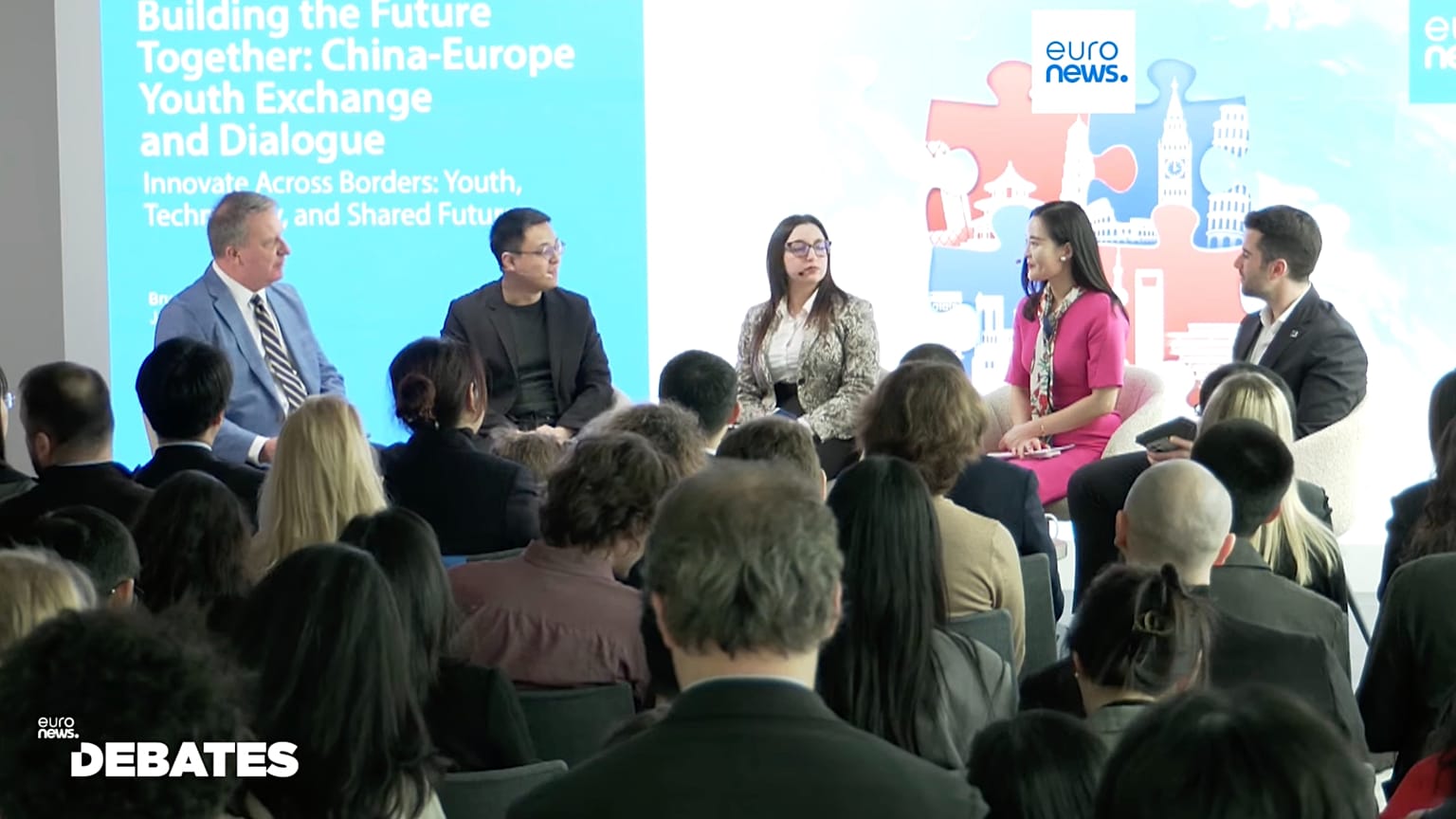














At Davos, where geopolitical tension often dominates the conversation, a Euronews panel on youth, technology and entrepreneurship offered a different proposition: that the next era of China–Europe cooperation may be built less by grand declarations and more by practical collaboration among young innovators.
 ADVERTISEMENT
ADVERTISEMENT
ADVERTISEMENT
The panel brought together four speakers from business, business associations, labour and youth networks: Zhang Min of Unitree Robotics (Hangzhou Yushu Technology), Liang Linlin of the China Chamber of Commerce to the EU, Antonello Pietrangeli of the European Confederation of Independent Trade Unions (CESI), and Nicole Rita Napoli of Young European Leadership and the European Commission.
Listening to market demand
Zhang Min began by describing Unitree’s focus on quadruped robots and humanoid robots, arguing that the mission is to fuse robotics with AI to “empower human life… for the factory [and] for the household.” Asked how important Europe is as a market, Zhang called EU demand “influential and potential” and pointed to requests from consumers that are strikingly practical: robotics for elderly care, hospital functions and repetitive household tasks. In a glimpse of his company’s ambitions, he suggested that within “maybe in five years, maybe in 10 years” humanoids might “wash the dishes… and fold clothes,” adding, “then everybody will be happy.”
Later, Zhang returned to a theme that echoed across the panel: innovation works best when it responds to local needs. “What we’re doing is going to the markets and learning from the markets,” he said, explaining that requirements differ by country and even by city. “Belgium has special Belgian needs and Germany has different requirements,” he said, calling for “more communication – at government level, public level, private level” to accelerate innovation.
Europe and regulation
Liang Linlin described Europe as a place Chinese young people associate with both heritage and research strength. Europe is “a continent with very long history, like China,” she said, but also “super dynamic,” with a strong talent base and a powerful research foundation. Asked whether young Chinese people want to engage with Europe, she was unequivocal: “Definitely,” adding that Europe remains “a very nice destination from all dimensions.”
But Liang also highlighted barriers to entrepreneurship and cross-border business, especially with regards to regulatory compliance. She argued that the cost can become a practical obstacle for market entry. “When Chinese AI companies, for instance, want to enter the EU, they have to pay a huge cost in terms of compliance,” she said, suggesting the “wall is a bit thick,” and that reducing compliance cost – without removing safeguards – could make cooperation easier.
Zhang offered a balanced view, pointing out that in his line of work regulation becomes more necessary as robots move out of laboratories and into everyday life. When robots “need to go to your factory every day,” he said, safety certification matters.
AI and inclusive innovation
When the conversation shifted to AI’s promise to reduce distance and barriers, Pietrangeli voiced the dichotomy: AI can help productivity, but workers often fear displacement. “A lot of workers are losing work,” he said, explaining that the response must be “upskilling and reskilling.” He warned that tech progress without social progress is not genuine innovation.
Napoli expanded the inclusion argument with an emphasis on access. Innovation can support inclusive growth, she said, “but only if they are paired with equal access. She pointed to digital tools like telemedicine and online learning, but warned that platforms can fail to reach rural youth or women if access is not measured and designed for. “We need to take the human dimension into consideration,” she said. “We are not robots, robots are supposed to help us.”
“Bridging” skills, countries and opportunity
Napoli framed youth entrepreneurship as building networks rather than single firms. “Nowadays, young people would rather launch ecosystems,” she said – collaborative structures that involve education, policymakers and business. The answer, she said, is to work together “in order to make policies which are sustainable and accessible in the long term, specifically for future generations.”
She also drew on her experience as an EU youth delegate at Y20, describing “the great collaboration we had with the Chinese delegation” and concluding that innovation is fundamentally “bridging” – “we need to bridge skills, sectors, competencies, generations and countries.”
Liang, meanwhile, highlighted concrete steps that have already been taken: China’s “visa-free policy for basically all Europeans,” scholarship opportunities, and the broader “China–EU people-to-people exchange, a high-level dialogue.” She also talked about the importance of awareness: “You are super welcome in China,” she said, saying that mobility exists, but perception and information gaps remain.
Audience questions: attraction, retention and perceptions
During the Q&A, a reporter from China News Service asked what China could do to attract more European youth. Napoli said a key problem is that opportunities do not always reach the intended groups: “There was a huge lack of awareness of programmes [involving] going abroad,” especially for rural youth and women.
A further question asked how Europe could retain more Chinese students after graduation. Napoli described it as a billion dollar question, linking retention to earlier workplace entry and proposing work-study models that build experience during university.
Finally, a participant raised bias and negative perceptions of China in Europe, asking whether people-to-people exchange can counter this. Liang said that narratives matter and shift slowly: “We cannot build Rome in a day… media can play a big part and perception will lead to policy change,” she said – adding that even social media platforms are a route to positive reinforcement of “what the real China is.”