
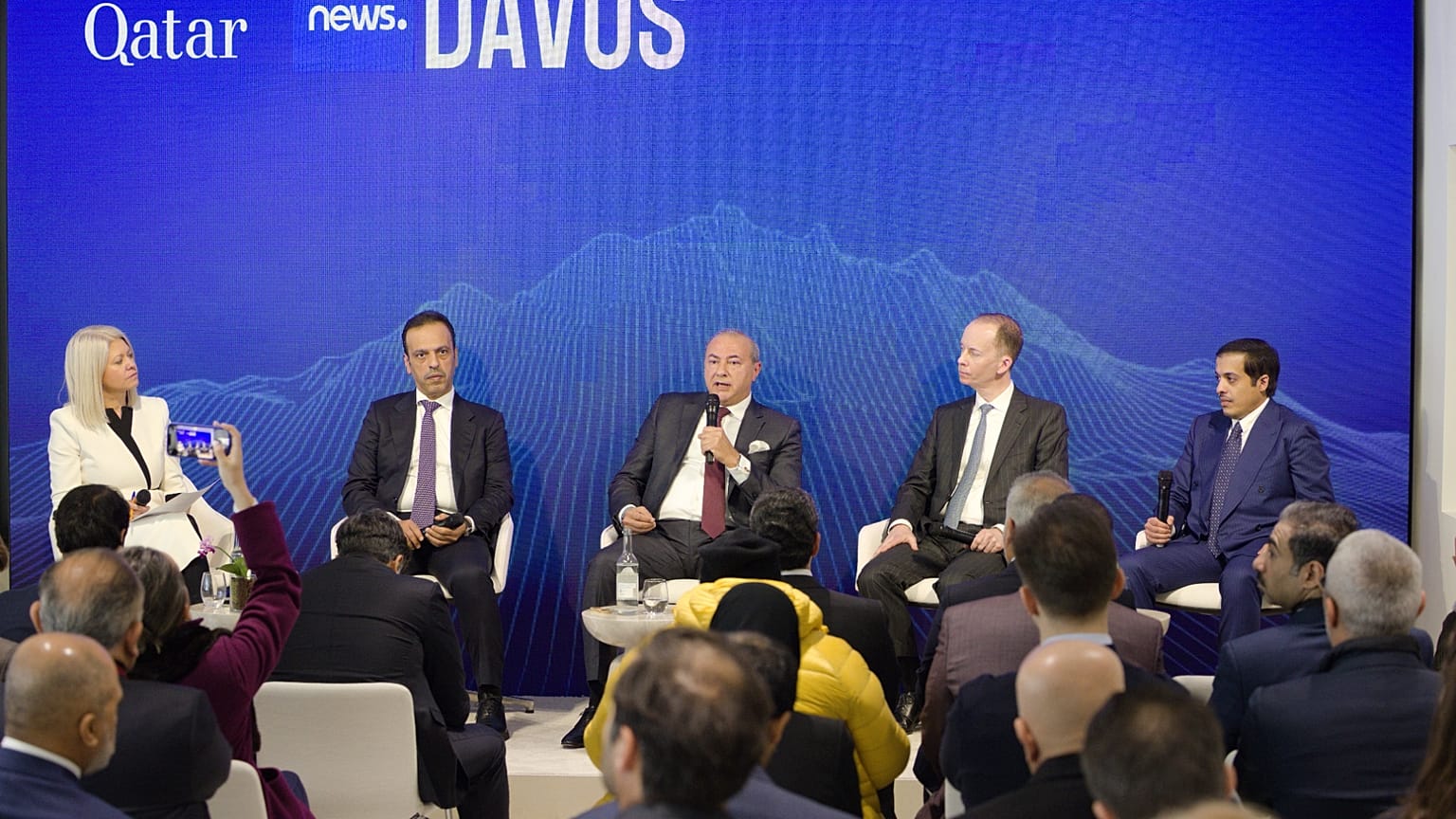














As the World Economic Forum takes stage once again in Davos, Euronews moderated a high-level discussion co-hosted by Qatar National Bank (QNB), Commercial Bank of Qatar (CBQ), Qatar Islamic Bank (QIB) and Doha Bank and bringing together the CEOs of each of the four institutions.
 ADVERTISEMENT
ADVERTISEMENT
ADVERTISEMENT
The event, titled “Qatar’s banking advantage: Expanding pathways for global capital” took place at the Invest Qatar Pavilion on January 20.
The session explored the evolutions of Qatar’s banking sector and how they create new opportunities for global investors.
The speakers discussed how the country’s banks are introducing new instruments, expanding their global linkages, supporting sustainable growth, and offering a broad range of financial solutions to international investors.
Ratings and global connectivity
Sheikh Abdulrahman bin Fahad Al Thani, CEO of Doha Bank Group, said that “the credit of Qatar is one of the highest in the Gulf,” explaining that this strength supports the issuing of bonds and sukuk on favourable terms in international markets.
He also pointed to the expansion of Qatar’s LNG sector as an important long-term support for growth. With production capacity expected to rise significantly by 2030, he said the energy sector continues to provide a stable base for the economy and a strong foundation for future investment.
QNB Group CEO Abdullah Mubarak Al Khalifa focused on how Qatar’s banks connect international capital with local opportunity. With QNB operating in “more than 30 countries in three continents,” he described the bank’s role in clear terms: “We see ourself as the financial ambassador of the state.”
He said Qatar’s push to diversify beyond oil and gas is creating “many opportunities that we see domestically,” and stressed that the country is open to partnering with foreign investors across sectors such as technology, logistics, healthcare and education.
Predictability and resilience
Speaking from the perspective of a recent arrival to Doha, CBQ Group CEO Stephen Moss said international investors typically look for three things: “predictability… certainty of policy… and the way that regulation works.”
He also described Qatar’s regulator as open and practical, calling it “a very accommodating, facilitating regulator,” while making clear that standards and supervision remain robust.
QIB Group CEO Bassel Gamal reinforced the message that Qatar’s stability has been proven in practice, not just on paper. “The banking sector in Qatar has withstood real-life shocks, not testing,” he said, pointing to strong oversight from the central bank and clear resilience requirements across the sector.
He added that investors benefit from the ability to move capital and profits easily across borders, supporting smooth international transactions and long-term investment planning.
Digital transformation and ESG
The discussion also turned to how banks are improving efficiency and competitiveness through digital tools, AI and sustainable finance. On ESG, Al Khalifa was unequivocal: “ESG today is not a choice. It’s a requirement,” citing both regulatory expectations and investor demand.
Sheikh Abdulrahman shared a recent example from Doha Bank, saying, “We issued the first green bond in Qatar riyal and last week we found out it was oversubscribed twofold,” highlighting strong appetite from both local and international investors.
In closing, the CEOs agreed that cooperation remains a defining strength of Qatar’s banking sector. Al Khalifa described this approach simply: “We believe in a long-term relationship that is mutually beneficial and helpful to both sides.”
That focus on trust, consistency and delivery – combined with stability and innovation – was presented as Qatar’s key advantage in attracting and supporting global capital.
You can watch the full discussion in the video below: