

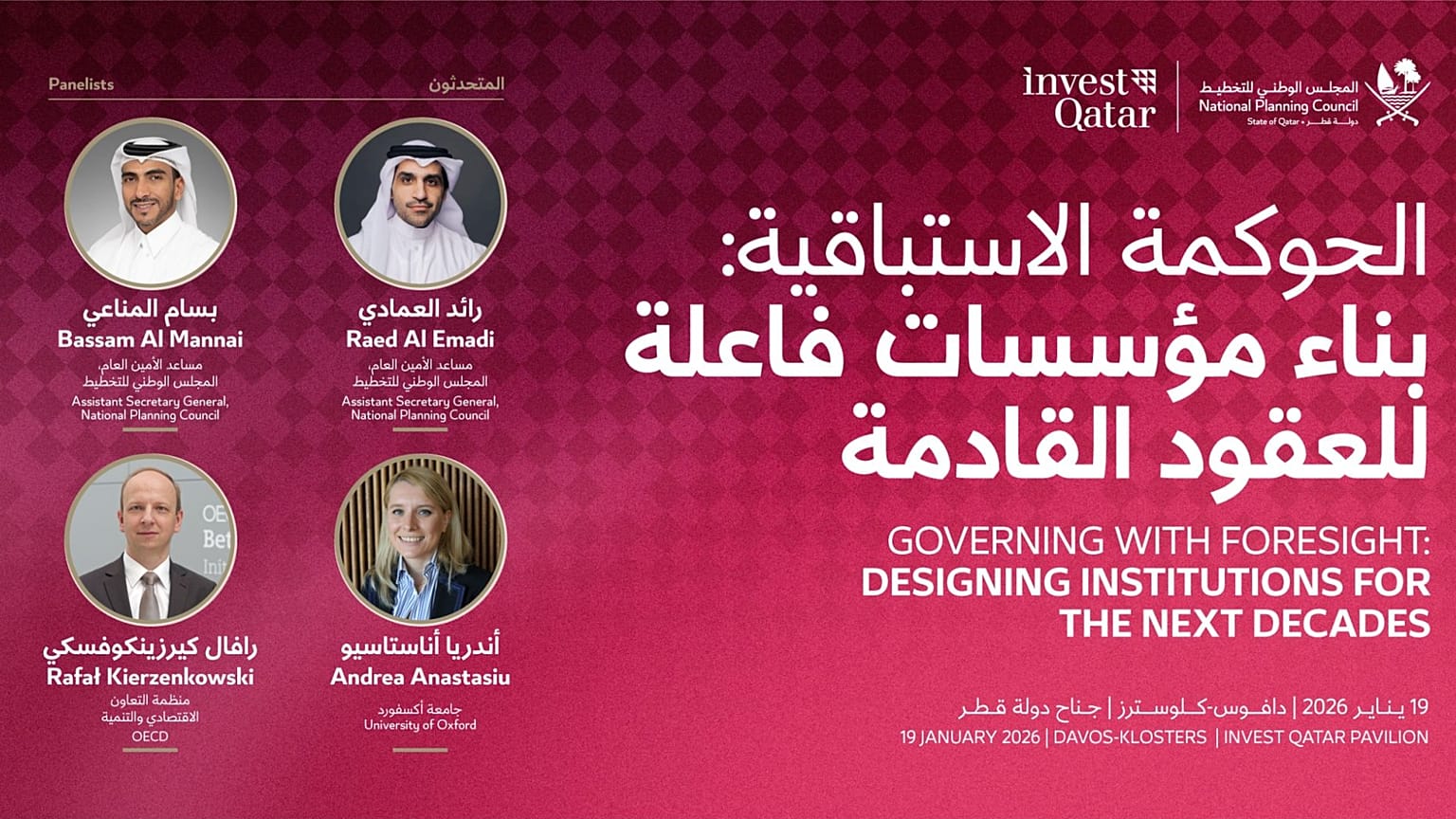













As the World Economic Forum once again brings state and corporate leaders together in Davos, Euronews moderated a panel discussion organised by the National Planning Council (NPC) at the Qatar Pavilion.
 ADVERTISEMENT
ADVERTISEMENT
ADVERTISEMENT
The session, titled “Governing with Foresight: Designing Institutions for the Next Decades”, took place on January 19 2026 and looked at how public institutions can plan for the long term while responding to constant disruption.
The panel featured three senior speakers from institutions and academia:
- Bassam Al Mannai, assistant secretary-general, Center for Future Foresight and National Visions, NPC, Qatar
- Rafał Kierzenkowski, senior counsellor for strategic foresight and head of the Strategic Foresight Unit, OECD
- Andreea Anastasiu, executive director of the Government Outcomes Lab (GO Lab) at the Blavatnik School of Government, University of Oxford
Jane Witherspoon, managing editor, Middle East, Central Asia and South Caucasus for Euronews, acted as moderator. She framed what she called “extraordinary paradox” for governments: they are expected to “plan decades ahead… while responding in real time to constant disruption, geopolitical shocks, technological acceleration, climate risks and shifting public expectations.”
Qatar’s “unified architecture”
Al Mannai described how Qatar is seeking to maintain coherence across government while accelerating delivery. He said the NPC has developed a single framework anchored in the Qatar National Vision 2030 and “seven national outcomes,” adding: “This is the first time that the whole of government is working around a unified architecture that measures performance… [so as] not to fragment the national direction.”
He also emphasised that, in Qatar’s approach, foresight is not treated as an isolated planning function: “Foresight for us is not a standalone exercise. It’s a government-wide capability that we’re developing.”
Outcomes as a bridge between strategy and real-world impact
Anastasiu argued that outcomes act as a bridge between long-term strategy and real-world impact, and that focusing on outcomes enables “real-time learning” that allows institutions to adapt as conditions change. Rather than prescribing how results must be achieved, she noted, effective outcomes frameworks create space for collaboration, innovation, and trust across government, the private sector, and civil society—making systems more resilient rather than more constrained.
When foresight matters
Kierzenkowski drew a distinction between governments that treat foresight as a discrete unit and those that embed it into decision-making. The best-performing governments, he argued, “don’t ask, ‘Do we have a foresight unit?’ They ask, ‘Where exactly does foresight change a decision?’” He added that foresight becomes impactful when it sits “in the routines where power, money, and accountability move.”
He also stressed the importance of translating scenarios into practical choices: “What to stop, where to start, what to scale, and what to hedge,” describing this as essential to making foresight actionable and continuously useful for learning. The discussion later turned to uncertainty, risk, and the limits of prediction. Responding to questions about so-called “black swan” events, Kierzenkowski argued that many shocks are not unforeseeable, but rather underestimated. He stressed the value of institutional preparedness, noting that “the cost of preparing for something that never happens will always be lower than the cost of not preparing for something that will.” For governments, he suggested, foresight is less about prediction than about building the capacity to adapt before crises escalate.
Find out more about registration and Qatar’s agenda at the World Economic Forum 2026 here.