

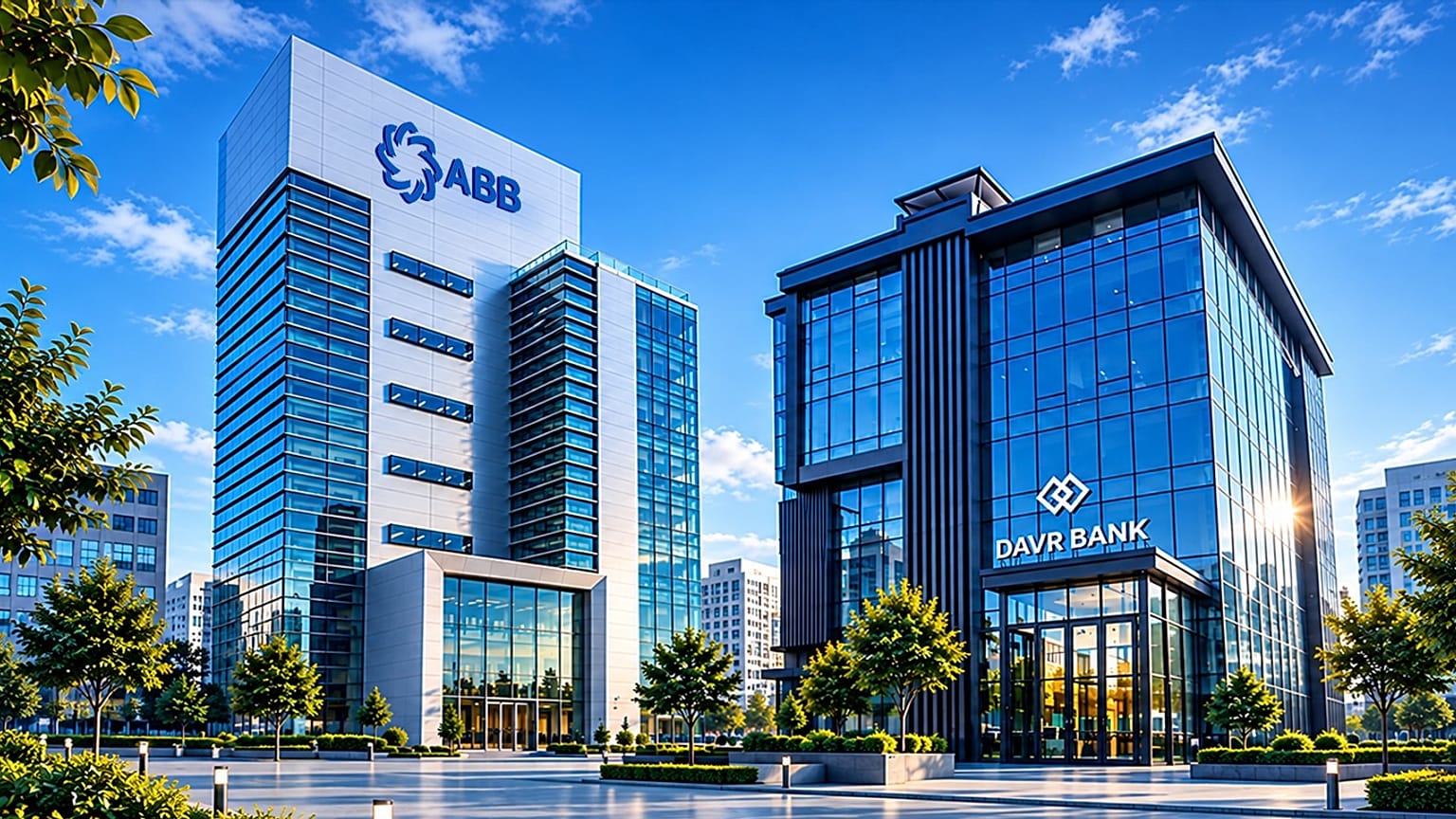













Regional banks are scaling beyond borders — ABB’s Uzbekistan move shows how
For Azerbaijan’s banking sector, international expansion is moving from strategy to reality. On August 23, a new chapter in the country’s financial sector opened in Tashkent with the official launch of the ABB Davr Bank project, marking ABB Financial Group’s entry into Uzbekistan’s banking market.
 ADVERTISEMENT
The launch took place with the online participation of President of the Republic of Azerbaijan Ilham Aliyev and President of the Republic of Uzbekistan Shavkat Mirziyoyev, as part of a ceremony marking the inauguration and groundbreaking of projects being implemented by Azerbaijan in Uzbekistan. Speaking at a joint press statement with the President of Uzbekistan, President Ilham Aliyev described the development as the entry of a leading Azerbaijani bank into the Uzbek market.
ABB successfully completed the acquisition of a controlling stake in Davr Bank. The transaction was registered on 10 September 2026 at the Tashkent Stock Exchange. Under the terms of the agreement, ABB acquired 51 million ordinary shares of Davr Bank, representing a 51% ownership stake in the bank.
The move represents an important step toward achieving the geographic expansion goals outlined in ABB’s 2026–2028 development strategy. Davr Bank will soon begin operating in the Uzbek market under the ABB DAVR brand as a universal bank, offering a wide range of banking services to individuals, small and medium-sized enterprises, and corporate clients.
Currently, Bank serves more than 2 million customers, employs over 1,800 people, and operates 43 branches and service centers across the capital and regions. The bank’s total assets exceed USD 2 billion equivalent. Bank maintains a strong position, particularly in financing small and medium-sized enterprises.
Following ABB Bank’s acquisition of a controlling stake in Davr Bank, the bank’s international ratings have also started to improve.
The international rating agency S&P Global Ratings upgraded Bank’s long-term credit rating from B to B+. The bank’s rating outlook was assessed as “Stable”. In its report, the agency noted that, if required, Bank could receive strong support from ABB Financial Group, which has a higher credit rating profile.
ABB’s international credit profile is supported by assessments from two leading global rating agencies. Fitch Ratings has assigned ABB a BB+ rating, while Moody’s has rated the Bank Ba1. Both agencies maintain a Stable Outlook for ABB.
With these ratings, ABB enters the Uzbek market with a credit profile that is stronger than that of many local banking sector peers. The ratings of several leading Uzbek banks are currently at BB on the Fitch scale and generally at Ba2 on the Moody’s scale.
ABB’s international ratings are also one notch higher than Uzbekistan’s sovereign ratings, which stand at BB from Fitch Ratings and Ba2 from Moody’s.
Presenting his vision for ABB DAVR, ABB Chairman of the Management Board Abbas Ibrahimov said that the project marks the expansion of Azerbaijan’s financial brand, technological capabilities, and banking expertise into a new international market: “Our goal is to build one of Uzbekistan’s leading modern private banks,”.
Uzbekistan has emerged as one of Central Asia’s fastest-evolving banking markets, driven by economic liberalisation and rising digital adoption, which are reshaping consumer behaviour across the country. The move comes as Uzbekistan continues to develop as one of Central Asia’s major growth markets. With a population of nearly 40 million and sustained economic growth, the country offers opportunities for the development of new banking practices and financial solutions.
For ABB Bank, the project is also positioned as the beginning of a longer-term presence in Uzbekistan. More than 470 companies with Azerbaijani capital are registered in Uzbekistan, while more than 130 companies with Uzbek capital operate in Azerbaijan. These figures demonstrate that a strong business ecosystem has already been established between the two countries. As mutual trade and investment continue to grow, so does the demand of these companies for reliable financial services.
ABB DAVR is positioned to become a financial bridge supporting this ecosystem. Through settlement services, trade finance, documentary operations, and financing of new business and investment projects, the bank will contribute to expanding financial cooperation and creating new opportunities for businesses operating across both markets. At the same time, ABB DAVR will primarily operate as a local bank serving the Uzbek market and meeting the needs of Uzbek customers.
“As ABB Financial Group, we will now serve approximately 5.5 million customers, while expanding our potential reach from around 10 million to 50 million people. We are also taking abroad the knowledge, expertise, and solutions we have developed in Azerbaijan in recent years. This will enable us to scale our digital solutions, AI models, risk management frameworks, corporate governance practices, and beyond-banking capabilities across a much larger market,” Abbas Ibrahimov said.
A larger customer base will enable to invest further in technology and artificial intelligence. Any digital solution or AI model that ABB develops in the future can create value for millions of customers across a broader geography, extending beyond Azerbaijan.
Banking beyond the branch
The expansion comes as ABB Bank continues to strengthen its position among internationally recognised financial institutions. In 2025, The Banker named ABB the “Bank of the Year” in Azerbaijan, describing ABB as “a driving force behind the modernisation” of the country’s banking sector and highlighting the bank’s investments in digital banking, fintech infrastructure and customer-focused technology platforms. In 2026, ABB Bank’s progress was further recognised by Global Finance and Euromoney, which named ABB among the leading banks in Azerbaijan. These international recognitions reflect ABB Bank’s broader transformation and growing role as a technology-driven financial institution.
ABB Bank’s expansion into Uzbekistan reflects a wider strategy to diversify operations and strengthen long-term competitiveness, as the bank looks to expand into emerging digital economies across Central Asia, Asia and African markets.
According to ABB Bank’s Sustainability Report 2025, approximately 90 percent of the bank’s operations are paperless. The bank’s AI capabilities have since expanded further: as of August 2026, ABB Bank was applying more than 180 AI models across more than 86 user scenarios, with these solutions generating a positive financial impact of more than AZN 50 million.
At the centre of ABB Bank’s strategy is a broader effort to build an integrated digital banking ecosystem that provides customers with seamless access to payments, business services, customer support and everyday financial management across multiple markets, while also expanding beyond traditional banking into areas such as lifestyle, travel and entertainment.
Over recent years, the bank has expanded services including ABB mobile, Internet Banking, ABB Biz and ABB Home as part of a broader push to integrate digital banking more closely into everyday financial activity.
For example, ABB Home reduces friction in everyday banking by enabling fully digital mortgage applications through government system integrations, while ABB Biz allows small businesses to access payment and tax services remotely without visiting a branch.
The strategy reflects changing customer expectations across rapidly digitising markets, where mobile banking, digital payments, SME support and automated financial services are increasingly shaping how consumers and businesses access and manage financial services, with ABB expected to place particular emphasis on SME banking and retail services in Uzbekistan.
AI moves into everyday banking
Artificial intelligence is becoming increasingly central to ABB Bank’s expansion strategy, supported by investment in secure enterprise AI infrastructure.
ABB completed the installation of a high-performance AI server at its data centre based on the Dell PowerEdge XE9780 platform and equipped with eight NVIDIA HGX B200 GPUs. The infrastructure is designed to support large language models, AI agents, model inference and training, as well as other high-performance computing applications, while enabling sensitive data to remain within the country.
Rather than limiting AI to standalone productivity tools, ABB Bank is integrating the technology across core operations including software engineering, testing and customer support, while maintaining human oversight.
ABB’s AI-powered transformation also extends to customer-facing services, where AI assistants (AI-nur&AI-khan) and other solutions are being used to support everyday banking interactions and personalised financial services.
Expanding through partnerships and regional connectivity
As regional financial systems become more interconnected, partnerships are playing an increasingly important role in banking growth strategies. ABB Bank recently secured a USD 230 million (€200 million) syndicated loan involving 12 financial institutions from Europe and the UAE, following a previous USD 200 million (€170 million) facility in 2025, as the bank expands its presence in international financial markets.
For Abbas Ibrahimov, Chairman of the Management Board at ABB Bank, regional expansion and digital transformation form part of the same long-term objective.
“At ABB, we aim to be a bank that continuously develops its international partnerships, builds strong credibility in global financial markets, and expands into new geographies to become a lifestyle partner for people in multiple countries,” he says.
While rapid digitalisation reshapes banking across emerging markets, ABB Bank’s expansion strategy remains deliberately measured, reflecting the realities of entering new financial systems where local partnerships and long-term economic alignment matter most.
Its expansion into Uzbekistan reflects ABB Bank’s broader ambition to position itself not simply as a digital bank, but as a regional financial platform built around long-term connectivity, technology infrastructure and cross-border growth.
